
Advancing South India’s Global Agenda

Closing the Gate:
The Law of International Straits after Hormuz and Why It Matters to India
Author: Simhanjana Gopikrishna Sumathi
Back
Closing the Gate:
The Law of International Straits after Hormuz and Why It Matters to India
Author: Simhanjana Gopikrishna Sumathi
Closing the Gate: The Law of International Straits after Hormuz and Why It Matters to India
Author: Simhanjana Gopikrishna Sumathi
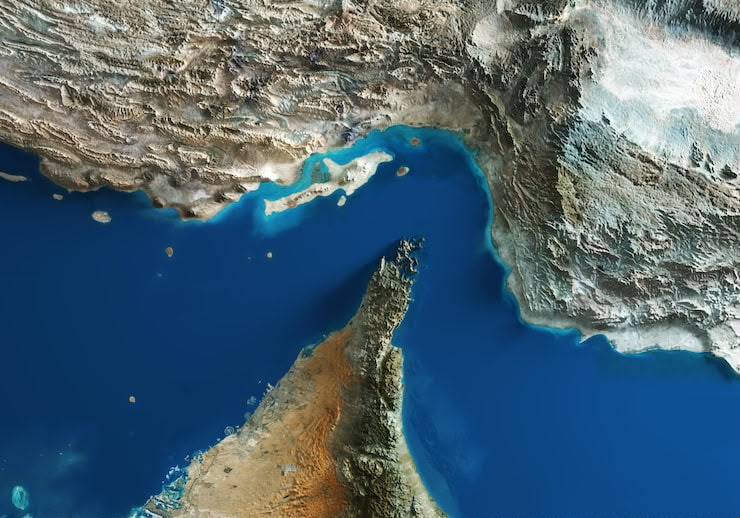
Source: Official source.
The 2026 crisis in the Strait of Hormuz has turned a familiar rule of the law of the sea into a far more nuanced question of application. Hormuz is now a theatre of armed conflict and a bargaining chip in the United States–Iran confrontation. It is also a chokepoint on which Asian energy security depends. Three questions follow. What protection does navigation enjoy where a coastal State is not party to the United Nations Convention on the Law of the Sea (UNCLOS)? How far may belligerent rights qualify neutral passage? And what follows when “closure” takes the form of selective permissions, mines, attacks or tolls?
As of late October 2026, the Strait is not sealed but navigation remains dangerous. A 22 October 2026 report by the International Maritime Organization (IMO) records 120 confirmed incidents in Hormuz and the wider ‘Middle East’. October’s 29 incidents were the highest monthly total since hostilities began. Earlier vessel-tracking data illustrates how sharply traffic initially fell; even Chinese-linked vessels, despite Beijing’s relationship with Tehran, largely ceased transiting the Strait during the early phase of the crisis. Later arrangements favouring “friendly” States mark a shift from indiscriminate disruption towards managed and politically differentiated access. That shift is legally more significant than the vocabulary of “open” or “closed”: a right of passage can be impaired just as effectively by discretionary access as by a physical barrier.
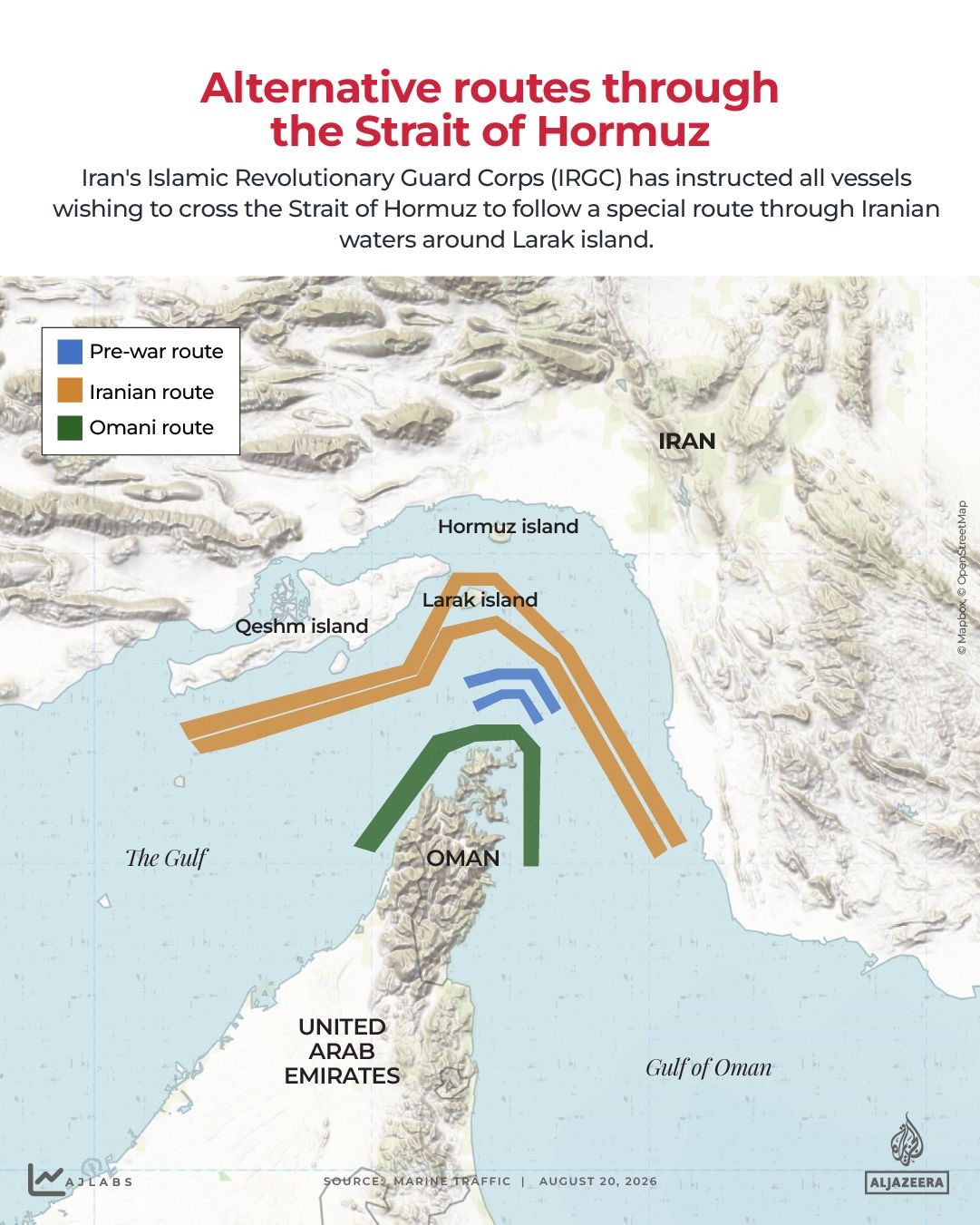
Pre-war traffic lanes and alternative Iranian and Omani navigation routes through the Strait of Hormuz, illustrating the fragmentation of maritime passage during the 2026 conflict.
© Sarah Shamim and Marium Ali,
Are ships passing Hormuz more willing to defy Iran or US? What data shows, Al Jazeera / AJLabs, 20 August 2026.
The Legal Baseline
The modern regime governing international straits did not begin with UNCLOS. Its customary foundation is usually traced to the International Court of Justice’s (ICJ) 1949 judgment in Corfu Channel in which the Court treated two features as defining a strait: a link between two parts of the high seas, and actual use for international navigation. The 1958 Convention on the Territorial Sea and the Contiguous Zone (Article 16(4)) then made innocent passage through such straits non-suspendable. Part III of UNCLOS created the broader right of transit passage (Article 38), which bordering States may not hamper or suspend (Article 44). Whether every element of transit passage has become customary law is a separate question.
That question matters because Iran signed UNCLOS but never ratified it. Tehran has consistently maintained that the transit passage regime formed part of the Convention’s negotiated bargain and cannot simply be imposed on non-parties as customary law. Iranian legislation has accordingly continued to approach passage through its territorial sea through the older concept of innocent passage. The United States has not ratified UNCLOS either. It too relies on custom, so the problem of opposability is not Iran’s alone.
Commentary and Scholarly Debate
Recent scholarship and commentary divides on whether transit passage is custom and whether Iran is a persistent objector. Among European scholars, Alexander Lott who specialises in navigational restrictions in straits, stresses uncertainty over transit passage’s customary status. Konstantinos Deligiannis-Vivros gives more weight to Iran’s persistent-objector claim.
A second group writes from naval practice. Mark Nevitt, a former US Navy Officer, separates the right of transit from narrowly tailored belligerent security measures. Elsewhere, he treats tolls as unlawful where they charge for passage itself. Pornomo Astri Yoga, also a naval officer, turns the same lens on Washington. He argues that US interdictions far beyond the blockade area fit neither the law of naval warfare nor the law of the sea.
Others write from outside the naval establishment. Bertina Kudrinargues that maritime law’s gaps on economic warfare fall hardest on neutral States. Safia Southey who researches Middle East policy for the Quincy Institute, still warns that Iran’s selective access converts regulation into coercion. Soheil Golchin, trained at the University of Tehran, states Iran’s case most fully: transit passage was a treaty bargain, and Iran is a persistent objector. Yet he concedes that security measures cannot justify complete or discriminatory disclosure.
The implication of non-ratification
Iran’s non-ratification matters, but it does not place Hormuz outside international law. Corfu Channel predates UNCLOS and recognised, in time of peace, a customary right of passage through international straits. The controversy therefore concerns the scope of the right, not its existence. Even if the customary status of the full UNCLOS transit-passage regime remains contestable, that uncertainty does not translate into a sovereign discretion to determine access to Hormuz solely according to political preference.
The opposability debate also obscures the Strait’s other coastal State. The IMO-adopted traffic separation scheme used by most large vessels lies predominantly within the territorial sea of Oman, an UNCLOS party since 1989. For those lanes, Iran’s treaty status is beside the point. Iranian interference there cannot be characterised as coastal-State regulation at all; it is belligerent action in a non-belligerent State’s waters, which Article 2 of Hague Convention XIII prohibits.
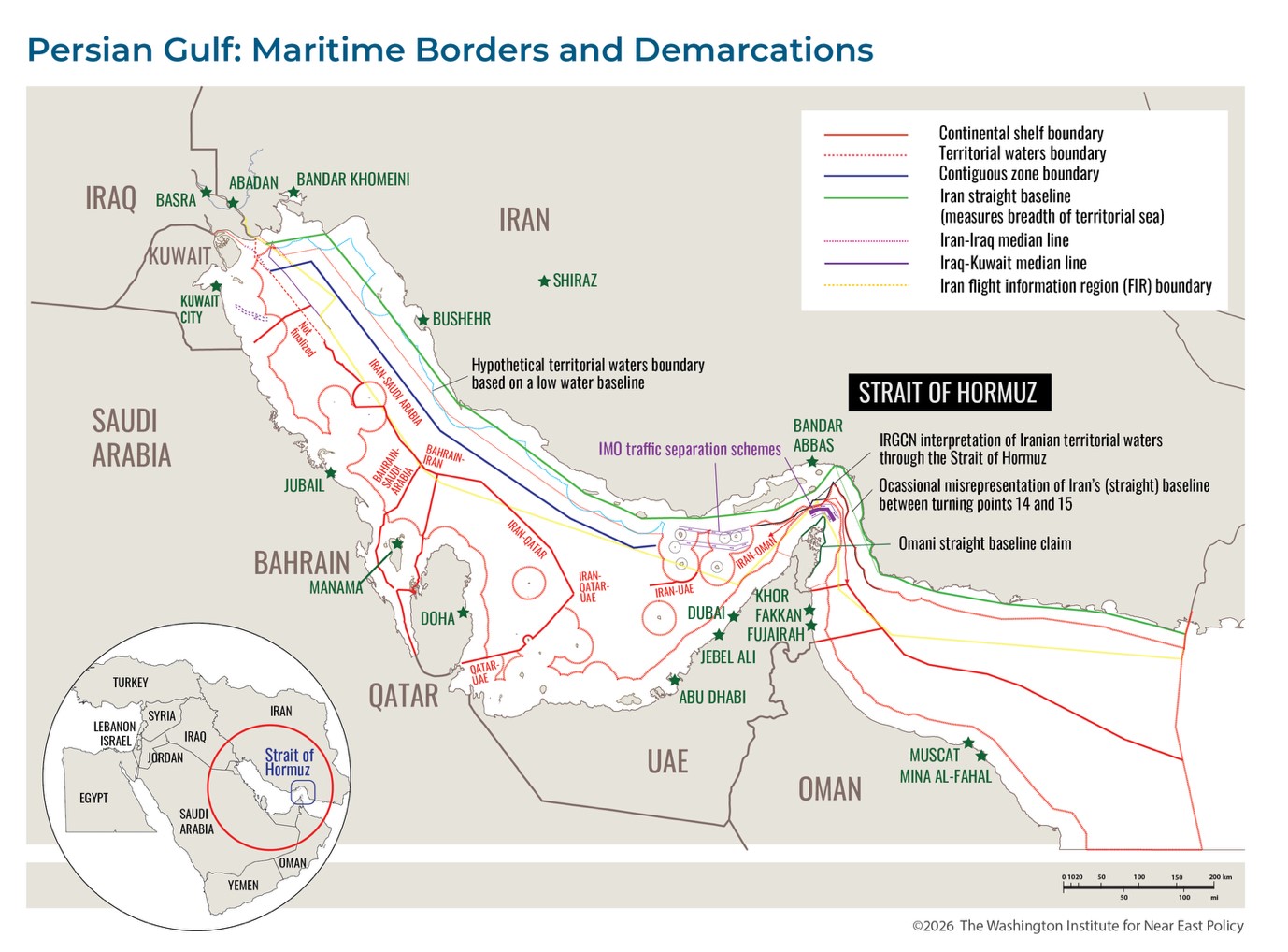
Maritime boundaries, baselines and demarcation claims in the Persian Gulf, including the IMO traffic separation scheme through the Strait of Hormuz.
Certain lines represent disputed or hypothetical delimitations.
© Originally published in Farzin Nadimi, Iran’s Evolving Approach to Asymmetric Naval Warfare: Strategy and Capabilities in the Persian Gulf, The Washington Institute for Near East Policy, 24 April 2020; reproduced in Noam Raydon & Farzin Nadimi, Reaching Viable Management Arrangements in the Strait of Hormuz, The Washington Institute for Near East Policy, 05 August 2026.
Self-Defence and its Limits
The position grows more complex in the context of an international armed conflict (IAC). An IAC does not displace the law of straits. Instead, the law of the sea operates alongside the law of naval warfare, while the legality of the resort to force is governed separately by jus ad bellum. The initial American-Israeli strikes are themselves contested under Article 2(4) of the UN Charter. On the better view, Iran is the State exercising the right to self-defence under Article 51.
However, that right has limits. It runs against the attacking States, not third States or their shipping. Its proportionality is measured against repelling the attack, not against the threat in general. Closing a strait to the world as leverage is hard to fit within that test, and tolls repel nothing. Self-defence also leaves the law of naval warfare intact, binding victim and aggressor alike.
Nonetheless, this problem is not novel. During the 1980–88 “Tanker War”, more than 400 merchant vessels were attacked in the Gulf. Security Council Resolution 552 (1984) condemned attacks on shipping bound for non-belligerent Kuwaiti and Saudi ports. In Oil Platforms (2003), the ICJ held that American strikes on Iranian installations failed the requirements of necessity and proportionality, while not excluding that mining a single warship could amount to an armed attack. Attacks at sea may thus trigger self-defence, but responses remain tightly bound. The same standard applies to Iran in the present context. Security Council Resolution 2817 (2026) expressly recalls Resolution 552.
The Law of Naval Warfare
Naval warfare law permits action against enemy vessels, military objectives. It also permits action against neutral vessels carrying contraband or otherwise contributing to hostile military operations. Identification, routing, warnings and case-specific inspections may therefore be defensible where directed to an actual military risk. Indiscriminate attack, mining that leaves no safe alternative route, or differentiation among neutral vessels primarily by political affiliation is much harder to justify.
The San Remo Manual (1994), the US Commander’s Handbook (NWP 1-14M) and the Newport Manual (2023) restate these limits. Each treats passage through international straits as continuing during armed conflict and require minelaying States to leave safe alternative routes for neutral shipping. Though non-binding, they evidence custom; the US Commander’s Handbook, moreover, governs the very navy now enforcing a blockade.
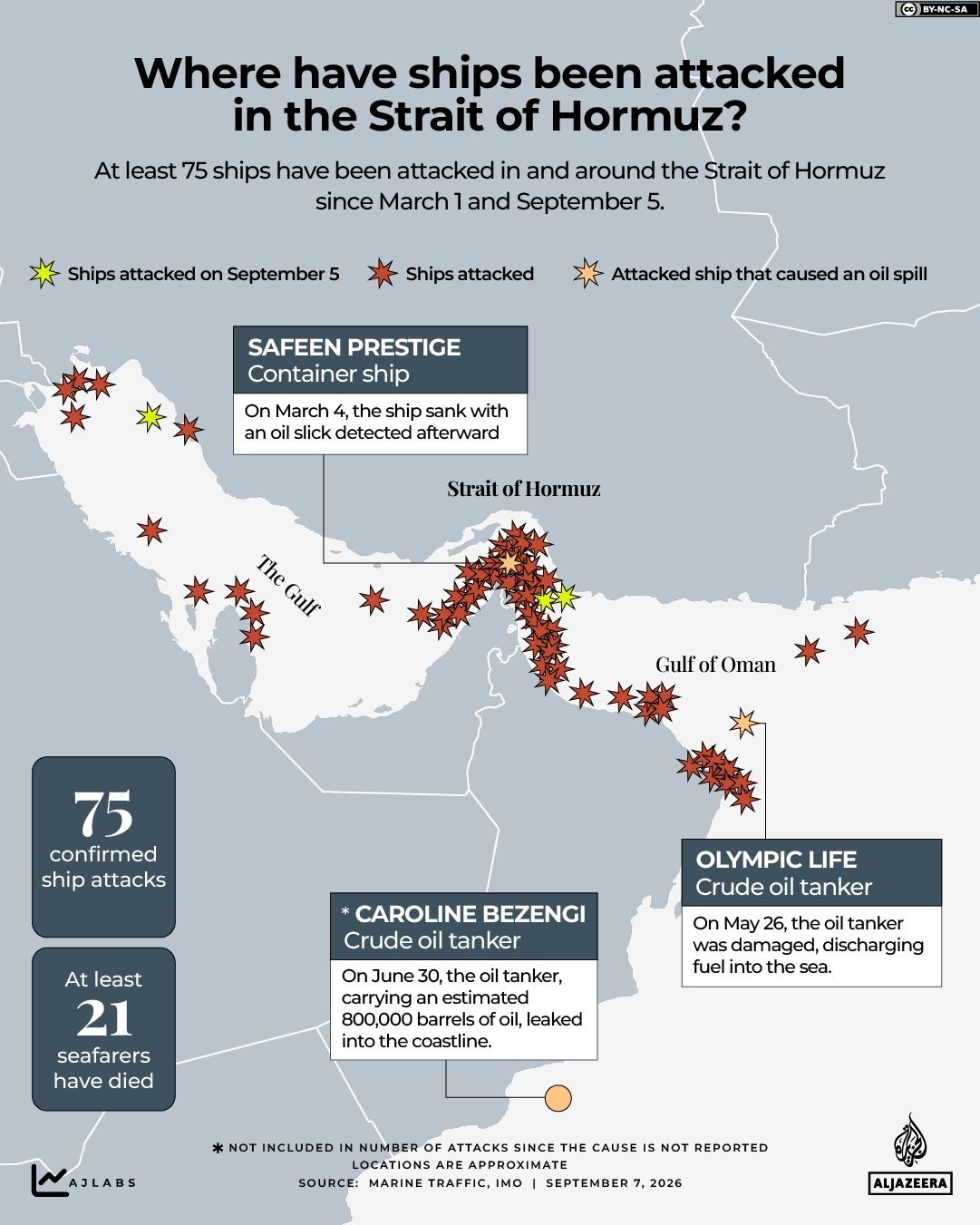
Reported attacks on vessels in and around the Strait of Hormuz between March and early September 2026, highlighting the risks to commercial navigation during the armed conflict.
Attack locations are approximate.
© Alia Chughtai and Marium Ali, Why US-Iran war over Hormuz is threatening the Gulf’s waters, 09 September 2026, Al Jazeera / AJLabs.
Blockade, Neutrality and Interdiction
This is also why “blockade” requires precision. A blockade targets an enemy coast. It must be declared, effective and impartial, and must protect neutral and humanitarian interests. A detailed study applies that framework to the current conflict. A blockade also may not bar access to neutral ports and coasts (see San Remo Manual, para. 99).
Whether the Gulf States hosting US forces remain “neutral” is, however, doubtful. Hague Convention V (Articles 2-5) bars neutral territory from serving as a belligerent’s base. Under Article 3(f), a State letting another use its territory for aggression itself commits aggression. Where bases are so used, Iran may treat them as military objectives (see San Remo Manual, para. 22). Nonetheless, neutral-flagged ships bound for those States do not become enemy shipping. Nor does Iran’s differentiated access become a lawful blockade, which must be impartial.
American enforcement raises the corresponding difficulty. The United States’ blockade of Iranian ports fits traditional blockade law more comfortably, being directed at the enemy coast and preserving navigation to non-Iranian destinations. But a long tradition from the International Law Association’s 1934 Budapest Articles to Hersch Lauterpatch, denies a State that unlawfully resorted to force belligerent rights against neutrals. Interdictions far beyond the declared area are harder to justify. Visit-and-search, statelessness and contraband may each ground action in defined circumstances; a unilateral sanctions designation does not by itself entitle a State to board foreign vessels wherever found. For India, legal consistency requires resisting both expanded coastal control over an international strait and the expansion of unilateral sanctions into a general high-seas enforcement power.
Tolls and Leverage
Iran’s use of tolls and differentiated access raises a related problem. UNCLOS permits coastal States to regulate navigational safety, pollution and certain customs matters, and payment for an identifiable service may be lawful; a charge merely for passage is however different. The IMO Council’s July 2026 position, reflected in its summary of the 137th session, emphasised non-discriminatory passage and opposed measures impairing or suspending navigation through international straits, and Resolution 2817 had already placed obstruction of Hormuz within the framework of international peace and maritime security. A compulsory charge for the right to pass risks converting a public navigational entitlement into a coastal-State permission.
The geopolitical logic explains why these rules have proved difficult to enforce. Mines, drones, missiles and small craft give Iran asymmetric leverage. Strategic analysis of the conflict describes a contest of endurance in which Iran raises the cost of military pressure while the United States responds by blockading Iranian commerce predating the war. Lloyd’s List has documented how ‘Middle East’- and India-linked services have reconsidered Red Sea and Cape of Good Hope routes, illustrating how disruption migrates between chokepoints. Strategic leverage, however, cannot itself generate legal title to control an international strait.
India’s Stake
India has a direct stake in preventing that proposition from taking hold. The International Energy Agency’s (IEA) Hormuz data show that about 20 million barrels per day of oil and petroleum products passed through the Strait in 2025, around 80 per cent of it destined for Asia, while pipeline bypass capacity is only a fraction of normal maritime flows. China and India together received 44 per cent of crude exports transiting Hormuz. By September 2026, Indian imports of Middle Eastern crude had recovered to roughly 2.8 million barrels per day, about 54 per cent of India’s total.
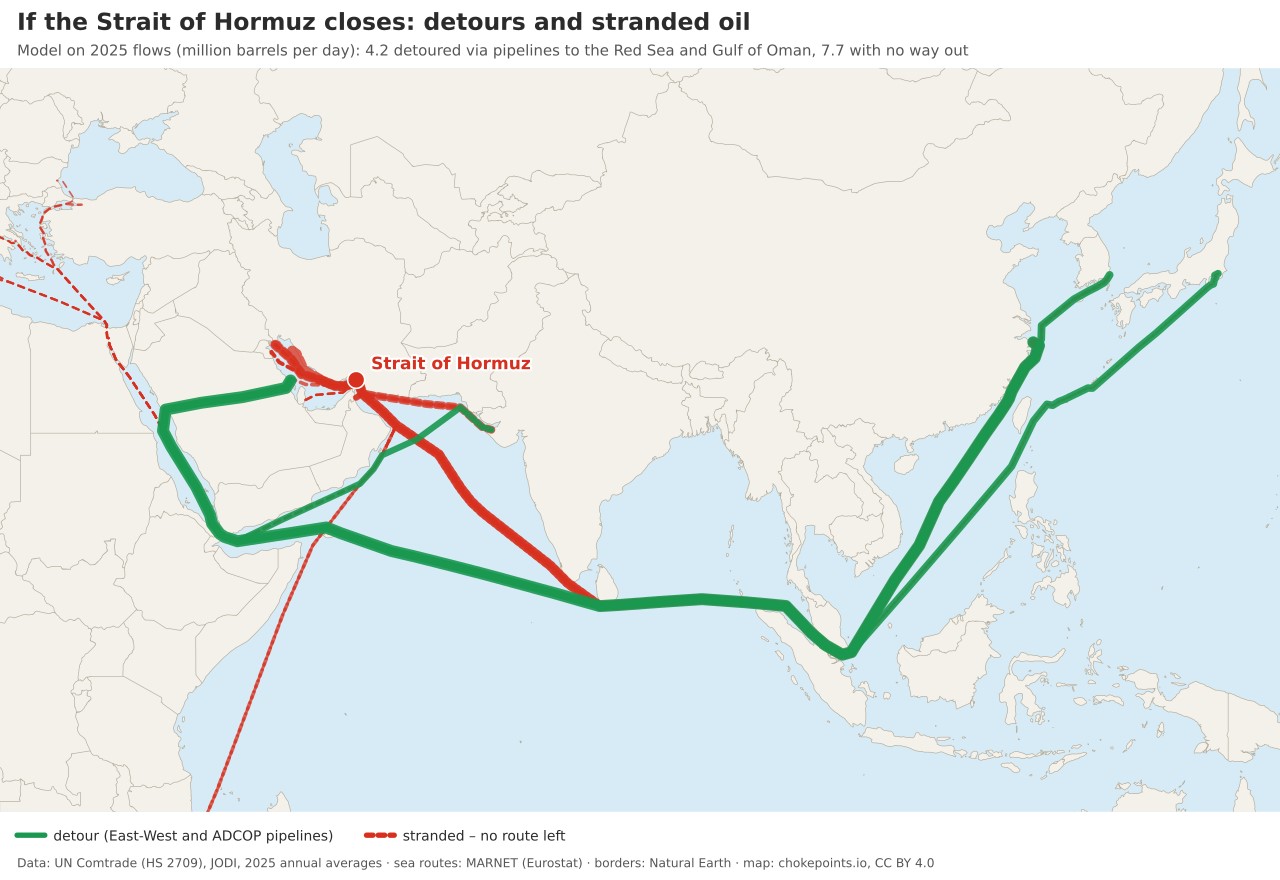
Model based on 2025 annual crude oil flows: which volumes could detour via the East-West (Saudi Arabia) and ADCOP (UAE) pipelines and which would be stranded if the Strait of Hormuz were closed.
Data: UN Comtrade (HS 2709, 2025), JODI; sea routes: MARNET (Eurostat, © European Union); borders: Natural Earth (public domain). Labels in English, Polish, German, French and Spanish.
Interactive version: https://chokepoints.io
© Traxlaren, Strait of Hormuz closure model detours, 9 October 2026, Wikimedia Commons. Licensed under CC BY 4.0.

The Indian response has already moved beyond energy procurement. The Bharat Maritime Insurance Pool, backed by a sovereign guarantee of Rs 12,980 crore (about USD 1.5 billion), preserves hull, cargo, protection and indemnity, and war-risk cover; the Government reports war-risk premiums 35–40 per cent below their wartime peak. India has also instituted real-time monitoring of vessels and seafarers and advised against deploying Indian seafarers on Hormuz voyages, under the Seafarer-First measures set out by the Press Information Bureau.
India’s interest is equally juridical. Naval operations have expanded into the Arabian Sea and Indian Ocean, and the reported docking of an Iranian warship at Kochi revived classical questions of neutrality. Under Article 17 of the Hague Convention XIII, repairs to a belligerent warship in a neutral port are limited to restoring seaworthiness and may not increase its fighting capability; the same law governs rescue and internment of belligerent personnel under neutral control. A contemporary analysis of those incidents is available here.
India’s Position
India should consequently avoid treating Hormuz as a binary choice between Iranian coastal sovereignty and American freedom-of-navigation enforcement. Its enduring interest lies in preserving the legal distinctions themselves: non-discriminatory neutral passage, narrowly confined belligerent rights, respect for flag-State jurisdiction, and coastal regulation directed to safety rather than political permission. A resident Indian Ocean power located between Hormuz, Bab-el-Mandeb and Malacca has more to lose than most from any precedent under which strategic control gradually hardens into a claimed legal entitlement.
Consistency, however, cuts both ways. India’s 1976 Maritime Zones Act requires prior notice from foreign warships entering its territorial sea; its 1995 UNCLOS declaration rejects foreign military exercises in its exclusive economic zone without consent; and it protested the USS John Paul Jones’s 2021 operation near Lakshadweep. Principled distinctions exist: India requires notification, not permission, and never conditions passage on alignment or payment; its rules concern its own maritime zones, not a strait used for international navigation; and its EEZ position addresses military activities, not merchant navigation. But these distinctions must be stated, not assumed. India should affirm that its notice requirement does not condition passage, and that passage through international straits cannot be subjected to coastal authorisation, for warships as much as merchant vessels.
Passage as a Right
Hormuz ultimately exposes a gap between legal entitlement and practical enforceability. International law can identify what Iran, the United States and neutral States may lawfully do; it cannot clear mines, restore insurance or compel commercial operators to sail into danger. Operational planning, coalition-building and legal clarity must therefore work together, a lesson also reflected in research on the failure to prepare for the foreseeable consequences of a Hormuz shutdown.
For India, the essential objective should be to ensure that any eventual settlement restores passage as a right rather than as a concession, and that neither coastal coercion nor counter-coercive naval practice rewrites the law of the Indian Ocean through faits accomplis backed by force.
Simhanjana Gopikrishna Sumathi is a Research Officer at the Deccan Centre for International Relations. She holds an LLM in National Security Laws with a Certificate in International Human Rights Laws from Georgetown University Law Centre, and her research focuses on national security law and policy, geopolitics, AI governance and emerging technologies, with particular emphasis on their implications for India and the Indo-Pacific. She is an attorney and published researcher with experience across legal practice, policy research and international affairs.
Disclaimer: The views and opinions expressed in the article are those of the author and do not necessarily reflect the official position of the Deccan Centre for International Relations.