
Advancing South India’s Global Agenda

Issue Brief No (07): Thirty Years of South Korean Industrial Presence in Tamil Nadu and South India (1996–2026): Mehak Gautam
BackIssue Brief No (07): Thirty Years of South Korean Industrial Presence in Tamil Nadu and South India (1996–2026): Mehak Gautam
Issue Brief No: 07
Thirty Years of South Korean Industrial Presence in Tamil Nadu and South India (1996–2026)
Author: Mehak Gautam
1. India and South Korea: Historical Background
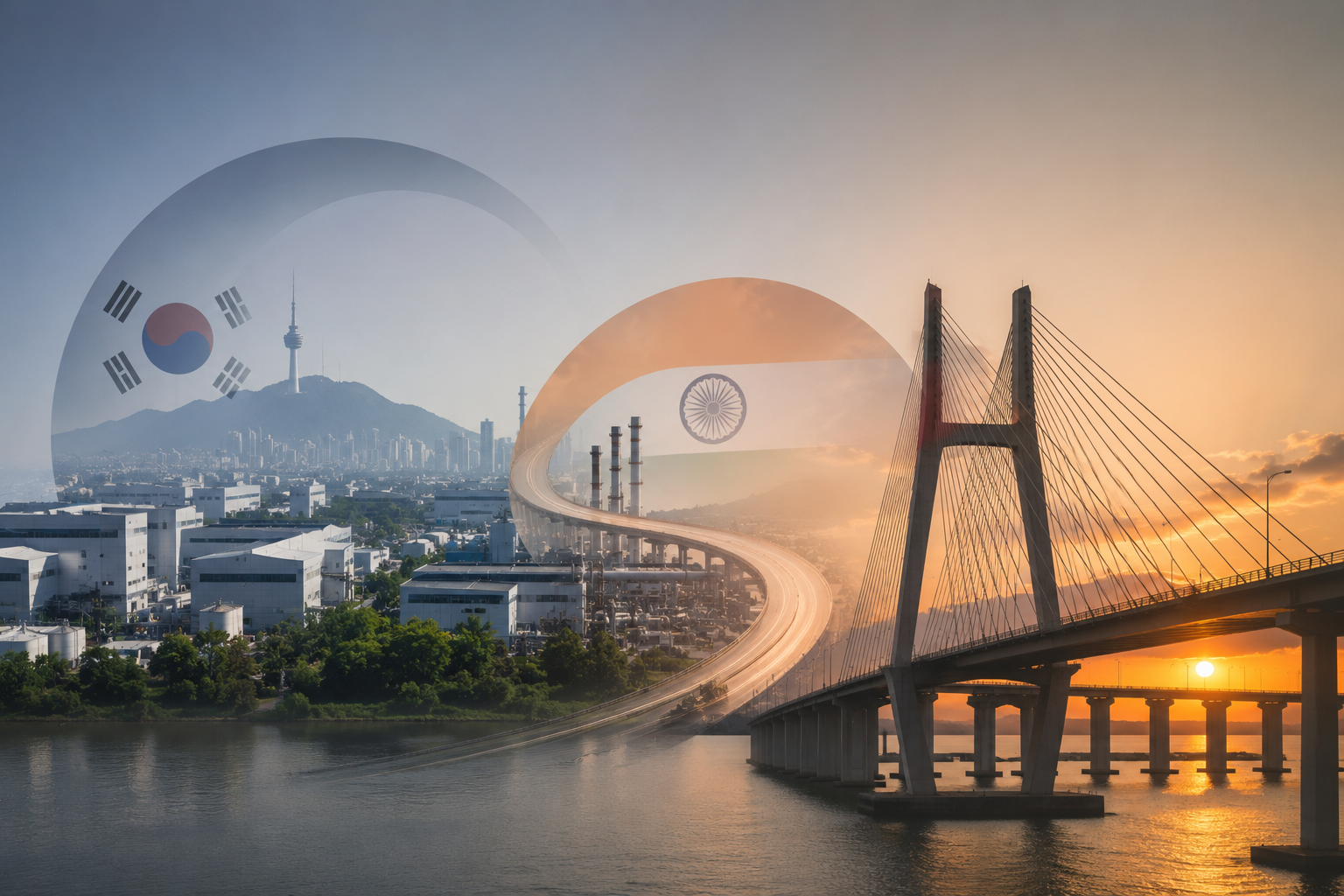
India and South Korea have been formal diplomatic partners since 10 December 1973, though consular ties go back even further, to 1962. For a long time, though, this was a quiet relationship. It was only after India opened its economy through economic liberalisation in the 1990s that this relationship took a new direction. Not coincidentally, this was also the period when the first Korean factory came up in South India[1].
The turning points since then have come steadily. In 2010, the India-Korea Comprehensive Economic Partnership Agreement (CEPA) came into force which was Korea's first free trade pact with a BRICS country (Embassy of India Seoul, Republic of Korea, n.d.). In 2015, during Prime Minister Narendra Modi's visit to Seoul, the relationship was upgraded to a 'Special Strategic Partnership'(India - Republic of Korea Joint Statement for Special Strategic Partnership (May 18, 2015) | Ministry of External Affairs , Government of India, n.d.). In 2023, the two countries marked fifty years of diplomatic ties. And most recently, in April 2026, South Korean President Lee Jae-myung made a state visit to India, his first to the country since taking office, where the two sides signed a 'Joint Strategic Vision for the India-ROK Special Strategic Partnership (2026-30)' along with a memorandum of understanding setting up an India-ROK Industrial Cooperation Committee, aimed squarely at semiconductors, shipbuilding, batteries, and supply-chain security[2].
Trade, however, tells a more complicated story. Bilateral trade has hovered between US$25 billion and US$28 billion for the past several years without much movement, even as both governments have set a target of US$50 billion by 2030[3]. Korea's cumulative FDI into India stands at roughly US$6.9 billion between April 2000 and September 2025, a reasonable sum, but modest next to Japan (USD 38.45 billion) or the US (USD 69.07 billion). What makes this story more interesting is where that investment has actually landed: Korean investment in India has developed a particularly strong presence in the southern region, reflecting the region’s advanced manufacturing ecosystem, skilled workforce and port connectivity.
This study explores the concentration of South Korean investment in India’s five southern states—Tamil Nadu, Karnataka, Andhra Pradesh, Telangana, and Kerala. The study will also attempt to examine the factors that have made the region the primary destination for Korean investment in India.
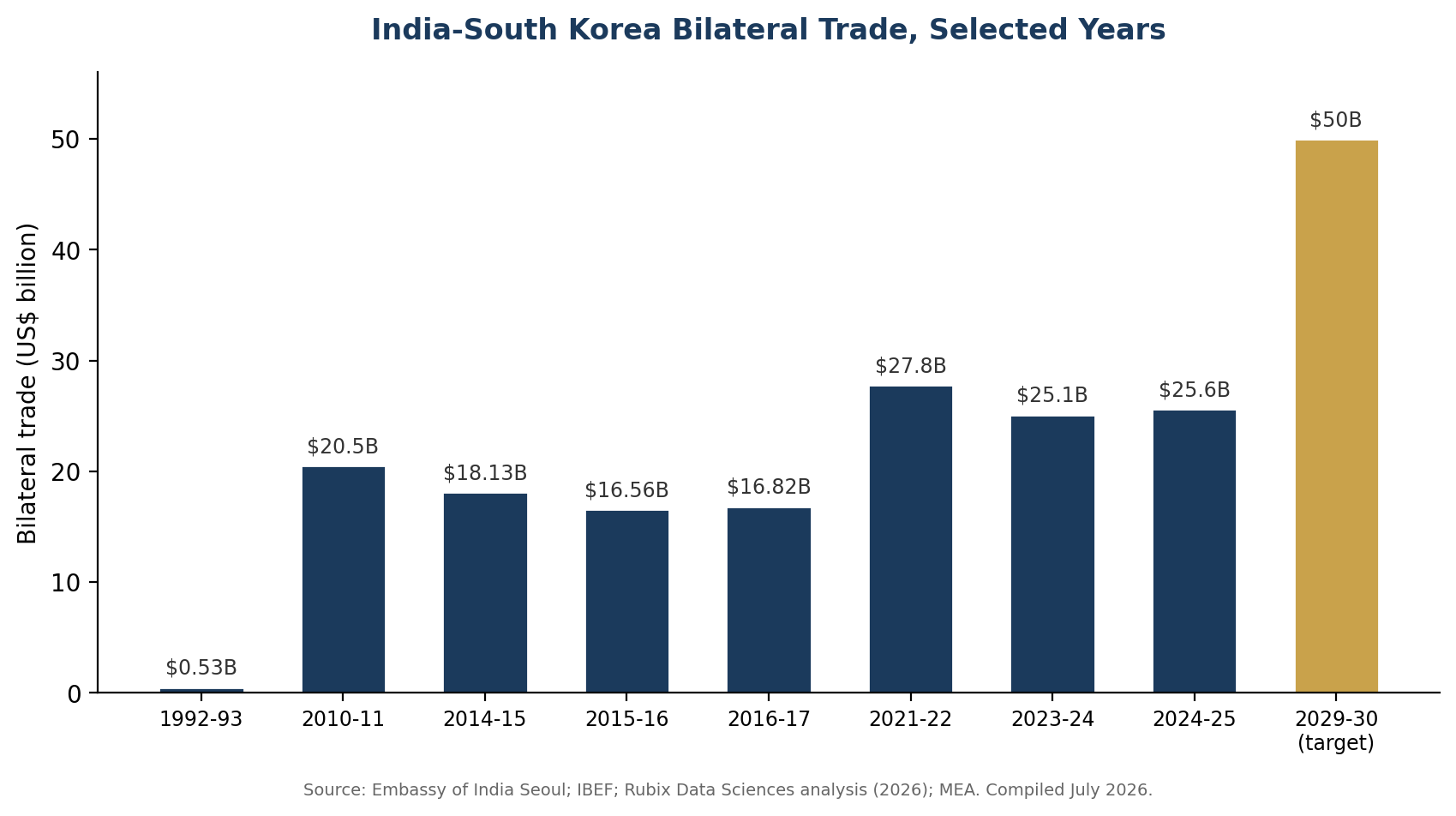
Figure 1: India-South Korea bilateral trade, selected years (US$ billion). Source: Embassy of India, Seoul; IBEF; Rubix Data Sciences analysis (2026).
2. How Korean Manufacturing Began in South India?
If you had to put a pin on a map and a date on a calendar for when Korean industry first arrived in South India in a serious way, it would be Sriperumbudur, near Chennai, in 1996 (How Chennai Became an Auto Hub, 2024). Hyundai Motor India Limited was incorporated on 6 May 1996, making it Hyundai Motor Company's first wholly owned manufacturing subsidiary outside Korea. Ground was broken on the Chennai plant in December 1996, and by September 1998, the first Hyundai Santro rolled off the assembly line (Hyundai Milestone 1996-2000 - History | Hyundai Motor India, n.d.). It was a modest 'tall-boy' hatchback, but it announced Korean manufacturing's arrival on Indian soil. Tamil Nadu, in other words, is where this thirty-year story starts.
The plant grew from there. A second Chennai facility was completed in 2008, roughly doubling capacity, and in 2006 Hyundai set up its Hyundai Motor India Engineering (HMIE) research and development centre in Hyderabad, an early sign that Korean firms would look at South India for more than just assembly lines. Hyundai went on to become one of India’s largest car exporters. Almost three decades after setting up its first factory in Tamil Nadu, the company is investing in a Global R&D Centre in Telangana, reflecting how its operations in South India have expanded beyond manufacturing.
Hyundai's early success paved a way for other Korean chaebols[4] including Samsung, LG, and later Kia to invest in India and in this matter particularly South India.
[4] Chaebol refers to a large, family-controlled South Korean business conglomerate, such as Samsung, Hyundai, LG, and SK Group, that has played a central role in the country’s industrial and export-led economic development.
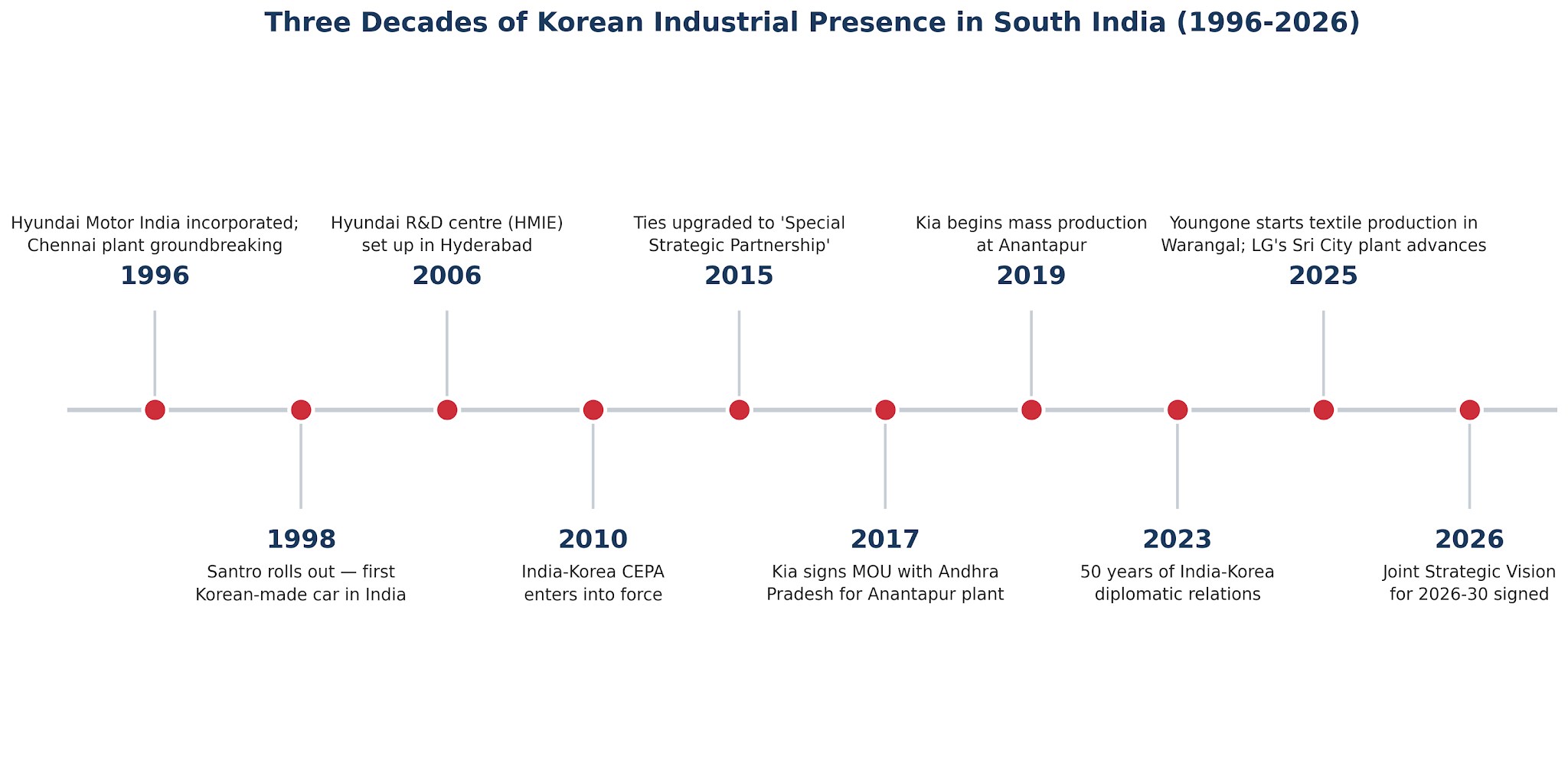
Figure 2: Key milestones in Korea's industrial presence in South India, 1996-2026. Source: Author’s compilation using data from multiple sources.
3. Recent Developments
Three decades on, Korean investment in South India has expanded beyond automotive manufacturing into consumer electronics, R&D, textiles, pharmaceuticals, shipbuilding, and financial services. However, the distribution of these investments is uneven. Each of the five southern states has settled into a fairly distinct role:
- Tamil Nadu and Andhra Pradesh anchor large-scale manufacturing, this is where Hyundai, Kia, Samsung, and LG actually build things.
- Karnataka has become a centre for R&D, software, and Korean corporate banking.
- Telangana is the newest and most diversified entrant, investments includes textiles, pharmaceuticals, EV R&D, and cosmetics.
- Kerala has seen only limited Korean investment, with a small industrial park being the main project so far.
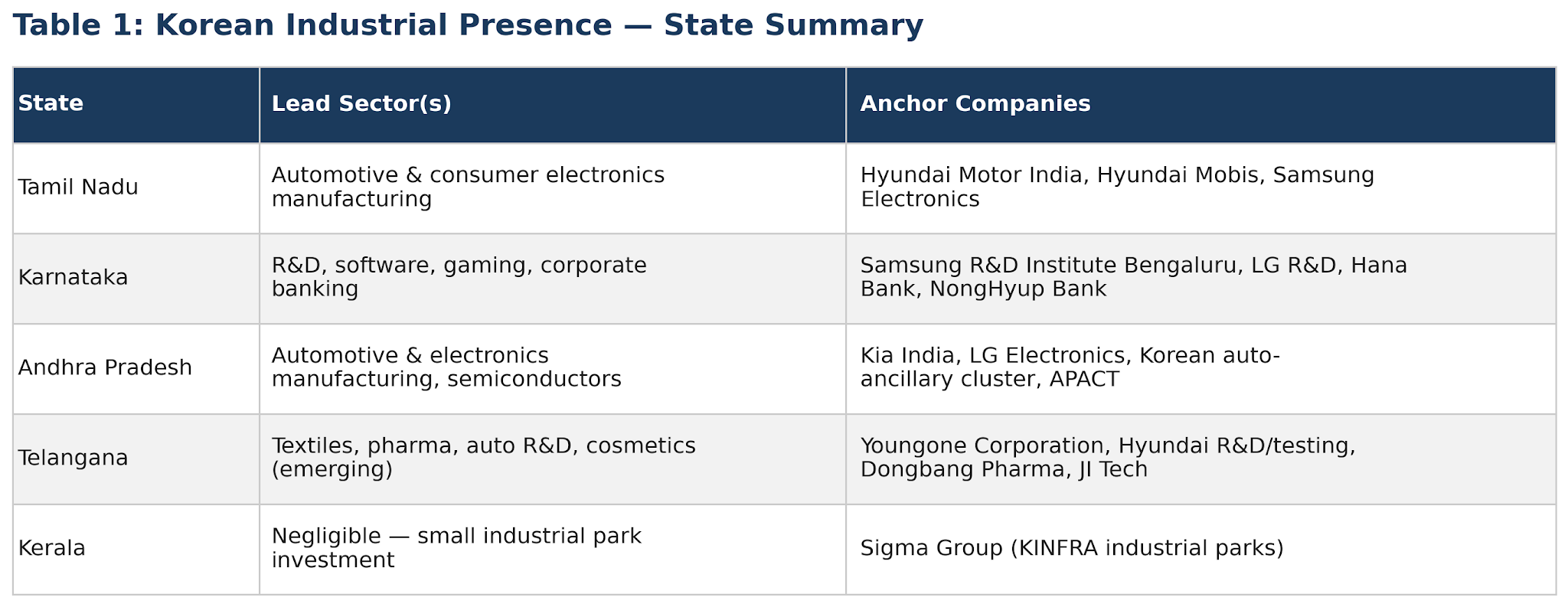
Source: Author’s compilation using data from multiple sources.
4. State Wise Data-
4.1 Tamil Nadu
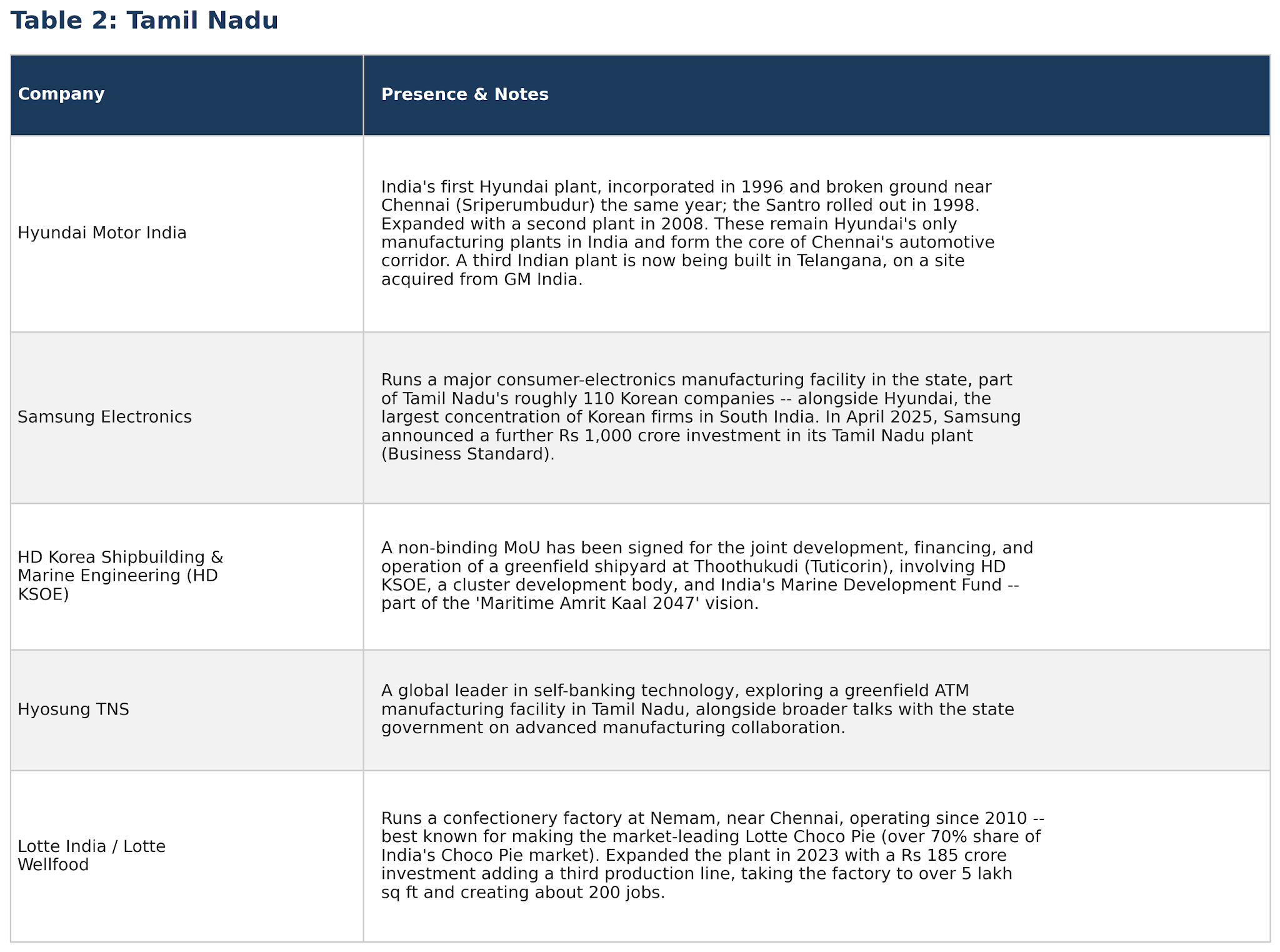
Tamil Nadu till now remains South India's biggest Korean industrial base (Kandavel). Chennai, the state capital, is South India's largest industrial city and one of the fastest-growing in the country; Tamil Nadu has more registered factories than any other Indian state, at roughly 38,000, and its GDP of $372.4 billion is the second-largest of any Indian state (Tamil Nadu & State Planning Commission, 2025). Samsung Electronics also runs a major consumer-electronics manufacturing facility in the state, and in April 2025 the company announced a further ₹1,000 crore investment in its Tamil Nadu plant (Ltd, n.d.).
Two newer trends are reshaping the state's Korean footprint. First, South India (Tamil Nadu specifically), is emerging as a base for the shipbuilding industry as part of a broader "China+1" shift, with state governments actively competing to build out the surrounding industrial ecosystem (인도, 글로벌 조선시장 진입 시동… 산업 생태계 구축 가속화, 2026). This has already produced a concrete outcome: a non-binding memorandum of understanding for the joint development, financing, and operation of a large greenfield shipyard, involving HD Korea Shipbuilding & Marine Engineering (HD KSOE), a designated cluster-development body, and India's Marine Development Fund. The shipyard is planned for Thoothukudi (Tuticorin) on Tamil Nadu's southeastern coast which sits under India's "Maritime Amrit Kaal 2047" vision, which frames shipbuilding, port development, and marine logistics cooperation with Korea as a way of giving the broader Special Strategic Partnership real economic substance (India-Rok Comprehensive Framework for Partnership in Shipbuilding, Shipping and Maritime Logistics | Ministry of External Affairs , Government of India, n.d.). Second, Hyosung TNS, a global leader in self-banking technology, has said it is considering a greenfield ATM manufacturing facility in the state, with company and government representatives describing ongoing talks on "advanced manufacturing and technology" collaboration, and Tamil Nadu reaffirming its commitment to "strengthening the state's industrial ecosystem and attracting global manufacturing investments"(Kandavel, 2026).
Beyond autos and electronics, Tamil Nadu is also home to one of Korea's oldest and steadiest investments in India: Lotte India, part of the Lotte Group (now run under Lotte Wellfood), which has operated a confectionery factory at Nemam, near Chennai, since 2010 (‘Lotte India Opens Expanded Confectionery Factory near Chennai’, 2023). The company invested ₹185 crore to expand the factory's confectionery-making capacity in a 2023 expansion that added an 85,562 square-foot extension, growing the plant to over 5 lakh square feet and creating around 200 new jobs. The Lotte products produced here are thereafter exported to West Africa and other African markets, thereby making India an important manufacturing and export hub for the region. This ultimately demonstrates that Korean industrial presence in the state isn't limited to cars or phones but stretches into everyday consumer food products too.
Tamil Nadu hosts Hyundai's only manufacturing plants in India, forming the core of Chennai's automotive corridor, along with a major Samsung consumer-electronics facility. Chennai is South India's largest industrial city and one of the fastest-growing in the country. Around 110 Korean companies, including Hyundai Motor and Samsung Electronics, now operate here (Network, 2022).
Source: Author’s compilation using data from multiple sources.
4.2 Karnataka
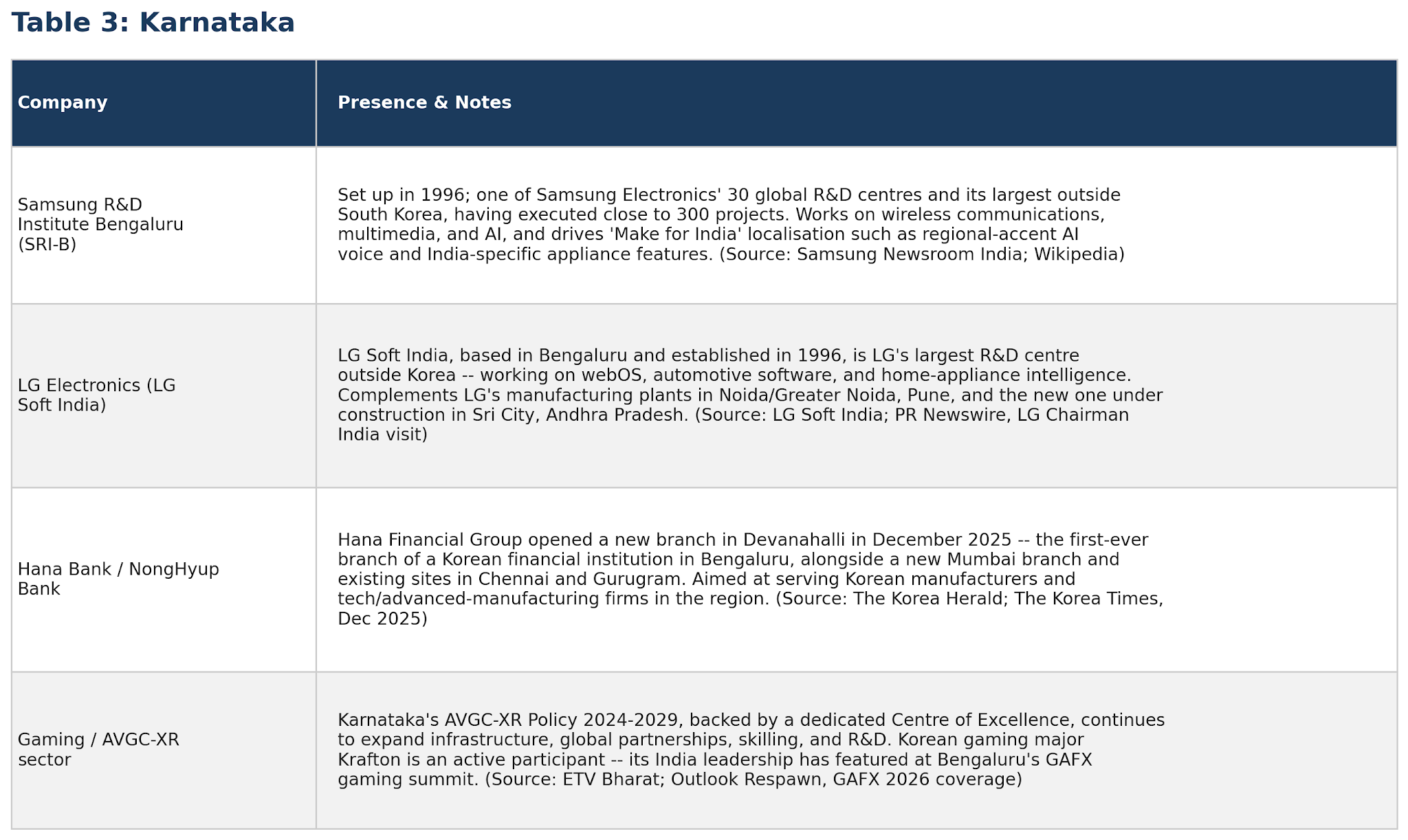
Karnataka's Korean presence centres on Bengaluru's standing as a global technology and R&D base, plus a growing corporate banking footprint serving the wider Korean manufacturing ecosystem across South India. The anchor here is Samsung R&D Institute Bengaluru (SRI-B): one of Samsung Electronics' 30 global R&D centres, and its largest outside South Korea, having executed close to 300 projects since it was set up (anil, n.d.). Set up in 1996, SRI-B has grown into an advanced R&D hub for Samsung globally, with strength in wireless communications, multimedia, image processing, and artificial intelligence. Its "Make for India" work includes things like regional-accent AI voice support and India-specific appliance features, tailoring Samsung's global product line to local needs.
LG Electronics runs a parallel operation in the city. LG Soft India, based in Bengaluru and established in 1996, is LG's largest R&D centre outside Korea, working on areas like webOS, automotive software, and home-appliance intelligence. This complements, rather than competes with, LG's manufacturing plants in Noida/Greater Noida and Pune (Ranjangaon), and its newer one coming up in Sri City, Andhra Pradesh (Company Overview - LG Soft India, n.d.).
On banking, the picture is actually a step ahead as Hana Financial Group has now opened new branches in Devanahalli (town in the Bengaluru Rural district), marking the first time a Korean financial institution has entered Bengaluru (Da-hye, 2025). Devanahalli’s rise as a centre for India’s advanced industries, from IT and biotechnology to semiconductors and aerospace, made it a natural choice for a Korean bank. (Hana Financial Opens Devanahalli, Mumbai Branches in India amid Overseas Expansion Drive - the Korea Times, 2025).
Finally, Karnataka's push in gaming and animation gives Korean firms another reason to stay engaged. The state's AVGC-XR Policy runs from 2024 to 2029, backed by a dedicated Centre of Excellence, and continues to expand infrastructure, global partnerships, skilling, and R&D across the sector. Korean gaming major Krafton has a visible presence in this ecosystem; it has featured prominently at Bengaluru's GAFX gaming summit, discussing India's emergence as a strategic global gaming market (Bharat,2026).
Source: Author’s compilation using data from multiple sources.
4.3 Andhra Pradesh
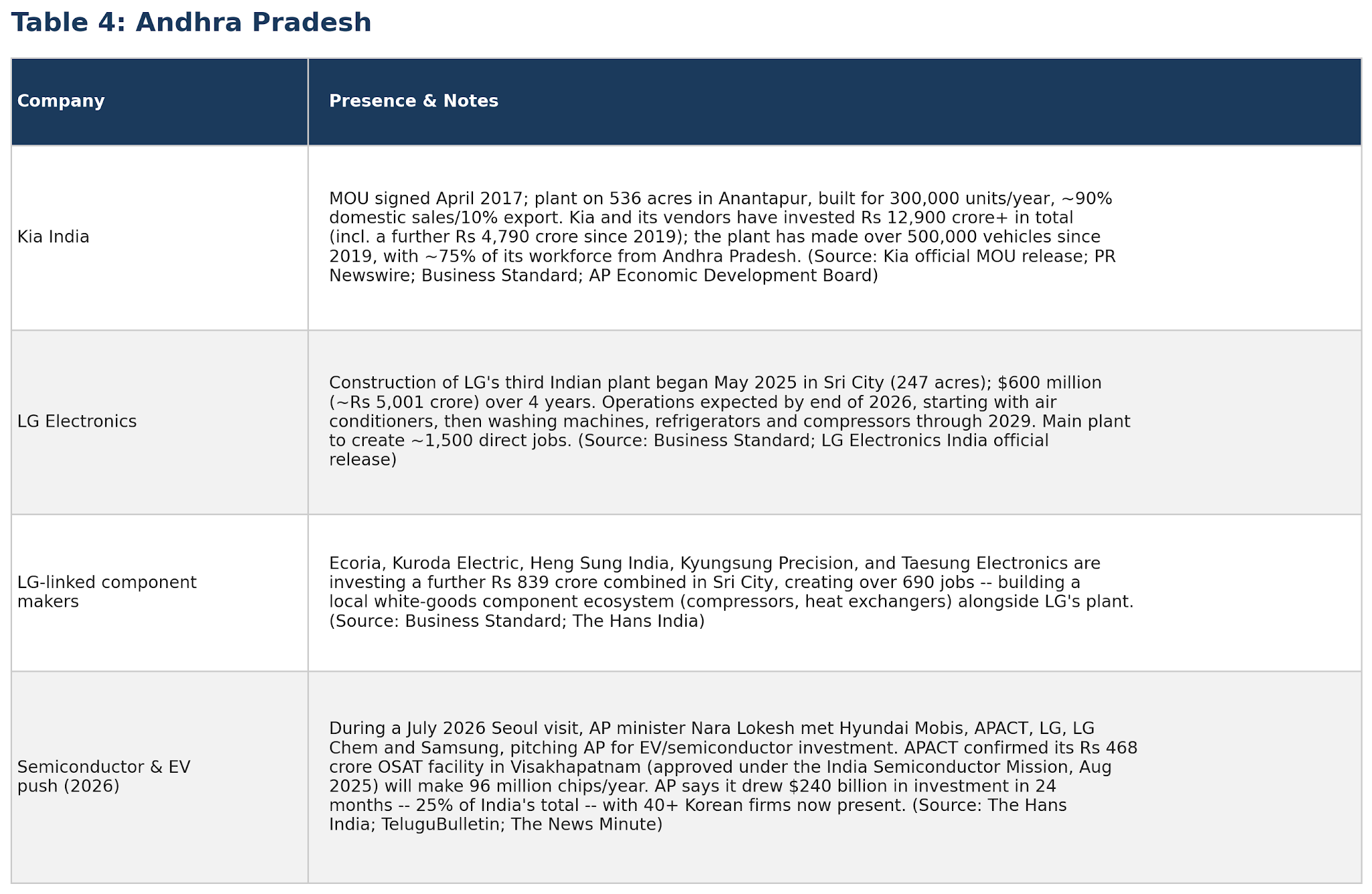
Andhra Pradesh has emerged as a major Korean manufacturing destination since 2017, anchored first by Kia and then by LG, with a semiconductor and EV push now layered on top. Kia motor has previously signed a MoU with the Andhra Pradesh government in April 2017 to build its first Indian manufacturing facility in Anantapur district, representing roughly a US$1.1 billion investment, with production originally targeted for the second half of 2019 at up to 300,000 units a year. That plant occupies 536 acres and can produce up to 300,000 vehicles annually, creating more than 3,000 direct and 7,000 indirect jobs (‘Kia Motors to Build Manufacturing Plant in India, 2017’). The wider figure of ₹12,900 crore reflects Kia's total investment along with its South Korean auto-ancillary partners, making it one of the largest FDI projects of its kind in India, with about 90% of production sold domestically and 10% exported (Tripathi, 2017). The plant has kept growing since: Kia and its vendors have invested a further ₹4,790 crore, and the plant has now manufactured more than 500,000 vehicles since 2019, with nearly 75% of its workforce drawn from Andhra Pradesh, especially Anantapur district.
LG Electronics' Sri City plant is the newer flagship. LG Electronics India began construction of its third Indian manufacturing plant in Sri City in May 2025, investing $600 million over four years, on a 247-acre site, with operations expected to start by the end of 2026. Once fully operational, the plant is expected to make up to 2 million AC compressors, 1.5 million air conditioners, 850,000 washing machines, and 800,000 refrigerators a year (Lg Electronics India Limited Begins Construction of Its Third Manufacturing Plant in India, n.d.). Alongside LG's own investment, five vendor partners — Ecoria, Kuroda Electric, Heng Sung India, Kyungsung Precision, and Taesung Electronics, are contributing a further ₹839 crore and creating over 690 additional jobs, building a local white-goods component ecosystem rather than just an assembly line (Mukherjee, 2025).
The most recent development is a broader semiconductor and EV push, after Andhra Pradesh's IT minister Nara Lokesh made visits to South Korea. Lokesh held meetings with Hyundai Mobis, APACT, LG Electronics, LG Chem, and Samsung Electronics, pitching Andhra Pradesh as India's emerging hub for semiconductors, EVs, electronics manufacturing, and AI, and proposing an EV semiconductor hub, an EV components and battery facility near Tirupati or Anantapur, and OSAT semiconductor facilities among other projects (Ilyas,2026). On the semiconductor front specifically, APACT confirmed its ₹468-crore OSAT facility in Visakhapatnam, approved under the India Semiconductor Mission on 12 August 2025, which is set to begin its construction soon, with capacity to produce 96 million semiconductor devices a year. Andhra Pradesh has attracted $240 billion in investment over the past 24 months, about a quarter of all investment India received in that period, with more than 40 Korean companies including Kia, LG Electronics, and MCNEX which are also running their manufacturing units (Raghavendra, 2026).
Source: Author’s compilation using data from multiple sources.
4.4 Telangana
Telangana's Korean investment has broadened out fast, and much of it traces back to a single trip: Chief Minister Revanth Reddy's August 2024 delegation visit to South Korea, which produced a wave of announcements well beyond any single flagship project.
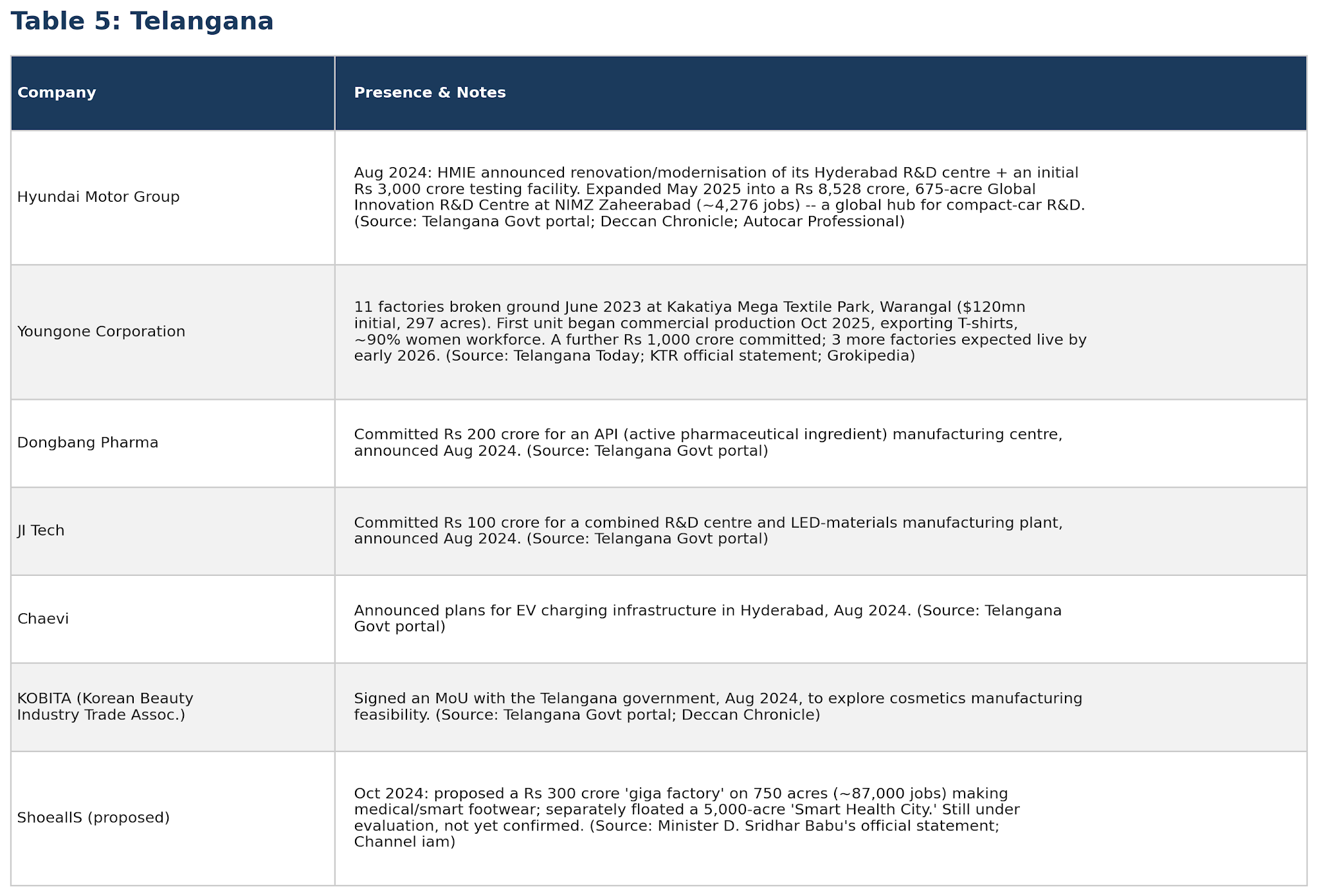
The biggest single outcome from that trip has grown considerably since. During the visit, Hyundai Motor India Engineering announced it would renovate and modernise its existing Hyderabad engineering centre to create more employment for India and the Asia-Pacific region, alongside an initial ₹3,000 crore investment for a vehicle testing facility (Service, 2024). That commitment has since expanded substantially: in May 2025, Telangana's cabinet sub-committee approved an upgraded ₹8,528 crore proposal for a 675-acre Global Innovation R&D Centre at the National Investment and Manufacturing Zone in Zaheerabad, Sangareddy district which is expected to generate over 4,276 jobs. The centre will include an automotive test track, a pilot production line, and prototyping systems, and works alongside Hyundai's existing 15-acre R&D centre in Hyderabad, positioning it as a hub for Hyundai's global compact passenger vehicle research (Media, 2024).
The same visit produced several smaller but concrete commitments, Dongbang Pharma agreed to invest ₹200 crore in an API manufacturing centre, JI Tech committed ₹100 crore to a combined R&D centre and LED-material manufacturing plant, and Chaevi announced plans for EV charging infrastructure in Hyderabad (Media, 2024). The state government also signed an MoU with the Korean Beauty Industry Trade Association (KOBITA) to explore cosmetics manufacturing in Telangana. The same delegation also held discussions with LS Group, POSCO, LG, Samsung C&T, Samsung Health Care, and GS Caltex, suggesting this list is likely to keep growing (Media, 2024).
On textiles, Youngone Corporation's in June 2023 have set up 11 factories under Youngone's Evertop Textile & Apparel Complex at the Kakatiya Mega Textile Park in Warangal, an initial US$120 million investment on 297 acres (Ltd, n.d.). The first unit began commercial production in October 2025, exporting T-shirts to international markets, with 90% of its workforce being local women (Today, 2025). Youngone has since committed a further ₹1,000 crore for an expanded unit, with three additional factories expected to be operational by early 2026.
Finally, Telangana is pursuing another major Korean investment. In October 2024, South Korean smart footwear company ShoeallS proposed a ₹300 crore factory that could create around 87,000 jobs. The project would manufacture medical and smart footwear, while the company also proposed a 5,000-acre Smart Health City with hospitals and biomedical research facilities. However, both proposals are still under evaluation and have not yet been approved (Desk, 2024).
Source: Author’s compilation using data from multiple sources.
4.5 Kerala
Kerala has seen the least Korean investment among the southern states. Unlike its neighbours, it has not attracted major Korean automotive or electronics manufacturers. Its only notable Korean investment is Sigma Group’s agreement with KINFRA to develop industrial parks, with an initial investment of about US$2 million. A modest amount when compared with the much larger investments in Andhra Pradesh, Tamil Nadu, and Telangana (Ltd, n.d.).
5. Comparing the Numbers
The scale of recent flagship investments makes the shift toward Andhra Pradesh and Tamil Nadu unmistakable. Kia's Anantapur plant alone, at nearly ₹13,000 crore, dwarfs every other single commitment in this list, with LG's Sri City project a distant second.
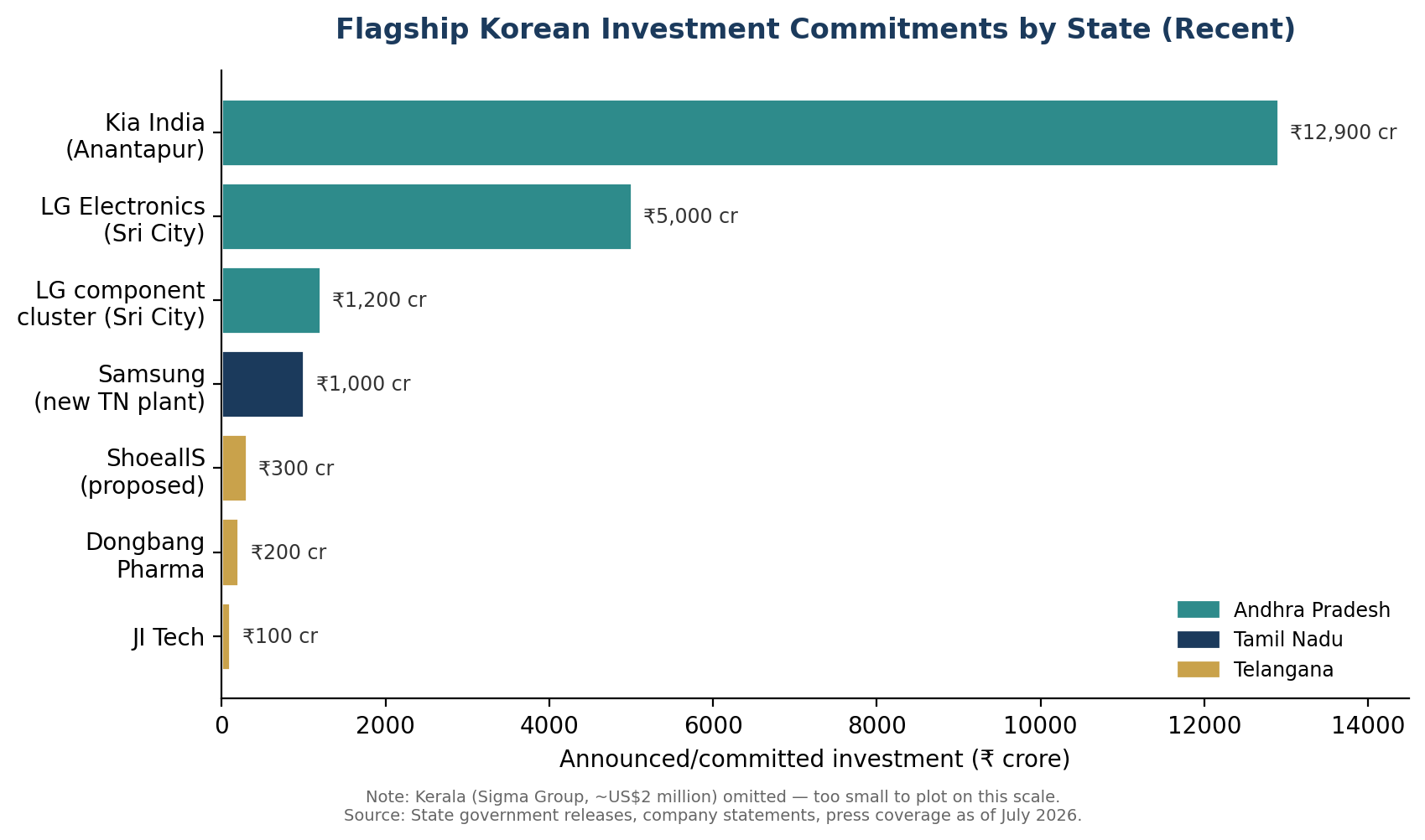
Figure 3: Flagship Korean investment commitments by state (₹ crore).
6. Why Growth Hasn't Been Faster
Despite the growing flow of Korean investment, the journey has not been without challenges. Korean businesses operating in India consistently point to two recurring concerns: a) customs clearance and b) administrative system, which many describe as opaque. India has kept fairly strict customs procedures in the name of protecting domestic industry and securing tax revenue, and even though the India-Korea FTA (CEPA) has been in force since 2010, a range of non-tariff barriers still make market entry harder than it should be.
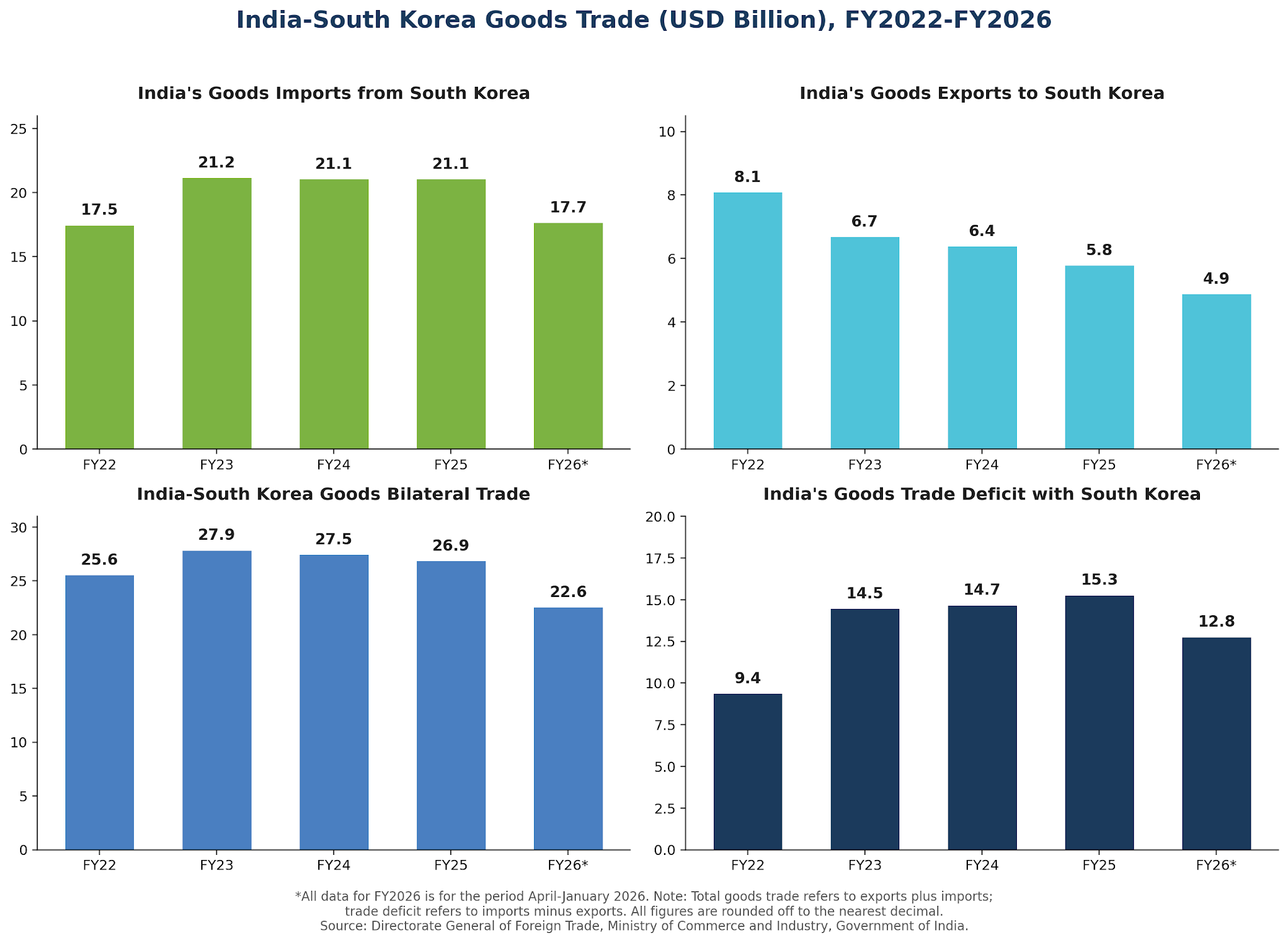
Figure 4: Goods trade between India and Republic of Korea.
This friction shows up in the trade numbers too. India's goods imports from South Korea have run consistently higher than exports: imports stood at $17.5 billion in FY22, rising to around $21 billion a year through FY23-FY25, before easing to $17.7 billion in FY26 (April-January). Exports, meanwhile, have been on a steady decline; from $8.1 billion in FY22 down to just $4.9 billion in FY26. The result is a trade deficit that has widened from $9.4 billion in FY22 to a peak of $15.3 billion in FY25, before easing slightly to $12.8 billion in FY26 (April-January) as import growth cooled. Total bilateral goods trade has followed the same pattern, up from $25.6 billion in FY22 to a peak of $27.9 billion in FY23, before slipping back to $22.6 billion in FY26 (April-January) (Rubix Data Sciences Pvt. Ltd, 2026). This is nowhere near the $50 billion target that both the governments have set for 2030. Both governments are now trying to address this directly. Commerce Minister Piyush Goyal and Korean Trade Minister Yeo Han-koo signed a joint declaration in April 2026 to accelerate talks on upgrading CEPA, and the 12th round of negotiations concluded in New Delhi in late May 2026, with both sides explicitly acknowledging the widening deficit and committing to address it(Agencies, 2026).
7. The Road Ahead
The recent April meeting between Indian Prime Minister Narendra Modi and ROK’s President Lee Jae-myung signifies a new phase in their growing ‘Special Strategic Partnership’. The evolution of their relationship is evident in the adoption of the ‘Joint Strategic Vision for India–ROK Special Strategic Partnership (2026–30)’. This is a shift from the earlier, largely automotive-led chapter of the relationship toward technology, energy, and strategic manufacturing.
Shipbuilding is a good example of this shift in practice. Under India's own 'Maritime Amrit Kaal 2047' vision, a non-binding memorandum of understanding has been signed for the joint development, financing, and operation of a large greenfield shipyard, involving HD Korea Shipbuilding & Marine Engineering (HD KSOE), a designated cluster development body, and the Marine Development Fund. This shipyard is planned for Thoothukudi (Tuticorin) on Tamil Nadu's southeastern coast. Andhra Pradesh is pushing hard on semiconductors and EVs, with its OSAT facility in Visakhapatnam under construction and further proposals on the table for Hyundai Mobis, APACT, and LG. Telangana is chasing its 'Rising 2047' targets with new entrants across textiles, pharma, EV charging, and cosmetics, and is currently evaluating ShoeallS's proposed giga factory. Karnataka's AVGC-XR policy runs through 2029 and is expected to keep drawing Korean gaming and animation investment.
The macro target both governments keep returning to is US$50 billion in bilateral trade by 2030 which is roughly double where trade has sat for the past few years. Whether that number is reached will likely depend less on any single mega-project and more on whether the customs and regulatory friction described above actually eases, and whether South Indian states keep competing, as they have for the past decade, to make themselves the easiest place for the next Korean companies to say yes.
8. Conclusion
Thirty years ago, a Korean carmaker set up its first factory near Chennai, making what was then a modest investment in India. Since then, that investment has grown into billions of dollars spread across five southern states. Today, Korean companies are involved in automobiles, electronics, home appliances, pharmaceuticals, textiles, footwear, shipbuilding, and semiconductors. South India did not become the preferred destination for South Korean investment overnight, in fact over the past three decades, states such as Tamil Nadu, Karnataka, Andhra Pradesh, and Telangana have successfully built an environment that appeals to Korean companies through better infrastructure, access to ports, a skilled workforce, reliable power supply, and investment-friendly policies. That early advantage ultimately helped in building institutions and industrial clusters, encouraging more Korean firms to follow. Where Korean companies have invested, Korean businesses have followed. Restaurants, grocery stores, and other community services have become part of the local landscape, creating an ecosystem that supports industry while bringing a slice of Korean culture to the region.
While South Korean investment in India has grown steadily, bilateral trade remains heavily tilted in Seoul’s favour. If the two countries are serious about achieving the US$50 billion trade target, the focus must shift from simply attracting more investment to building a more balanced economic relationship. South Indian states have far more to offer than automobiles and electronics. Their strengths in pharmaceuticals, food processing, textiles, renewable energy, shipbuilding, defence manufacturing, aerospace, semiconductors, and digital services can help diversify India’s exports to South Korea and narrow the trade deficit. Realising this potential, however, will require state governments to deliver on their commitments, identify sectors where they hold a comparative advantage, and work more closely with both New Delhi and Seoul to turn opportunities into long-term partnerships.
BIBLIOGRAPHY
- Agencies. “India and South Korea Begin next Round of Negotiations on Upgrading Trade Agreement.” May 26, 2026. https://www.millenniumpost.in/business/india-and-south-korea-begin-next-round-of-negotiations-on-upgrading-trade-agreement-661526.
- Amos, Dr Alon Levkowitz, Dr Lauren Dagan. India-South Korea Relations in a Fragmented Strategic Order. May 14, 2026. https://besacenter.org/india-south-korea-relations-in-a-fragmented-strategic-order/.
- Andhra Pradesh Eyes Korean Investments to Expand EV and Chip Ecosystem. July 8, 2026. https://www.electronicsforyou.biz/industry-buzz/andhra-pradesh-eyes-korean-investments-to-expand-ev-and-chip-ecosystem/.
- ANI News. “India-South Korea Trade Remains Range-Bound at USD 25-28 Billion amid Push towards USD 50 Billion Target: Report.” https://www.aninews.in/news/business/india-south-korea-trade-remains-range-bound-at-usd-25-28-billion-amid-push-towards-usd-50-billion-target-report20260423194309/.
- anil, Malay. “Samsung Completes Twenty Successful Years of ‘Make in India’ and ‘Make for India’.” Samsung Newsroom India. https://news.samsung.com/in/samsung-completes-twenty-successful-years-of-make-in-india-and-make-for-india.
- anil, Malay. “Samsung R&D Institute, Bangalore Wins a Double for Engineering Excellence & Innovation at the Nasscom Spotlight Awards 2023.” Samsung Newsroom India. https://news.samsung.com/in/samsung-rd-institute-bangalore-wins-a-double-for-engineering-excellence-innovation-at-the-nasscom-spotlight-awards-2023.
- Author, Guest. “How Chennai Became an Auto Hub.” November 21, 2024. https://madrasmusings.com/vol-34-no-15/how-chennai-became-an-auto-hub/.
- “Backstory: How Hyundai’s ‘Tall Boy’ Santro Captured the Imagination of Indian Car Buyers - CNBC TV18.” January 17, 2022. https://www.cnbctv18.com/auto/backstory-how-hyundais-tall-boy-santro-captured-the-imagination-of-indian-car-buyers-12148312.htm.
- Bharat, E. T. V. “CEPA Upgrade Talks: India, South Korea Agree To Address Widening Trade Deficit.” May 28, 2026. https://www.etvbharat.com/en/bharat/cepa-upgrade-talks-india-and-south-korea-agree-to-address-widening-trade-deficit-enn26052805452.
- Bharat, E. T. V. “CM Siddaramaiah Inaugurates Bengaluru GAFX 2026 to Reinforce Karnataka’s Global AVGC-XR.” ETV Bharat News, February 27, 2026. https://www.etvbharat.com/en/bharat/cm-siddaramaiah-inaugurates-bengaluru-gafx-2026-to-reinforce-karnatakas-global-avgc-xr-enn26022707247.
- Bureau, BL Hyderabad. “Telangana Govt Clears ₹8,528 Cr Investment by Hyundai in Zaheerabad.” May 26, 2025. https://www.thehindubusinessline.com/news/national/telangana-govt-clears-8528-cr-investment-by-hyundai-in-zaheerabad/article69621729.ece.
- Bureau, Our. “India, Korea Acknowledge Need to Address Widening Trade Deficit in CEPA Talks.” May 28, 2026. https://www.thehindubusinessline.com/economy/india-korea-acknowledge-need-to-address-widening-trade-deficit-in-cepa-talks/article71034267.ece.
- Bureau, The Hindu. “Tamil Nadu Tops in Number of Factories, Has Strong Industrial Workforce: Annual Survey of Industries 2023-24.” The Hindu, August 28, 2025. https://www.thehindu.com/news/national/tamil-nadu/tamil-nadu-tops-in-number-of-factories-has-strong-industrial-workforce-annual-survey-of-industries-2023-24/article69983608.ece.
- “Company Overview - LG Soft India.” https://www.lgsoftindia.com/aboutus.php.
- Correspondent, A. C. N. Success Stories Scripted by Korean Companies in Telengana to Inspire Others: Duddilla Sridhar Babu. June 22, 2024. https://www.asiancommunitynews.com/success-stories-scripted-by-korean-companies-in-telengana-to-inspire-others-duddilla-sridhar-babu/.
- Da-hye, Ji. “Hana Financial Expands India Network with New Mumbai, Devanahalli Branches.” Aju Press, December 8, 2025. https://www.ajupress.com/view/20251208153556135.
- Desk, News. “Shoealls Plans ₹300 Cr Smart Footwear Factory in Telangana.” Channeliam, October 26, 2024. https://en.channeliam.com/2024/10/26/shoealls-investment-telangana/.
- “Embassy of India Seoul, Republic of Korea.” https://www.indembassyseoul.gov.in/pages/NDE.
- “Exploring India Korea Trade and Economic Relations | IBEF.” Accessed May 11, 2026. https://www.ibef.org/indian-exports/india-korea-trade.
- GatewayHouse. Korea Re-Engages India. April 23, 2026. https://www.gatewayhouse.in/korea-re-engages-india/.
- “Global Banking & Finance Review.” Accessed March 17, 2026. https://www.globalbankingandfinance.com/.
- Gopalakrishnan, K. Youngone Corporation: Shaping the Future of Global Apparel with Innovation, Sustainability, and Purpose. May 12, 2025. https://www.indiantextilemagazine.in/youngone-corporation-shaping-the-future-of-global-apparel-with-innovation-sustainability-and-purpose/.
- Grokipedia. “Kakatiya Mega Textile Park.” Accessed July 29, 2026. https://grokipedia.com/page/Kakatiya_Mega_Textile_Park.
- “Hana Financial Opens Devanahalli, Mumbai Branches in India amid Overseas Expansion Drive - The Korea Times.” December 8, 2025. https://www.koreatimes.co.kr/business/banking-finance/20251208/hana-financial-opens-devanahalli-mumbai-branches-in-india-amid-overseas-expansion-drive.
- HYUNDAI MOTORS. “Hyundai Milestone 1996-2000 - History | Hyundai Motor India.” https://www.hyundai.com/content/hyundai/in/en/hyundai-story/hyundai-motor-india/history-1996-2000.
- Ilyas, M. D. “Nara Lokesh Woos South Korean Giants for Investments.” July 7, 2026. https://www.deccanchronicle.com/southern-states/andhra-pradesh/nara-lokesh-woos-south-korean-giants-for-investments-1969051.
- India Brand Equity Foundation. ‘Exploring India Korea Trade and Economic Relations | IBEF’. https://www.ibef.org/indian-exports/india-korea-trade
- “India Can Become Key Manufacturing, Export Hub for South Korea: Experts | DD News.” Accessed May 27, 2026. https://ddnews.gov.in/en/india-can-become-key-manufacturing-export-hub-for-south-korea-experts/.
- “India and Republic of Korea Joint Statement for Special Strategic Partnership (May 18, 2015) | Ministry of External Affairs.” https://www.mea.gov.in/bilateral-documents?dtl/25261/India__Republic_of_Korea_Joint_Statement_for_Special_Strategic_Partnership_May_18_2015.
- “India, South Korea Reaffirm Commitment to Conclude CEPA Upgrade in Time-Bound Manner.” https://www.aninews.in/news/business/india-south-korea-reaffirm-commitment-to-conclude-cepa-upgrade-in-time-bound-manner20260528135113/.
- “India-Republic of Korea Relations: Evolving into a Futuristic Partnership.” April 24, 2026. https://www.vifindia.org/2026/april/24/India-Republic-of-Korea-Relations-Evolving-into-a-Futuristic-Partnership.
- “India-ROK Comprehensive Framework for Partnership in Shipbuilding, Shipping and Maritime Logistics.” https://www.mea.gov.in/bilateral-documents?dtl/41065/IndiaROK_Comprehensive_Framework_for_Partnership_in_Shipbuilding_Shipping_and_Maritime_Logistics.
- “India-ROK Trade and Economic Relations | Embassy of India, Seoul.” Accessed May 11, 2026. https://www.indembassyseoul.gov.in/india-rok-trade-and-economic-relations.
- “Joint Strategic Vision for India-ROK Special Strategic Partnership.” http://www.pib.gov.in/PressReleaseDetail.aspx?PRID=2253977®=3&lang=1.
- Kandavel, Sangeetha. “Hyosung TNS Eyes ATM Manufacturing Plant in Tamil Nadu: Industries Minister.” The Hindu, June 13, 2026. https://www.thehindu.com/news/national/tamil-nadu/hyosung-tns-eyes-atm-manufacturing-plant-in-tamil-nadu-industries-minister/article71097166.ece.
- “Kia Motors to Build Manufacturing Plant in India.” April 27, 2017. https://press.kia.com/content/dam/kiapress/EU/download-files/17-05-03-India-Production-release/Kia-MOU-Indian-production-Final-3-May-2017.doc.
- “Korea-India Economic Co-Op Forum Held in Hyderabad to Boost Investment in Telangana.” Accessed July 8, 2026. https://www.newsvoir.com/release/korea-india-economic-co-op-forum-held-in-hyderabad-to-boost-investment-in-telangana-28674.html.
- Kumar, Sanjay. “[Hello India] Telangana: Gateway for Korean Companies to Access India’s Market.” August 14, 2024. https://www.koreaherald.com/article/3454213.
- LG Global. “LG Electronics India Limited Begins Construction of Its Third Manufacturing Plant in India.” https://www.lg.com/global/newsroom/news/corporate/lg-electronics-india-limited-begins-construction-of-its-third-manufacturing-plant-in-india/.
- Ltd, Economic Research India Pvt. “Korean Company to Invest in Industrial Parks in Kerala - PT Pulse.” https://projectstoday.ai/News/Korean-company-to-invest-in-industrial-parks-in-Kerala.
- Ltd, Economic Research India Pvt. “Samsung Electronics To Expand Operations With Rs 1000 Cr Investment In Facility In TN - PT Pulse.” https://projectstoday.ai/News/Samsung-Electronics-to-expand-operations-with-Rs-1000-cr-investment-in-facility-in-TN.
- Ltd, Economic Research India Pvt. “Youngone Corpn Breaks Ground For Facilities At Kakatiya Textile Park In Warangal - PT Pulse.” https://projectstoday.ai/News/Youngone-Corpn-breaks-ground-for-facilities-at-Kakatiya-Textile-Park-in-Warangal.
- Madras Musings. “How Chennai Became an Auto Hub.” November 21, 2024. https://madrasmusings.com/vol-34-no-15/how-chennai-became-an-auto-hub/.
- Media, TG Digital. “CM’s USA and South Korea Visit Puts Telangana as the Best Investment Destination in the World.” Telangana State Portal, August 14, 2024. https://www.telangana.gov.in/news/press-releases/2024/08/cms-usa-and-south-korea-visit-puts-telangana-as-the-best-investment-destination-in-the-world/.
- Media, TG Digital. “Hyundai Motor to Set up a Car Testing Facility in Telangana.” Telangana State Portal, August 12, 2024. https://www.telangana.gov.in/news/press-releases/2024/08/hyundai-motor-to-set-up-a-car-testing-facility-in-telangana/.
- Mukherjee, Writankar. “K-Tech Plugs into India to Light up Electronics.” The Economic Times, April 25, 2025. https://economictimes.indiatimes.com/industry/cons-products/electronics/k-tech-plugs-into-india-to-light-up-electronics/articleshow/120594504.cms?from=mdr.
- Network, KNN India-Knowledge & News. “Tamil Nadu Accounts for Largest Number of Factories in India.” November 22, 2022. https://knnindia.co.in/news/newsdetails/state/tamil-nadu-accounts-for-largest-number-of-factories-in-india.
- Raghavendra, V. “Lokesh Pitches Andhra Pradesh as Hub for Korean Tech Investments.” The Hindu, July 6, 2026. https://www.thehindu.com/news/national/andhra-pradesh/lokesh-pitches-andhra-pradesh-as-hub-for-korean-tech-investments/article71189518.ece.
- Rao, G. V. R. Subba. “Lokesh Seeks EV, Semiconductor Investment from Korean Giants for Andhra Pradesh.” The Hindu, July 7, 2026. https://www.thehindu.com/news/national/andhra-pradesh/lokesh-courts-korean-tech-giants-for-electronics-semiconductor-investments-in-andhra-pradesh/article71192344.ece.
- Rubix Data Sciences Pvt. Ltd. “INDIA AND SOUTH KOREA: TRADE SCENARIO.” Rubix, 2026. https://www.vayana.com/wp-content/uploads/2026/04/b262d-india-south-korea-trade-scenario.pdf.
- Salai, Mount. Tamil Nadu Pollution Control Board. n.d.
- Service, Express News. “Hyundai to Make Test Vehicles in Telangana.” The New Indian Express, August 13, 2024. https://www.newindianexpress.com/states/telangana/2024/Aug/13/hyundai-to-make-test-vehicles-in-telangana.
- Service, Express News. “Korean Firms Invited to Explore Andhra Pradesh’s Investor-Friendly Industrial Ecosystem.” July 11, 2026. https://www.newindianexpress.com/states/andhra-pradesh/2026/Jul/11/korean-firms-invited-to-explore-andhra-pradeshs-investor-friendly-industrial-ecosystem.
- Service, Express News. “Minister Lokesh Invites Korean Firms to Expand Investments in Andhra Pradesh.” July 8, 2026. https://www.newindianexpress.com/states/andhra-pradesh/2026/Jul/08/minister-lokesh-invites-korean-firms-to-expand-investments-in-andhra-pradesh.
- Tamil Nadu Government and State Planning Commission. “Economic Survey of Tamil Nadu 2025–26 Highlights.” 2026. https://spc.tn.gov.in/wp-content/uploads/Economic-Survey-Highlights-Eng.pdf.
- “The Hyundai Journey: How South Korea’s Chaebol Became India’s Automotive Icon.” https://www.storyboard18.com/brand-marketing/the-hyundai-journey-how-south-koreas-chaebol-became-indias-automotive-icon-45109.htm.
- The Times of India. “From Korea to Kilpauk.” July 24, 2010. https://timesofindia.indiatimes.com/city/chennai/from-korea-to-kilpauk/articleshow/6207242.cms.
- The Times of India. “Kia Motors Vendors Investing Rs 4,790 Cr in AP.” December 7, 2018. https://timesofindia.indiatimes.com/business/india-business/kia-motors-vendors-investing-rs-4790-cr-in-ap/articleshow/66977145.cms.
- The Times of India. “Korean Firms Plan to Invest Rs 4,500 Crore in Telangana: CM A Revanth Reddy.” August 15, 2024. https://timesofindia.indiatimes.com/city/hyderabad/korean-firms-to-invest-4500-crore-in-telangana-revanth/articleshow/112535844.cms.
- The Times of India. “Lokesh Seeks Korean Investments in AP Tech Sector.” July 7, 2026. https://timesofindia.indiatimes.com/city/vijayawada/lokesh-seeks-korean-investments-in-ap-tech-sector/articleshow/132245012.cms.
- The Times of India. “Lotte India Opens Expanded Confectionery Factory near Chennai.” September 27, 2023. https://timesofindia.indiatimes.com/business/india-business/lotte-india-opens-expanded-confectionery-factory-near-chennai/articleshow/103989477.cms.
- Today, Telangana. “Korean Firm Youngone Begins Commercial Production from Warangal Textile Park.” October 11, 2025. https://telanganatoday.com/korean-firm-youngone-begins-commercial-production-from-warangal-textile-park.
- Tripathi, Karan. Kia Motors’ Product Portfolio for India to Include a Small Car, Sedan and an SUV | Motoroids. April 18, 2017. https://www.motoroids.com/news/kia-motors-product-portfolio-for-india-to-include-a-small-car-sedan-and-an-suv/.
- Tripathi, Siddharth Hariani, Saloni Shroff, Harshvardhan. India-Korea: Building Blocks for $50-Billion Bilateral Trade by 2030 & Other Investments. May 21, 2024. https://corporate.cyrilamarchandblogs.com/2024/05/india-korea-building-blocks-for-50-billion-bilateral-trade-by-2030-other-investments/.
- “Welcome to New Project Tracker.” Accessed July 8, 2026. https://newprojectstracker.com/south-korean-shoe-company-proposes-giga-factory-in-telangana.
- “What Holds India-South Korea Relations Back? – NUS Institute of South Asian Studies (ISAS).” Accessed May 25, 2026. https://www.isas.nus.edu.sg/papers/what-holds-india-south-korea-relations-back/.
- www.etnews.com. “‘印 텔랑가나, 한국과 함께 아시아 혁신의 교량 세울 것.’” September 16, 2025. https://www.etnews.com/20250916000288?SNS=00002.
- www.fibre2fashion.com. “Youngone Corp Turns First Sod to Set up 11 Units in India’s Telangana.” https://www.fibre2fashion.com/news/manufacturing-news/youngone-corp-turns-first-sod-to-set-up-11-units-in-india-s-telangana-288357-newsdetails.htm.
- 기자첸나이(인도)·콜롬보(스리랑카)=김사무엘. “‘인건비 저렴, 한국 좋아해’…삼성·현대차도 찍은 ‘이 나라’ 무섭게 큰다.” June 20, 2025. https://www.mt.co.kr/economy/2025/06/20/2025061708373999852.
- 대구경제. “한국 기업은 인도 텔랑가나주로… 주 정부 투자 ‘확’ 늘어날 듯.” November 25, 2025. https://www.dgenews.com/news/articleView.html?idxno=40097.
- 대외경제정책연구원. “인도 권역별 진출환경 평가: 남부 | 전체보고서 | 보고서 | 발간물.” Accessed July 28, 2026. https://www.kiep.go.kr/gallery.es?act=view&bid=0001&list_no=1445&mid=a10101010000&utm_source=chatgpt.com&act=view&list_no=1445&cg_code=.
- 쉬핑뉴스넷. “인도, 글로벌 조선시장 진입 시동… 산업 생태계 구축 가속화.” April 15, 2026. http://www.shippingnewsnet.com/news/articleView.html?idxno=69892.
- “인도에서 한류를 묻다 : 첸나이 인코센터 방문기.” Accessed July 8, 2026. https://kita.net/board/totalTradeNews/totalTradeNewsDetail.do?no=%2054822&siteId=1.
REFERENCES:
[1] Ministry of External Affairs. ‘INDIA – REPUBLIC OF KOREA BILATERAL RELATIONS’. Ministry of External Affairs , December 2025. https://www.mea.gov.in/Portal/ForeignRelation/India-ROK-Dec-2025.pdf.
[2] Joint strategic vision for india-rok special strategic partnership. (n.d.). http://www.pib.gov.in/PressReleaseDetail.aspx?PRID=2253977®=3&lang=1
[3] ‘India-South Korea Trade Remains Range-Bound at USD 25-28 Billion amid Push towards USD 50 Billion Target: Report. ANI News, https://www.aninews.in/news/business/india-south-korea-trade-remains-range-bound-at-usd-25-28-billion-amid-push-towards-usd-50-billion-target-report20260423194309/.
[4] Chaebol refers to a large, family-controlled South Korean business conglomerate, such as Samsung, Hyundai, LG, and SK Group, that has played a central role in the country’s industrial and export-led economic development.
Mehak Gautam is a Research Officer at the Deccan Centre for International Relations. Her research focuses on geopolitics, with particular emphasis on Africa, China, and the Indo-Pacific.
Disclaimer: The views and opinions expressed in the article are those of the author and do not necessarily reflect the official position of the Deccan Centre for International Relations.