
Advancing South India’s Global Agenda

Stadiums Without Borders: The FIFA World Cup and the Evolution of Sovereignty: Parag Gilada
BackStadiums Without Borders: The FIFA World Cup and the Evolution of Sovereignty: Parag Gilada
Stadiums Without Borders: The FIFA World Cup and the Evolution of Sovereignty
Author: Parag Gilada
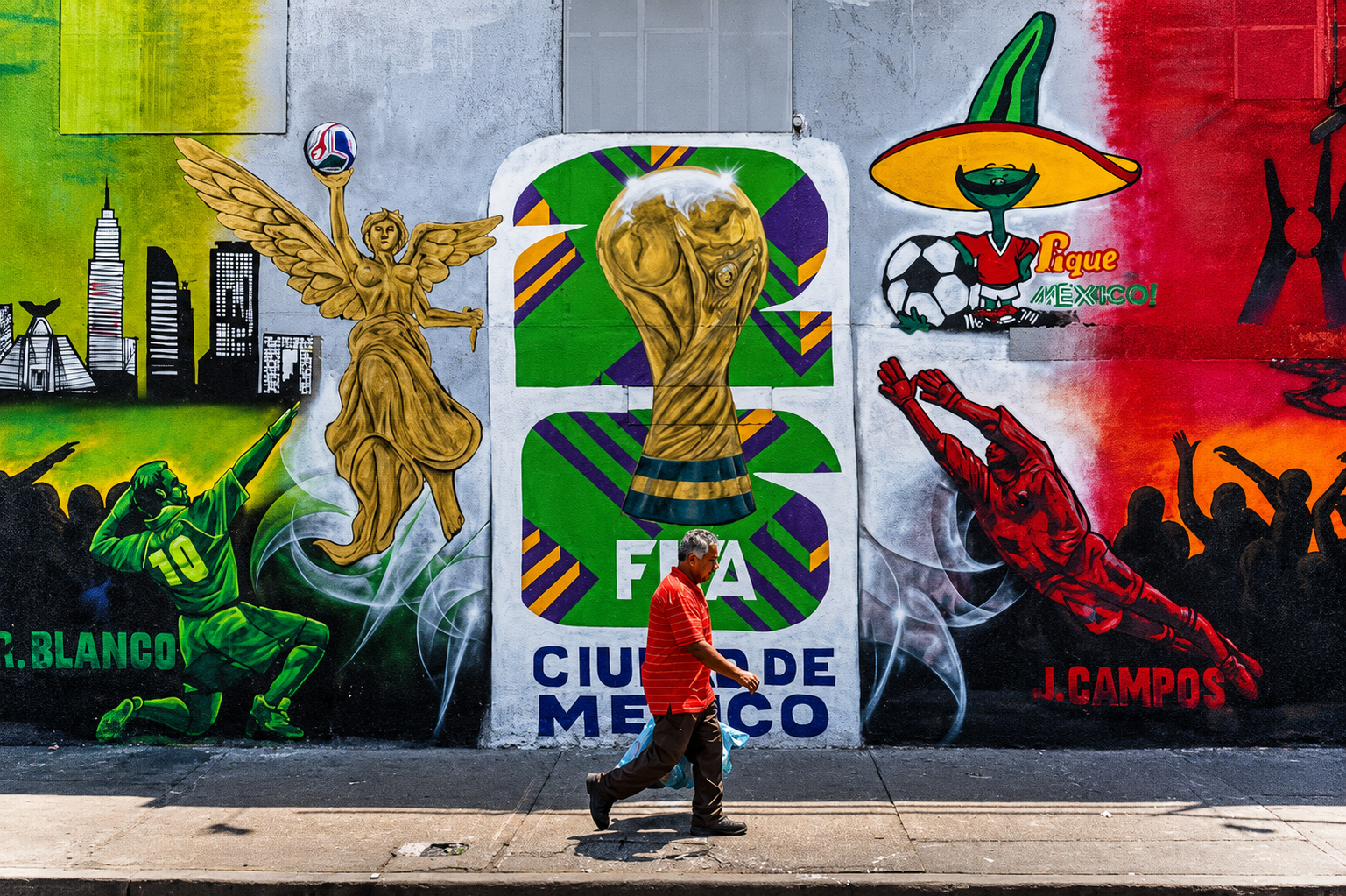
Every four years, the FIFA World Cup turns into a high-stakes global laboratory. It wears the mask of traditional parade flags, anthems, and territorial pride, but beneath that, it’s a borderless network. It acts as a proving ground for modern power: a tournament that celebrates national borders while rendering them increasingly permeable.
Billions of viewers witness what they assume is a traditional clash of sovereign states. Upfront, the tournament seems to validate the classical realist view of international politics that the nation-state remains the primary, autonomous actor in global affairs. Yet, a single match reveals a highly intricate web of transnational relationships. A player born and educated in France represents Morocco because of ancestral ties; his coach is trained in Spain; his boots are designed by an American corporation in Germany, manufactured in Vietnam, and sold globally. The game itself is dictated not by local legislation, but by Zurich-based FIFA regulations enforced by referees from an entirely different continent.
This reality is far more than a mere footnote in global affairs; it is living evidence of how sovereignty is negotiated and enacted within dense networks of states, non-state actors, and transnational communities.
Consider the frenzy surrounding the commercial spectacle of the Indian Premier League (IPL). To a layman, these events represent the ultimate celebration of unyielding national identity, a pure expression of state-backed sports diplomacy. Yet, beneath the flying flags and national anthems lies a complex, borderless ecosystem. An Indian franchise, owned by a multinational conglomerate, is coached by an Australian, captained by a domestic star, and propelled by West Indian power-hitters. The matches are played on pitches prepared using globally shared technologies, governed by International Cricket Council (ICC) frameworks, and broadcast via cross-border digital networks.
The Diplomatic Illusion and the Networked World
Globalisation hasn't killed the state; it's just changed the playbook. Anne-Marie Slaughter, a specialist in international law and global networks, calls this a "networked world," where power has leaked away from unilateral capitals toward institutional networks. FIFA, with its 211 member associations, now influences state behaviour more effectively than many sovereign bodies. If cricket serves as a familiar lens for the Indian audience to see how modern sports transcend domestic borders, the FIFA World Cup is that very phenomenon scaled to its absolute extreme. The modern World Cup operates along the lines of national borders, but fundamentally functions by completely erasing them.
The Global South Asymmetry
These networks are rarely equal, though. For the Global South, this system is often an asymmetrical trap. To host, nations are frequently forced to rewrite domestic tax codes and labour laws for FIFA. While Western hosts negotiate from positions of strength, developing states often grant blanket tax exemptions, effectively legalising capital flight while taxpayers pick up the tab for empty stadiums. These structures mirror neo-colonial economic models: the Global South provides the infrastructure and passion, while the financial windfall is extracted to European cores.
Layered Identities and Diaspora Diplomacy
A fluid environment has radically transformed the concept of the nation-state’s most foundational element: its people. Modern football challenges simple, monolithic ideas of national identity. The cross-pollination of talent and identity is no longer an anomaly; it is a calculated tool of statecraft. Sports thrive on diaspora diplomacy today. During Morocco’s historic semi-final run in the 2022 FIFA World Cup, the majority of the squad was born and trained in European nations but chose to represent their ancestral homeland, including stars like Achraf Hakimi, a Spanish-born Moroccan international footballer, and Hakim Ziyech, a Netherlands-born Moroccan international footballer. This cross-pollination is strategic.
States actively leverage their diaspora to systematically "import" elite tactical discipline and physical standards into their own domestic ecosystems. This knowledge transfer is directly analogous to technology transfers in the defence or space industries. Take Saurabh Netravalkar, an Indian-origin USA national cricket player; he represents the US despite his roots. A prime manifestation is Australian-born winger Ryan Williams giving up his Tier-1 passport to navigate India's strict non-dual citizenship laws and represent the Indian national team. By returning to his maternal roots- his grandfather was a 1950s Santosh Trophy player in Bombay, Williams provides a profound example of Diaspora Diplomacy. His inclusion sets a precedent that the 32-million-strong global Indian diaspora can be converted from an external community into an active, on-pitch strategic resource.
Beyond this classic example, the global talent marketplace functions via highly strategic pipelines. Elite football academies across West Africa, such as those in Senegal or Ivory Coast, operate as hyper-efficient talent pipelines designed explicitly to harvest human capital for European club markets.
The IPE Matrix and State Re-assertion
Scholars argue that states are losing market control to private institutions, and the World Cup bears this out. The World Cup mirrors this broader shift where the tournament is an independent, multi-billion-dollar economic ecosystem intersecting logistics, aviation, cybersecurity, insurance, and digital commerce. Broadcast rights are negotiated by multinational media conglomerates, and corporate sponsorship revenues often dwarf the GDP of several participating nations.
Yet, a counter-trend has emerged: aggressive state re-assertion. Saudi Arabia, via its Public Investment Fund (PIF), isn't just negotiating with the market; it's buying it. The PIF’s takeover of Newcastle United Football Club wasn't just a sponsorship; it was a direct entry into the highest tier of global football. Launching the LIV Golf series wasn't about negotiating with the existing ecosystem, either; it was about replacing it.
Building on this trend of structural investment, Saudi Arabia officially secured the hosting rights for the 2034 FIFA World Cup in December 2024. Through these "sportswashing" strategies and massive structural investments, the state is forcing its way into global governance, using the borderless architecture of sports to secure prestige and long-term economic resilience.
Sovereignty Transformed
Robert Keohane, a theorist of neoliberal institutionalism, and Joseph Nye, an expert on soft power and international interdependence, theorised that complex interdependence doesn't make the state obsolete; it just complicates its mission. States still hold the monopoly on hard power: visas, security, borders, but the 2026 World Cup tests the limits of that control. The multi-host model demands unprecedented legal harmonisation between the US, Canada, and Mexico. This isn't just a sporting event; it's a stress test for how sovereign entities navigate shared, transnational responsibilities.
The next generation shouldn't try to resist this borderless architecture; they need to harness it. Navigating the future of global sports diplomacy requires three strategic pivots. First, mid-sized powers should invest in "niche" sporting governance, becoming indispensable hubs for specific tournaments or tech-sport intersections rather than chasing general prestige. They must, however, weigh the financial volatility and the risk of geopolitical miscalculation if they back the wrong tech-sport play. Second, international bodies need to establish harmonised legal frameworks that protect domestic taxpayers and labour forces from asymmetrical exploitation. Finally, sports diplomacy must move from the periphery to the centre of foreign policy. The goal is to go from passive hosting to active rule-making, ensuring the "networked world" of sports serves national interests, not the other way around.
Parag Gilada is a Master's student at the International Institute of Sports Management, Mumbai, with a BA in Global Affairs from OP Jindal Global University, specialising in sports diplomacy and governance.
Disclaimer:The views and opinions expressed in the article are those of the author and do not necessarily reflect the official position of the Deccan Centre for International Relations.