
Advancing South India’s Global Agenda

Japan’s Infrastructure Diplomacy in South India: Venkatakrishnan Asuri
BackJapan’s Infrastructure Diplomacy in South India: Venkatakrishnan Asuri
Japan’s Infrastructure Diplomacy in South India
Author: Venkatakrishnan Asuri
Introduction
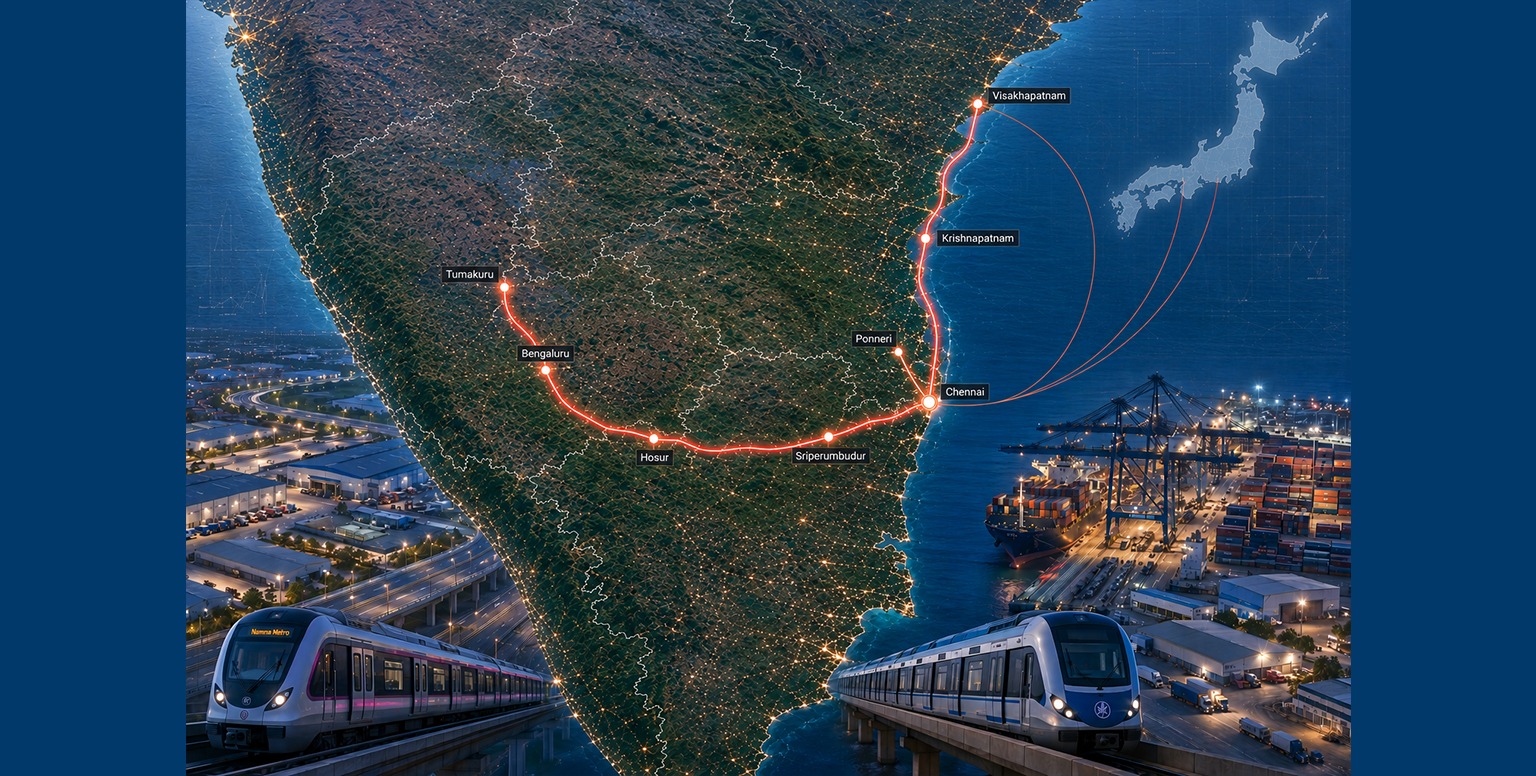
While discussions on infrastructure diplomacy in South Asia are heavily centered around China’s Belt and Road Initiative (BRI), Japan has steadily expanded its developmental footprint in India over the past four decades. Through developmental assistance, infrastructure financing and long-term economic partnerships, Tokyo has emerged as India’s largest bilateral development partner and its largest Official Development Assistance (ODA) provider since 2003[1]. India has surpassed China as Japan’s largest ODA recipient, with commitments standing roughly at ₹4.4 lakh crore ($46.21 billion USD) spread across more than eighty ongoing projects[2]. Unlike the BRI’s highly visible flagship projects, Japanese engagement has in large part been embedded within the day-to-day infrastructure that enables long-term economic development. The Japanese footprint is perhaps nowhere more evident than in South India, where the Chennai and Bengaluru metro systems, financed substantially through the Japan International Cooperation Agency (JICA), stands out as the most visible manifestations of the deep partnership between New Delhi and Tokyo.
The Metro Financing
Urban transit has emerged as one of the most enduring pillars of Japan’s developmental partnership with India. Over the past two decades, JICA has played a key role in expanding metro rail infrastructure, providing financing for projects across several Indian cities such as Chennai, Bengaluru, Ahmedabad, Delhi and Mumbai. In Chennai alone, JICA has financed roughly half the cost of Chennai Metro’s successive expansion phases on concessional terms, with the loan for the 52-kilometer second phase amounting to approximately ₹20,000 crore ($2 billion USD), on repayment periods extending across three decades[3]. Bengaluru's Namma Metro has followed a
comparable trajectory, with JICA financing its successive phases including a 2026 commitment of roughly ₹6,100 crore ($640 million USD) for a 44.65-kilometer line linking the outer ring road to the city's western growth corridor[4]. Overall, Tokyo’s commitments to urban transit projects now exceed 1.6 trillion yen ($10 billion USD) making it India’s most significant partner in the sector[5]. The distinguishing factor of the Japanese approach remains its consistency, remaining the default external financier across changes of government at both the state and central level.
Tokyo’s Planning Assistance
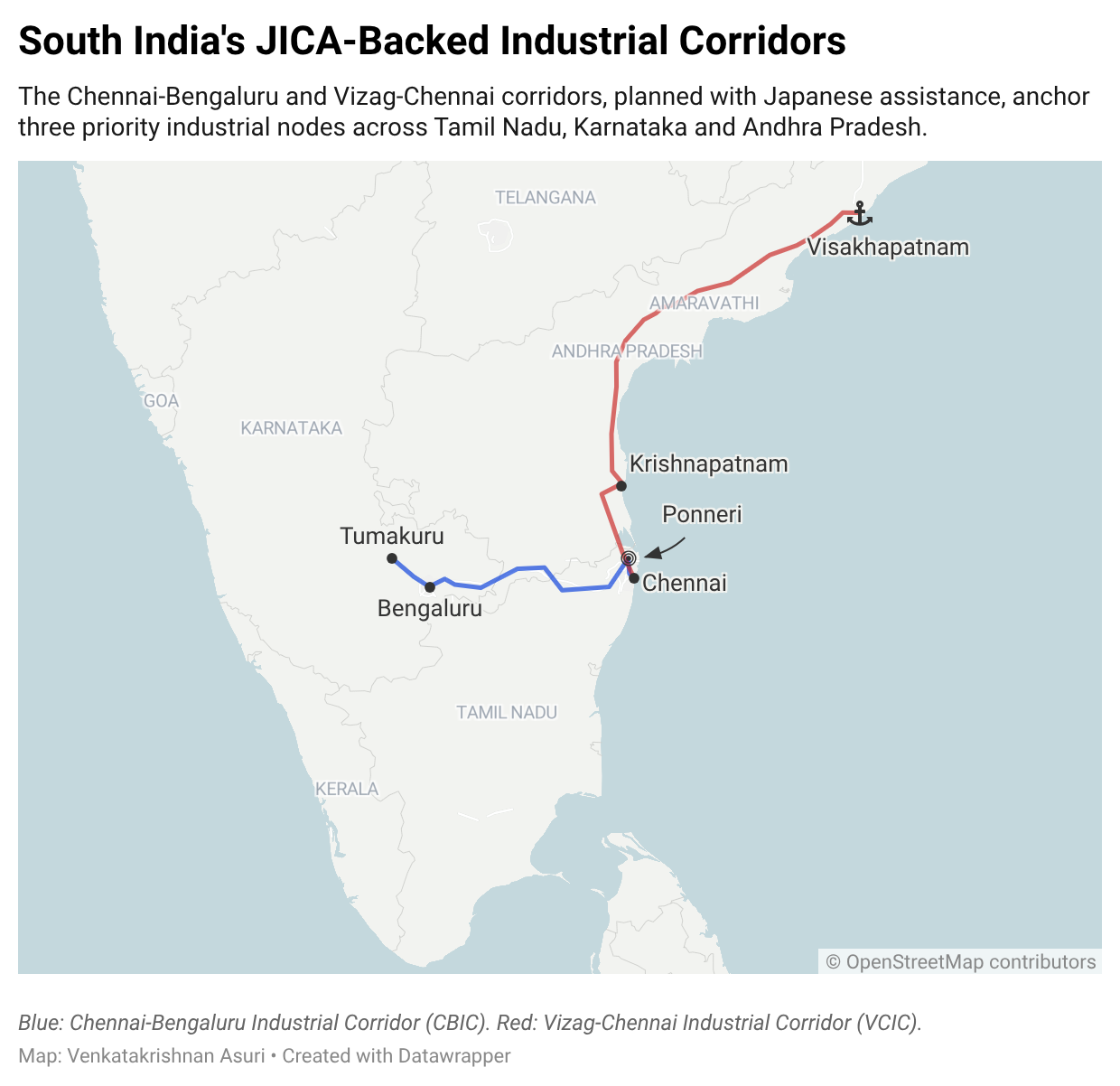
The more significant dimension of Tokyo’s role lies in planning, rather than construction. In the early 2010s, the Government of India tasked JICA with preparing a master plan for industrial development along the corridor connecting Chennai and Bengaluru[6]. The resulting Comprehensive Integrated Master Plan for the Chennai-Bengaluru Industrial Corridor estimated investments of nearly $180 billion, with key nodes at Ponneri in Tamil Nadu, Tumakuru in Karnataka and Krishnapatnam in Andhra Pradesh[7], with the Tumakuru and Krishnapatnam sites alone spanning roughly 8,500 and 11,000 acres respectively[8]. In parallel, the Vizag-Chennai Industrial Corridor extending up to the Andhra coast, involved JICA assistance alongside the Asian Development Bank. By identifying industrial nodes and logistics corridors, Tokyo’s approach builds a framework on which subsequent governments build inside, rather than continually redrawing it.
The Supply Chain Angle
Tokyo’s assistance in planning architecture has developed and reinforced its corporate presence in the region. Tamil Nadu has built one of the largest hubs of Japanese manufacturing in India, with around 620 Japanese companies operating in the state, the second-highest in the country and accounting for one-fifth of Japan’s manufacturing output in India[9]. The industrial corridors envisioned and supported through Tokyo’s planning initiatives have improved connectivity between production centres, ports and urban markets in these manufacturing ecosystems. This is reflected in the fact that three of India’s twelve Japan Industrial Townships are located in Tamil Nadu[10]. Karnataka has developed a different approach, positioning itself more closely as a hub for technology, research and advanced manufacturing with automotive assembly forming one component of a broader portfolio.
At the same time, the relationship between infrastructure and corporate investment is mutually enforcing. Industrial corridors and ring roads lower the cost of operating and expanding existing plants, while an established manufacturing base provides a strong foundation for attracting additional investment. This has acquired greater relevance as Japanese firms increasingly pursue China Plus One strategies to diversify their production networks. By 2025, India had overtaken China as the single largest destination for Japanese FDI inflows[11].
The Subnational Dimension
Japan’s engagement with South India has developed direct channels to state governments, maintaining a consulate-general in Chennai since the mid-1960s and opening a consulate in Bengaluru in 2008[12]. This subnational dual consular approach reflects the institutional density that few foreign missions maintain in India. Recently, this partnership has expanded into formal partnerships between Japanese prefectures and Indian states, including an agreement between Tamil Nadu and Ehime prefecture alongside similar arrangements involving Andhra Pradesh, Gujarat and Uttar Pradesh[13]. These partnerships indicate that Japan treats Indian states as their counterparts, similar to the way Japanese prefectures conduct their external engagement.
Limitations
The implementation of the Chennai-Bengaluru Industrial Corridor has, however, progressed unevenly across its identified development nodes. The Tumakuru node in Karnataka and the Krishnapatnam node in Andhra Pradesh have advanced to construction while the Ponneri node in Tamil Nadu has progressed more slowly, with land acquisition and project development lagging behind for an extended period[14]. While a well-designed master plan has not translated evenly into
outcomes on the ground, JICA's own communications acknowledge the value of visibility. For instance, recent project documentation for Bengaluru’s Namma Metro links Japanese financing to improving the business environment in areas where Japanese firms already operate, highlighting the strategic and reputational returns that accompany development assistance[15].
Conclusion
Japan's engagement with South India illustrates a model of partnership built more around sustained financing, planning assistance, and institutional cooperation over four decades, than over high-profile flagship projects. This framework of concessional financing, industrial corridor planning, and subnational engagement is likely to remain an important feature of the India-Japan bilateral relationship. South India's experience suggests that the impact of external partnerships often extends far beyond individual projects to the broader economic landscape they help create.
REFERENCES:
[1] "India Top Recipient of Japanese Financial Aid Since 2003, Surpassing China," Deccan Herald, March 26, 2021, https://www.deccanherald.com/india/india-top-recipient-of-japanese-financial-aid-since-2003-surpassing-china-966938.html.
[2] Embassy of India, Tokyo, "India-Japan Bilateral Relations," accessed June 2026, https://www.indembassy-tokyo.gov.in/eoityo_pages/NjQw.
[3] "Chennai Metro Rail Phase 2: Japanese Agency to Loan Rs 20,000 Crore to TN Govt," The News Minute, May 28, 2021, https://www.thenewsminute.com/article/chennai-metro-rail-phase-2-japanese-agency-loan-rs-20000-crore-tn-govt-93843.
[4] Japan International Cooperation Agency, "JICA Extends ODA Loan of 102,480 Million Japanese Yen for Bengaluru Metro Rail Project (Phase 3) (I) in India," March 24, 2026, https://www.jica.go.jp/english/overseas/india/information/press/2025/1579721_59609.html.
[5] Japan International Cooperation Agency, "JICA Extends ODA Loan of INR 4710 Cr for Chennai Metro Rail Project Phase 2 (II)," March 31, 2022, https://www.jica.go.jp/english/overseas/india/information/press/2021/press220331_03.html.
[6] "Chennai Bengaluru Industrial Corridor: Latest Updates (2026)," Blackridge Research, accessed June 2026, https://www.blackridgeresearch.com/project-profiles/chennai-bengaluru-industrial-corridor-route-map-nodes-extension-cost-investment-current-status-updates.
[7] "Chennai-Bengaluru Industrial Corridor to Need $181 bn Investment Over 20 Years: Plan Report," Business Standard, September 24, 2015, https://www.business-standard.com/article/economy-policy/chennai-bengaluru-industrial-corridor-to-need-181-bn-investment-over-20-years-plan-report-115092400267_1.html.
[8] Press Information Bureau, Government of India, "PM Lays Foundation Stone of South India's 1st Industrial Corridor Project, the Tumakuru Industrial Township," February 6, 2023, https://www.pib.gov.in/PressReleasePage.aspx?PRID=1896780.
[9] "Japan," Guidance Tamil Nadu, accessed June 2026, https://investingintamilnadu.com/japan.
[10] Ministry of Economy, Trade and Industry (Japan), "Review Meeting for Economic Relations including Japan Industrial Townships (JITs) in Tamil Nadu, India," May 12, 2022, https://www.meti.go.jp/english/press/2022/0512_001.html.
[11] "Japanese Firms Eye India in 'China Plus One' Strategy," The Pioneer, February 2025, https://www.dailypioneer.com/2025/business/japanese-firms-eye-india-in----china-plus-one--strategy.html.
[12] Consulate-General of Japan in Chennai, "Greeting from the Consul-General," accessed June 2026, https://www.chennai.in.emb-japan.go.jp/greeting.html.
[13] Prime Minister's Office, Government of India, "15th India-Japan Annual Summit Joint Statement: Partnership for Security and Prosperity of Our Next Generation," August 30, 2025, https://www.pmindia.gov.in/en/news_updates/15th-india-japan-annual-summit-joint-statement-partnership-for-security-and-prosperity-of-our-next-generation/.
[14] "Chennai Bengaluru Industrial Corridor: Latest Updates (2026)," Blackridge Research, accessed June 2026, https://www.blackridgeresearch.com/project-profiles/chennai-bengaluru-industrial-corridor-route-map-nodes-extension-cost-investment-current-status-updates.
[15] Japan International Cooperation Agency, "Signing of Japanese ODA Loan Agreement with India: Contributing to Development of Urban and Rural Areas in India through Promotion of Japan-India Collaboration," March 25, 2026, https://www.jica.go.jp/english/information/press/2025/20260324_11.html.
Venkatakrishnan Asuri is an undergraduate student at the Indian Institute of Technology, Madras. His research interests include South Asian security, Chinese studies, and India’s neighbourhood. His works have appeared in reputable platforms, such as The Rise, Diplomatist, CNN News18, the Deccan Herald and the Deccan Centre for International.
Disclaimer: The views and opinions expressed in the article are those of the author and do not necessarily reflect the official position of the Deccan Centre for International Relations.