Advancing South India’s Global Agenda

Beyond West Asia: India’s Energy Investment in Africa: Sairakshit Raghupathy
BackBeyond West Asia: India’s Energy Investment in Africa: Sairakshit Raghupathy
Beyond West Asia: India’s Energy Investment in Africa
Author: Sairakshit Raghupathy
India's abroad investments in oil and natural gas have become an increasingly important component of its energy security policy. As the world's third largest energy consumer, India imports approximately 85% of its crude oil, 50% of its natural gas, 20% of its thermal coal, and 95% of its cooking coal, considering energy security a tactical necessity instead of an economical preference. While West Asia continues to remain India’s principal energy supplier, recurring geopolitical disruptions including Israel-Iran tensions and the risks surrounding the Strait of Hormuz, through which nearly one-fifth of global oil trade passes have reinforced New Delhi’s urgency to diversify supply chains. Against this backdrop, India’s overseas hydrocarbon investments particularly in Africa are increasingly become instruments of both energy resilience and strategic diplomacy.
Indian public sector companies, including ONGC Videsh Ltd (OVL), Indian Oil Corporation Ltd (IOCL), Oil India Ltd (OIL), Bharat PetroResources Ltd (BPRL) and GAIL currently maintain 45 overseas assets across 21 countries with investments worth approximately US $41 Billion. Out of the 45 assets, 21 are producing, 14 are under exploration, 3 are pipeline projects, and 7 are under various phases of development. During FY 2024-25, overseas production of oil and gas was approximately 20.2 MMTOE highlighting how India’s foreign energy investments are increasingly supplementing domestic energy requirements.
Africa occupies an especially important place in India’s overseas
hydrocarbon engagement. The continent has emerged as both an energy supplier and a strategic partner with India
importing crude oil and LNG while simultaneously investing in upstream exploration and production. Historically,
African countries have accounted significant
share of India’s crude imports during certain periods particularly through suppliers such as Nigeria,
Angola and Algeria. India’s engagement with Africa however, extends beyond energy purchases and has evolved
through capacity building, technical cooperation, institutional trust and long-term development partnerships. Unlike
extractive relationships often associated with external powers, India’s model emphasizes partnership, workforce
development and
mutual benefit.
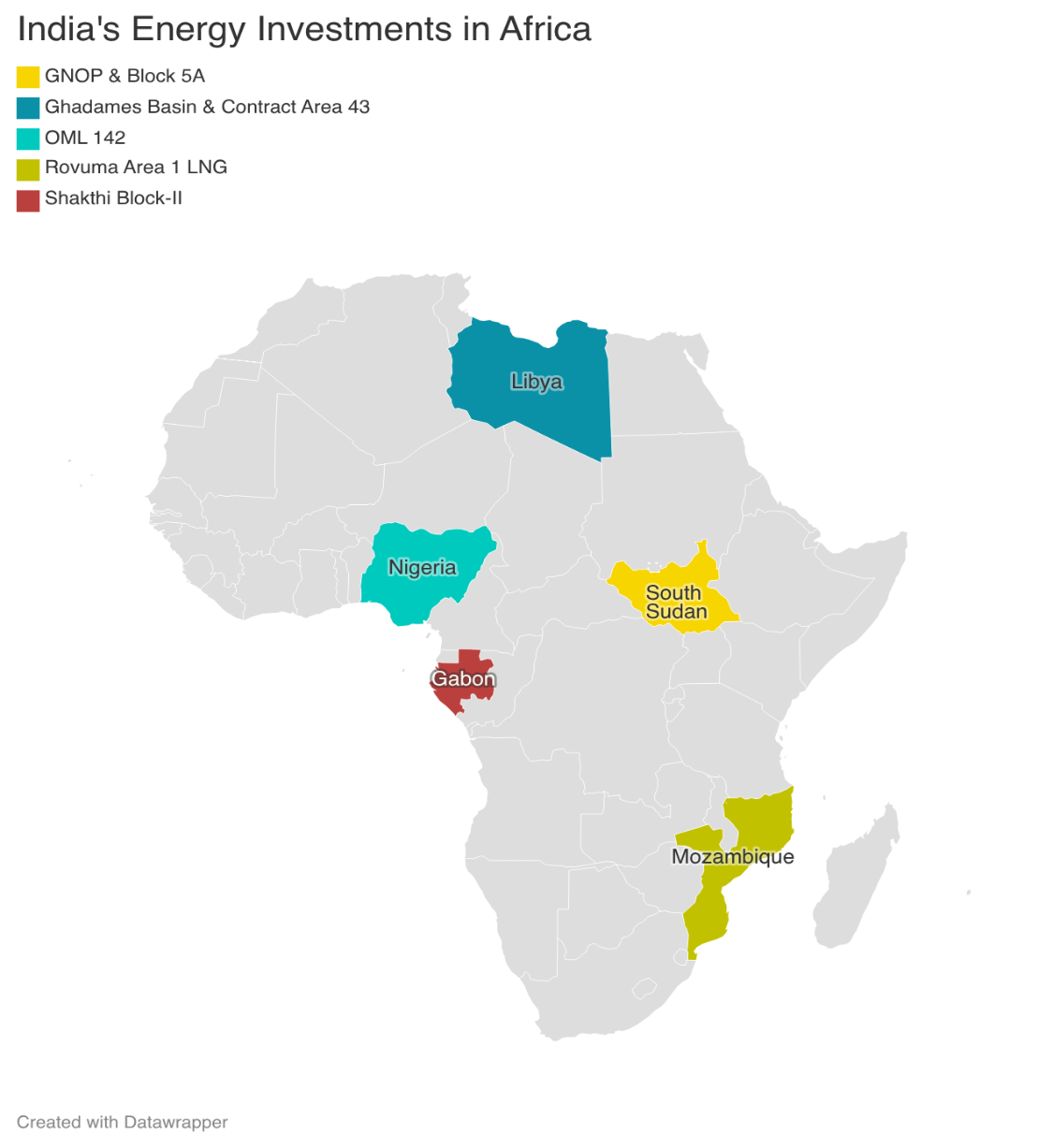
Source: ONGC Videsh (Libya
(Contract Area 43), Mozambique, South Sudan)
Oil India Limited (Gabon, Nigeria, Libya
(Ghadames
Basin)
- Gabon
Gabon reflects India’s long term frontier investment strategy. Oil India Ltd. (OIL) and Indian Oil Corporation Ltd. (IOCL) are exploring for oil in the Shakti Block, spanning 3761 square kilometers. The block is situated 150-180 kilometers southeast of Gabon's main city, Libreville. OIL is in Phase II of exploration, which is expected to go until 2020/23. Although oil has been noticed, the offshore and onshore blocks on west and south-western sides are more prolific.
- Libya
Despite years of political unrest, Libya has resurfaced as a key component of India’s energy diversification strategy. In 2007, ONGC Videsh purchased a 100% ownership in Contract Area 43 in the Cyrenaica Offshore Basin obtaining exploration rights over four offshore blocks totalling almost 7,449 square kilometres. Home to Africa’s largest proven crude reserves of nearly 48 billion barrels, Tripoli offers immense untapped hydrocarbon potential. Indian firms, including Oil India Limited and Indian Oil Corporation have revived upstream cooperation through exploration activities in Libya’s Ghadames Basin alongside SIPEX, a Sonatrach affiliate.
- Mozambique
Mozambique represents one of India’s most consequential natural gas investments abroad. Indian firms including Oil and Natural Gas Corporation (ONGC), Bharat Petroleum Corporation Ltd (BPCL) and Oil India Ltd collectively hold close to a 30% stake in Rovuma Area 1 LNG project among the world’s largest offshore natural gas discoveries.
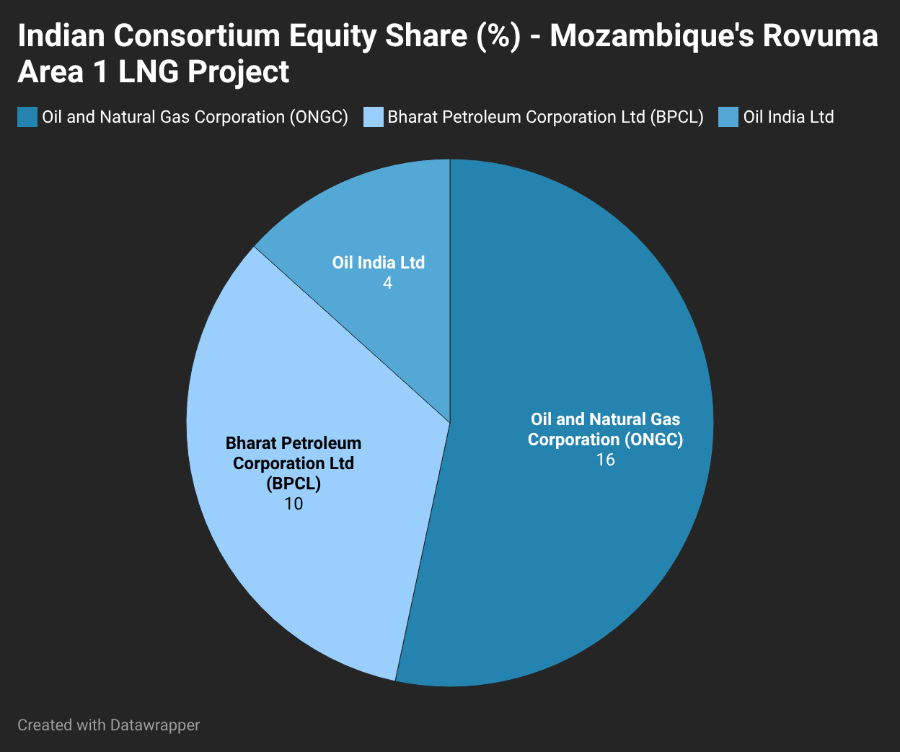
Image 1: Indian Consortium Equity Share (%) – Mozambique’s Rovuma Area 1 LNG Project
The basin contains nearly 75 trillion cubic feet (TCF) of recoverable natural gas reserves, positioning Mozambique as a future global LNG supplier. ONGC Videsh holds 16% interest in the Mozambique Rovuma Area-1 Offshore Project out of which 10% PI is held directly by ONGC Videsh and another 6% interest is held through its 60% shareholding in ‘Beas Rovuma Energy Mozambique Limited’ (“BREML”).
- Nigeria
Abuja has long served as one of India’s most important hydrocarbon partners in Africa. Nigeria possess proven crude oil reserves of over 37 billion barrels and natural gas reserves exceeding 200 trillion cubic feet making it one of Africa’s most energy rich economies. Nigeria supplies about 8-12% of India's crude oil consumption. Indian firms such as ONGC pursued trading and upstream investment opportunities in Nigeria's hydrocarbon sector, recognizing its strategic importance.
- South Sudan
The ONGC Videsh entered Soth Sudan’s Greater Nile Oil Project (GNOP) in 2003, acquiring a 25% participating interest in producing oil assets in the Muglad basin. Following South Sudan’s independence in 2011, parts of the project came under South Sudan and are jointly operated through the Greater Pioneer Operating Company (GPOC). OVL holds a 24.12% stake in Block 5A operated through the SUDD Petroleum Operating Company (SPOC). Together, GNOP and Block 5A remain among India’s most significant upstream oil investments in Africa. The country holds proven crude reserves estimated at nearly 3.5 billion barrels, while petroleum accounts for over 90% of government revenues.
India-Africa energy cooperation is evolving beyond hydrocarbons into clean energy transitions partnerships. India’s experience with the Pradhan Mantri Ujjawala Yojna (PMUY), which has delivered more than 10 crore LPG connections to low-income households, provides a scalable model for expanding clean cooking access across Africa. Similarly, India’s Ethanol Blended Petrol (EBP) Programme, which has target to achieve 20% ethanol blending ahead of schedule, demonstrates how large developing economies can reduce fossil fuel dependence while supporting agricultural livelihoods.
This partnership is being strengthened by the growing participation of African countries such as South Africa, Kenya, Uganda, and Tanzania in the Global Biofuels Alliance (GBA), which have high biofuel potential due to their vast agricultural base, which produces sugarcane, maize, jatropha, and cassava, indicating potential for second generation biofuel development. As geopolitical uncertainty persists in West Asia, Africa offers India an important avenue for diversifying energy supplies. Investments in African oil and gas assets help strengthen energy security and reduce dependence on traditional suppliers.
Disclaimer : Mr. Sairakshit Raghupathy is a Research Officer at the Deccan Centre for International Relations. The views expressed are those of the author and do not reflect the views of the Deccan Centre for International Relations.