
Advancing South India’s Global Agenda

Issue Brief No (05): Ports of Tamil Nadu & Andhra Pradesh as Geoeconomic Hubs: Implications on Trade Corridors, Supply Chains and Strategic Autonomy in the Indo-Pacific: Ms. Joshna Sri K V
BackIssue Brief No (05): Ports of Tamil Nadu & Andhra Pradesh as Geoeconomic Hubs: Implications on Trade Corridors, Supply Chains and Strategic Autonomy in the Indo-Pacific: Ms. Joshna Sri K V
Issue Brief No: 05 Ports of Tamil Nadu & Andhra
Pradesh as Geoeconomic Hubs: Implications on Trade Corridors, Supply Chains and Strategic Autonomy in the
Indo-Pacific
Author: Ms. Joshna Sri K V
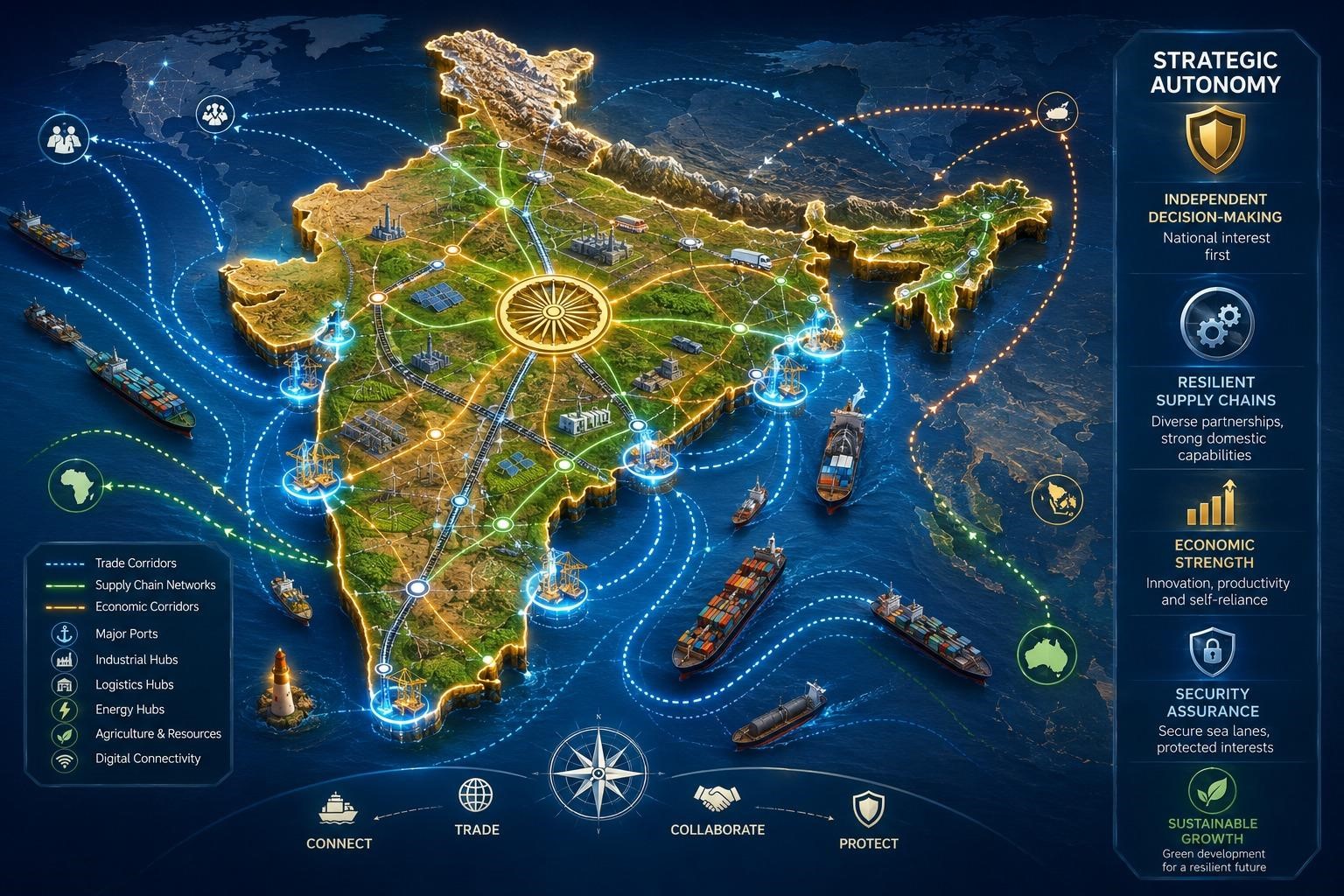
Abstract
The ports of Tamil Nadu and Andhra Pradesh are emerging geoeconomic hubs within India’s eastern coast. Over 80% of trade occurs via shipping routes, and maritime infrastructure plays a central role in global economic and strategic systems. The paper seeks to analyse their role in shaping trade corridors, increasing supply chain resilience, and strengthening India’s strategic autonomy in the Indo-Pacific. It focuses on key ports in India’s eastern region, such as the Chennai Port and Visakhapatnam Port, to analyse their development and the changing nature of global maritime trade, including post-COVID-19 reforms in supply chains and trade competitiveness.
The paper compares India’s eastern coast ports with the Port of Singapore, the Port of Colombo, the Port of Hambantota, and Kandla Port, one of India's western coast ports. This comparison highlights India’s position in global maritime trade and its influence in the Indo-Pacific region, and it highlights the main functional differences between manufacturing-biased ports and transit trade ports. The study identifies a significant research gap, as little research has been conducted on the functioning of regional and local ports within India. Therefore, the paper draws on empirical data, geoeconomics, trade routes, and policy opinions. India’s eastern coastline is connected to global markets. However, they are underutilised due to conventional buildings, limited transit trade capabilities, and the great power rivalry in the Indo-Pacific. Robust policy measures and sector-specific incentives are required to enhance India’s position in global maritime trade while protecting its strategic autonomy in the Indo-Pacific.
Keywords: Ports, Infrastructure, Indo-Pacific, Geoeconomics, Maritime Trade
1. Introduction
Globalisation can be defined as the linkage between economics and geopolitics commonly referred to as geoeconomics (Kurlantzick, 2016). Under geoeconomics, maritime trade becomes important to facilitate the global economy for production and manufacturing of goods. Hence, ports and docks also play a major role in maritime trade. Over 80% of maritime trade globally occurs through sea routes underlining the role of ports as geoeconomic hubs (UNCTAD, 2023).
UN Trade and Development indicate that Asia holds a major share of cargo throughput out of the 11.6 billion tons traded globally. It is expected to have steady growth in the coming decade (UNCTAD, 2023). Transit traffic also increased to 54% in 2023 because of high participation of Asian countries in trade. Asian countries provide influence, alliances and security in trade with India holding 95% of trade by volume and 70% of trade by value achieved by its strategic location and proximity to markets in Southeast Asia and East Asia (Indian Port Association, 2024; Notteboom & Rodrigue, 2005).
Before eastern ports gained recognition, India’s western coastline was highly integrated with Europe, the Middle East, and Africa. In this context, the Kandla port played a key role during that period. Now, the eastern coast ports such as Chennai and Visakhapatnam are close to the markets of Southeast Asia and East Asia. India’s eastern ports are the main hubs of the East Coast Economic Corridor (ECEC), a project funded by the Asian Development Bank and designed to integrate local industries with Southeast Asian trade links (ADB, 2018).
Though ports of Chennai and Visakhapatnam have great importance, they face structural challenges like limited technological advancement, limited transit capacities and competition for influence in the region (Indian Port Association, 2024; Sudan, 2022). Post COVID 19 period has exposed the realities of single source supply chains which made India opt for strategies like China+1 to improve its port efficiency and supply chain resilience (Indian Port Association, 2024).
Existing studies often tilt towards national goals without analysing the role of regional and local port activities in India (Medcalf, 2018). Though existing studies have limited comparison on coastal ports and global hubs, World Bank and UNCTAD show records on how to reduce logistics costs and increase trade competitiveness in the Indo-Pacific (UNCTAD, 2023). Finally, the paper analyses how these ports function as emerging geoeconomic hubs while strengthening trade connectivity, facilitating supply chain resilience and protecting India’s strategic autonomy in the Indo-Pacific.
Research Questions:
- How do the ports of Tamil Nadu and Andhra Pradesh emerge as geoeconomic hubs in the Indo-Pacific region?
- How do India’s eastern coast ports different from India’s western coast ports with regard to trade orientation, industrial integration and strategic importance?
- In what ways can Chennai and Visakhapatnam ports provide supply chain resilience, EXIM growth, and regional trade diversification in the post Covid 19 pandemic period?
- How can India reduce overreliance on foreign transshipment hubs through eastern coast maritime development?
- What challenges in governance, infrastructure and geopolitics limits India’s transformation of eastern coast ports to globally important and competitive maritime hubs?
Research Objectives:
- To analyse the role of ports in Tamil Nadu and Andhra Pradesh as emerging geoeconomic hubs in the Indo-Pacific.
- To analyse the functional differences between the ports of India’s eastern and western coasts.
- To compare the ports key global players like Singapore, Colombo, Hambantota, and Kandla to analyse port efficiency, trade connectivity and transit trade capabilities.
- To identify the challenges these ports face due to complex policies and procedures, as well as great power competition in the Indo-Pacific, that limit India's ability to transform from local gateways into key global players in trade.
- To analyse how India enhances supply chain resilience in the post-COVID-19 period by adopting diversification strategies.
Methodology
This study adopts a qualitative-comparative research design to analyse the role of ports in Tamil Nadu and Andhra Pradesh as emerging geoeconomic hubs in the Indo-Pacific. The paper depends on the collection of secondary data from official reports, such as, the Ministry of Ports, Shipping and Waterways, Indian Ports Association, Asian Development Bank (ADB), UNCTAD, Invest India, port authorities and scholarly literature on the topics of maritime geoeconomics and supply chain resilience. The comparative framework provides five indicators: cargo throughput, container handling capacity (TEUs), trade connectivity, industrial integrations and strategic importance in the Indo-Pacific region. Under India’s eastern coast ports, Chennai and Visakhapatnam are selected because of their location, their connections with industrial corridors and their increasing role in Indo-Pacific maritime trade. These two ports are comparatively analysed with the Kandla Port on India’s western coast and with key regional maritime sectors such as Singapore, Colombo and Hambantota. The paper adopts a geoeconomic lens to examine how they function as strategic assets by connecting industrial production, logistics networks, regional supply chains and maritime influence. The study also embeds policy analysis by examining the Sagarmala programme, the East Coast Economic Corridor (ECEC), the Visakhapatnam Chennai Industrial Corridor (VCIC), Tamil Nadu Ports Policy 2023, and Andhra Pradesh Maritime Policy 2024. The analysis demonstrates interpretive and policy oriented information focusing on maritime infrastructure, supply chain resilience, regional integration and India’s strategic autonomy in the Indo-Pacific region.
3. Literature review: Ports, Geoeconomics, and Strategic Autonomy
Ports are recognised as hubs for facilitating trade and transportation across air, sea, and land modes. A country’s ability to trade lies in its port efficiency, trade connectivity and transit trade capabilities (Notteboom and Rodrigue, 2005). Export-oriented ports often face high inventory and transportation costs, reducing their expected profits and investment returns. So ports can accelerate or inhibit development in a country (Notteboom and Rodrigue, 2005).
Ports should be strengthened to reduce the logistics costs by 20-30% and attracts foreign direct investment to the country (UNCTAD, 2023). India is a place of resource intensive and labour intensive sectors that relies on proper governance in shipping and transit schedules. In this case, port-led development remains essential for India to grow its influence in the Indo-Pacific (Sagarmala, 2026). Existing studies indicate that countries use port-led development as a strategy to build industry hubs, reduce transit times, and link domestic production with global trade routes (ADB, 2026). The Sagarmala initiative aims to modernise ports and connect terminals with key manufacturing and industrial zones and, logistics parks (Indian Port Association, 2024).
The East Coast Economic Corridor (ECEC) and the Visakhapatnam Chennai Industrial Corridor (VCIC) aims to improve the coastal ports and related trade routes (ADB, 2018; NICDC, 2010). The ECEC range from Kolkata to Tuticorin links multiple ports with inland road and rail links (ADB, 2026). The VCIC covers Visakhapatnam, Kakinada, Gangavaram, Chennai, Kamarajar, and Krishnapatnam and links local industries, MSMEs into global production areas (NICDC, 2010). India needs to reduce its reliance over foreign countries, single sources for transit of goods, and protect its autonomy. India should regain its power over intelligence, security and shipping routes. Ports such as Singapore, Colombo, Hambantota and Kandla are the main actors which India depends during peak seasons and high traffic periods which must be reduced for India to enhance its strategic power in maritime trade and of Indo-Pacific (Medcalf, 2022; Sudan, 2022; Verma, 2021).
Existing studies on geoeconomics often view ports as logistical infrastructure, not as strategic assets within global production networks and regional power competition. Theory of port regionalisation explains port modernisation to be viewed beyond cargo handling. They should be viewed as industrial logistics ecosystems connected with railways, freight corridors, warehousing systems and manufacturing hubs (Notteboom & Rodrigue, 2005). Similarly, studies on the Indo-Pacific region identifies maritime infrastructure as a strategic tool by which states pursue strategic autonomy, diversify their supply chains, and balance geopolitical competition. India’s eastern coast ports are instruments of regional integration, industrial relocation and maritime influence across the Bay of Bengal and Southeast Asia (Medcalf, 2018; J. Schöttli, 2026).
4. About the ports in Tamil Nadu and Andhra Pradesh
Chennai, largest container port, handles automobiles, bulk cargo and shipping units marking it as a critical entry point to Southeast Asia and East Asia (Indian Port Association, 2024). However, Kamarajar and V.O. Chidambaram ports also dominate Tamil Nadu’s ports, making the State an important shipping hub in the Indo-Pacific. These ports handled 145.38 MMT in the financial year 2023-24 due to standardised shipping containers, oil and gas trade, and exports of automobiles (Ministry of Ports, Shipping and Waterways, 2024). It accounts for a major share of Chennai's exports, contributing 30-40% to India’s automobile exports (Ministry of Ports, Shipping and Waterways, 2024). Its inland connections, such as road and rail links, particularly the Chennai-Sriperumbudur belt, allow it to be the largest car manufacturing centre in India. Nevertheless, the port relies on shipping goods overseas to markets such as the United States, Europe, and Southeast Asian countries (ADB, 2026).
The South Andhra Pradesh - North Tamil Nadu shipping region, which consists of Chennai, Kamarajar (Ennore), Kattupalli, and Krishnapatnam (Invest India, 2025). Ports such as Kamarajar and Kattupalli specialise in bulk cargo and automobile exports, with major automobile manufacturers such as Hyundai and Kia (Invest India, 2025). The Krishnapatnam port has space to berth the world’s largest ships, a gateway for containerised and unpackaged goods, connecting Andhra Pradesh’s inland connections to global markets. Hence, they form an interconnected network that links ports, industries, and logistics into a single arena within major East Coast trade routes (Invest India, 2025).
The Visakhapatnam port is one of India's technologically advanced ports and the largest port on the east coast (ADB, 2026). It is a multipurpose deep-water port and a major hub for the trade of iron ore, coal, petroleum products, and general cargo. It has a major hub for ship repair and shipbuilding, with the Hindustan Shipyard adjacent to this port (Invest India, 2025). Therefore, this port is a critical point for the mineral industries, including steel, power, and petrochemicals, in Andhra Pradesh and Telangana. The port system in Andhra Pradesh is chiefly served by the Visakhapatnam, Gangavaram, and Krishnapatnam ports, which handle bulk cargo and resource-oriented trade.
India attempts to modernise its coastal ports and reduce dependence on foreign countries and single source markets through East Coast Economic Corridor (ECEC), Visakhapatnam Chennai Industrial Corridor (VCIC) and the Sagarmala initiative so that ports are easily connected with global markets, enriched with required technology and influence in the Indo-Pacific (ADB, 2026; ET Edge, 2025).
Major hubs for electronics, textiles and equipment manufacturing units are present in Tamil Nadu and Andhra Pradesh because they are cost effective and feasible to global markets. This also denotes that Tamil Nadu and Andhra Pradesh can take risks in trade while having influence in the Indo-Pacific (Medcalf, 2023).
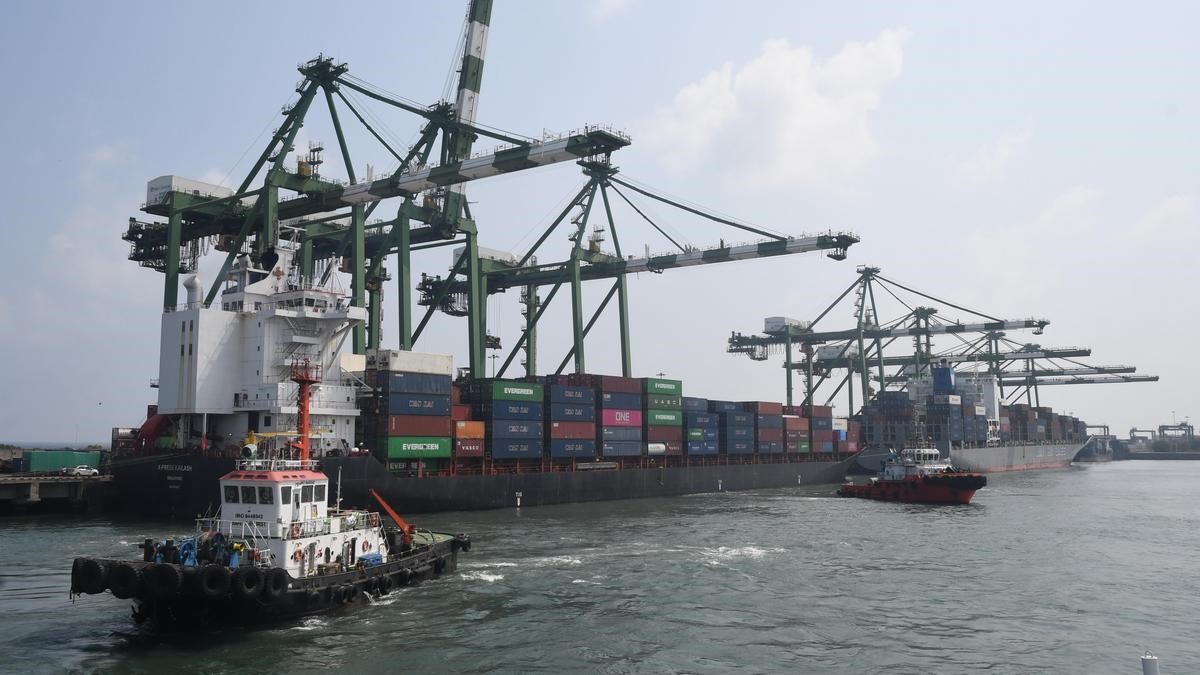
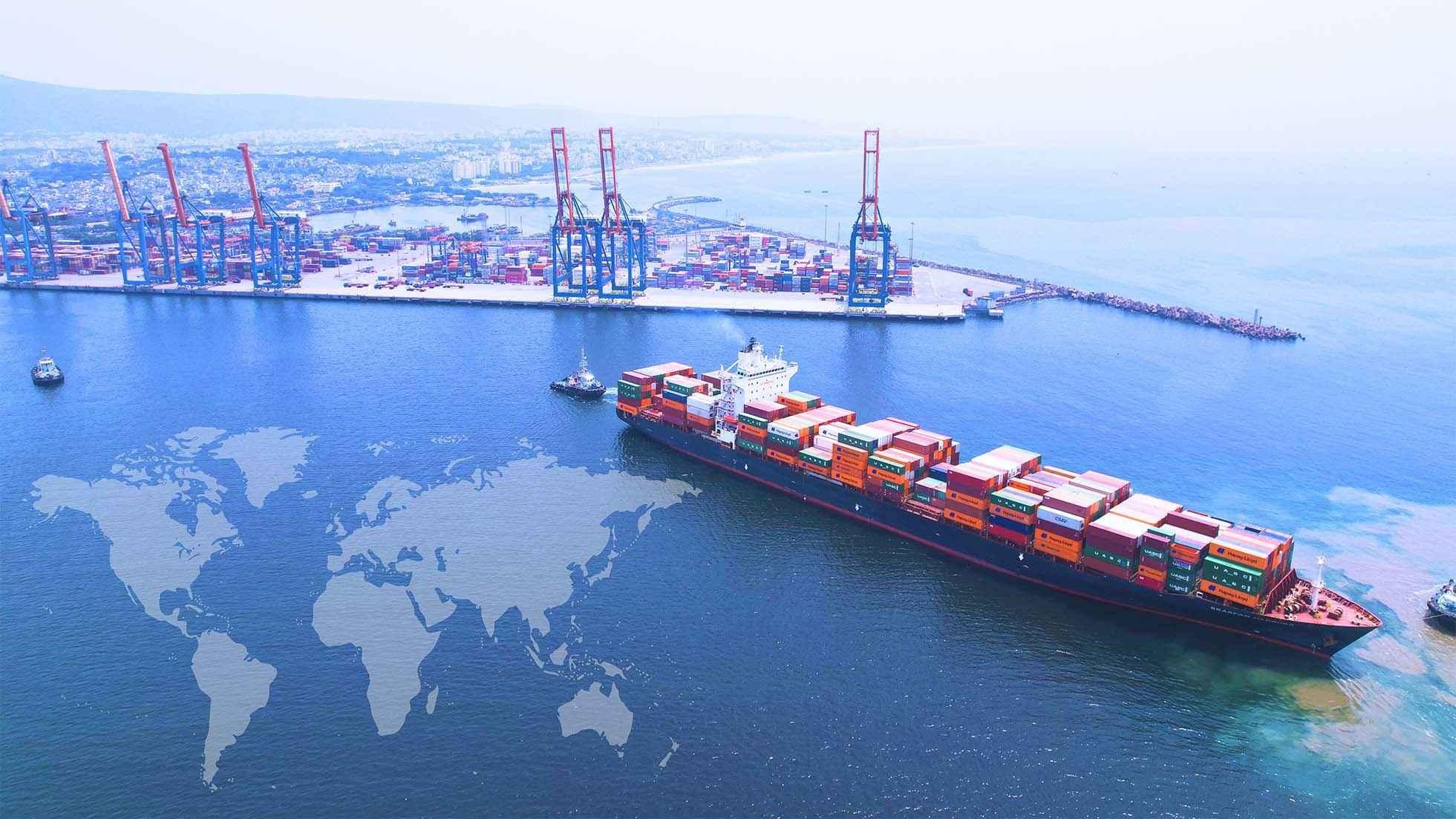
Figure 2. Chennai PortSource: The HinduFigure 3. Visakhapatnam PortSource: Visakhapatnam Port Authority
4.1 Visakhapatnam–Chennai Industrial Corridor (VCIC) and Factory-to-Port Connectivity
The Visakhapatnam Chennai Industrial Corridor (VCIC) represents India’s most important attempts to integrate its manufacturing hubs with maritime infrastructure through a model of factory to port development. As a major component of the East Coast Economic Corridor (ECEC), the VCIC connects the industrial centres in Tamil Nadu and Andhra Pradesh consisting of Visakhapatnam, Kakinada, Krishnapatnam, Chennai, Kamarajar and Kattupalli.
The VCIC helps in the improvement of multimodal logistics by the integration of ports with highways, dedicated freight systems, industrial nodes, warehousing facilities and rail connectivity. This method reduces cargo dwell time, transportation costs and turnaround delays while enhancing India’s export competitiveness. The VCIC benefits major hubs of India, particularly, automobiles, electronics, textiles, pharmaceuticals, petrochemicals, food processing concentrated across India’s eastern coasts. It also strengthened India’s posture in regional production networks by facilitating nearshoring and diversifying the supply chain in the post Covid 19 pandemic period. Multinational companies adopt China+1 strategies to seek locations with integrated logistics networks and a stable maritime access. In this sense, the VCIC provides a significant platform for maritime linked industries connecting domestic manufacturing hubs with Southeast Asian and East Asian markets. Traditional port development models mainly focus on cargo handling, while the VCIC focuses on promoting integrated port led industrial development where these ports dominate the growth of manufacturing, logistics services, employment generation and regional economic integration.
Table 1: VCIC linked sectors and corresponding port gateways
|
Sector |
Industrial hubs |
Port Gateways |
|
Electronics |
Chennai Sriperumbudur industrial belt, BIC-Papisal cluster |
Chennai Port, Kamarajar Port |
|
Automobiles |
Chennai Sriperumbudur industrial belt, Tirupati-Chittoor belt |
Chennai Port, Kamarajar Port |
|
Pharmaceuticals |
Visakhapatnam, Kakinada and Nellore |
Visakhapatnam Port, Kakinada Port |
|
Petrochemicals |
Visakhapatnam, Kakinada and industrial nodes in Andhra Pradesh’s coastal belt |
Visakhapatnam Port, Kakinada Port |
|
Textiles |
Tiruppur linked clusters, VCIC textile nodes |
Chennai Port, Kamarajar Port |
|
Food Processing |
Andhra Godavari Kaveri belt and industrial nodes |
Chennai Port, Krishnapatnam Port, Kakinada Port |
Source: Author’s own, using data from multiple sources
Table 1 presents sector specific port mapping by VCIC inserting export production and port handling into a single system.
4.2 EXIM Growth and Transshipment Potential
The development of India’s eastern coast ports has a significant impact on its own export import (EXIM) trade and transshipment capabilities. Today, a substantial amount of India’s container traffic is transported through foreign maritime hubs such as Colombo and Singapore due to limited domestic deep draft terminals, automation capacity and shipping connectivity. This increases their logistics costs, cargo delays and strategic dependence on external maritime hubs. India’s eastern coast ports should be strengthened to reduce the above dependencies by improving its own domestic transshipment network. Improved deep draft terminals, automated container systems and improved multimodal logistics could enable larger mother vessels to dock in directly at Indian ports rather than relying on foreign feeder routes through Singapore or Colombo.
India’s eastern coast ports also provide direct access to the Bay of Bengal sea routes linking ASEAN, Japan, South Korea and Pacific markets. This increases India’s EXIM trade efficiency by reducing diversion through western shipping routes and congestion related delays. As industrial production is increased across these ports, they can emerge as important gateways for containerised exports like automobiles, electronics, engineering goods, textiles and petrochemicals. As a result, this transformation could significantly reduce their vulnerabilities in external logistics and strengthen India’s competitiveness in the Indo-Pacific region.
4.3 Supply-Chain Resilience, Nearshoring, and Regional Integration
The Covid 19 pandemic has exposed the realities of concentrated single source supply chains and production systems which led the multinational companies to adopt diversification strategies such as China+1, nearshoring, and restructuring regional supply chains. This changing environment provides opportunities for India’s eastern coast ports to integrate manufacturing, logistics, and maritime trade within Indo-Pacific centric production networks. Tamil Nadu and Andhra Pradesh have strong industrial bases in automobiles, electronics, pharmaceuticals, textiles and petrochemicals. When these states are linked with efficient ports and industrial corridors, they create supply chains resilience capable of connecting with ASEAN and East Asian markets. Nearshoring strategies in India benefit its eastern coast ports due to lower operational costs, large labour force and geographical proximity to Southeast Asia. These ports should be integrated with logistics parks, industrial hubs, cold chain facilities and hinterland freight systems to improve supply chain resilience, capable flexibility and reduce transportation risks. This diversification also reduces over-concentration of cargo traffic on India’s western coast ports while improving its resilience against disruptions in global shipping routes. Therefore, ports in Tamil Nadu and Andhra Pradesh should be viewed as integrated supply chain ecosystems for regional economic integration and trade resilience in the Indo-Pacific region.
4.4 Port-Led Industrial Clusters and Employment Generation
Port led industrial development contributes to regional employment generation and urban industrial development. Industrial hubs around Chennai, Ennore, Kattupalli, Visakhapatnam and Krishnapatnam have generated employment opportunities across major hubs like manufacturing, logistics, warehousing, transportation, ship repair and ancillary services. The manufacturing ecosystem of automobiles and electronics around Chennai and Sriperumbudur demonstrates how port connectivity could attract investments from multinational firms and export oriented industries. Similarly, industrial development around Visakhapatnam region supports the petrochemical industries, steel production, shipbuilding and logistics services. These industry-port connectivities create multiplier effects across MSME sectors, construction, services and transport. Port led clusters enhance the development of logistics parks around port linked industries, facilitate the development of cold storage systems, freight corridors, and digital trade infrastructure while increasing regional competitiveness and labour absorption. Consequently, the development of maritime infrastructure contributes to trade expansion, employment generation, industrial diversification and regional economic growth.
4.5 Policy Push: Tamil Nadu Ports Policy 2023 and Andhra Pradesh Maritime Policy 2024
Recently, Tamil Nadu and Andhra Pradesh have made policy initiatives around the maritime sector indicating enhanced state level emphasis on maritime led economic development. The Tamil Nadu Ports Policy 2023 emphasises port modernisation, private sector participation, logistics integration, green port development and expansion of container handling infrastructure. This policy also aims to improve connectivity between ports and industrial corridors, while reinforcing export oriented manufacturing ecosystems.
Similarly, the Andhra Pradesh Maritime Policy 2024 emphasises port led industrial development, multimodal logistics integration, coastal economic zones and investments for deep draft infrastructure. This policy seeks to position ports in Andhra Pradesh as major gateways in maritime trade on India’s eastern coast ports by strengthening connectivity between ports, industrial nodes and inland freight systems. These two policies advantage national goals and initiatives such as the Sagarmala programme and PM Gati Shakti aligning India’s Indo-Pacific objectives on trade and connectivity. This increasing coordination between state level industrial policies and maritime infrastructure strategies demonstrate a transition from isolated port expansion into an integrated geoeconomic planning.
5. Comparative analysis
Table 2: Comparative assessment of India’s coastal ports with global maritime hubs - Singapore, Colombo, Hambantota
|
Port |
Cargo Throughput |
Container Throughput (TEUs) |
Main Trade Type |
Corridor Linkages |
|
Chennai, Tamil Nadu |
57.9 MMT (FY 2025–26) |
1.94 million TEUs (FY 2025-26) |
Automobiles, engineering goods, containers, and electronics |
VCIC, ECEC, Chennai–Sriperumbudur industrial belt, Sagarmala |
|
Visakhapatnam, Andhra Pradesh |
91.17 MMT (FY 2025–26) |
0.67 million TEUs (FY 2025-26) |
Iron ore, coal, petroleum products, containers, and bulk cargo |
VCIC, ECEC, Sagarmala, industrial clusters of Andhra Pradesh and Telangana |
|
Kandla, Gujarat |
160.11 MMT (Year 2025 estimate ) |
60,708 TEUs (October 2025 estimate) |
Crude oil, petroleum products, fertilisers, and bulk cargo |
Delhi–Mumbai Industrial Corridor (DMIC), Western Freight Corridor |
|
Port of Singapore |
3.22 billion GT (Year 2025 estimate) |
44.66 million TEUs (Year 2025 estimate) |
Global transshipment, containers, petroleum, and high-value cargo |
ASEAN maritime networks, Belt and Road connectivity, global shipping alliances |
|
Port of Colombo, Sri Lanka |
~32 MMT (approx.) |
8.29 million TEUs (Year 2025 estimate) |
Transshipment containers, and regional feeder traffic |
Bay of Bengal shipping routes, India–Sri Lanka maritime links |
|
Port of Hambantota, Sri Lanka |
8.24 MMT (Year 2025 estimate) |
13,260 TEUs (April 2026 estimate) |
Vehicle transshipment, bulk cargo, and logistics services |
Belt and Road Initiative (BRI), Indian Ocean shipping routes |
Source: Author’s own, using data from multiple sources
Table 2 presents a direct comparison of India’s eastern coast ports with other key players in the Indo-Pacific such as Singapore, Colombo, Hambantota and Kandla ports across various parameters.
5.1 Ports of Chennai and Visakhapatnam vs Kandla Port
India’s western coast ports had served Europe, the Middle East and Africa (UNCTAD, 2023). The Kandla port, one of the oldest major ports of India, handles unpackaged goods, unrefined oil and transit trade traffic, showing its key role in India’s maritime trade globally. This port benefits from rail connectivity via the Western Freight rail link, which also connects to Gujarat’s industrial belt and to the mainland via road and rail links (ET Edge, 2025). Being managed by the Deendayal Port Authority, this port handles about 131 MMT for the financial year 2023-24 (Deendayal Port Authority, 2024; Maritime Gateway, 2024).
The comparative analysis of these ports highlights differences in their working and operation of maritime trade. Tamil Nadu ports indicate improved growth rates in trade because of its manufacturing sectors (Chennai Port Authority, 2024; Visakhapatnam Port Authority, 2024). In this context, the Chennai Port handles about 1.59 MMT of cargo in the financial year 2023-24 and up to 1.83 MMT in the financial year 2024-25. This highlights their importance as the largest container ports after Mundra and Nhava Sheva (JNPT) (Chennai Port Authority, 2024; Sagar Sandesh, 2026).
The Kandla port handles bulk cargo like oil, gas, and raw materials. It is also a transit trade hub in western coastline of India. While the western coast ports handle resources, the eastern coast ports handle manufacturing and manufacturing related trade (ET Edge, 2025). India relies on both the coastlines having its geostrategic location to connect with global markets. However, this also allows the coastlines to trade risks (ET Edge, 2025). This port is under the Gujarat Delhi Mumbai Industrial Corridor, becoming an important sea mode for transit of cargo (ET Edge, 2025). Likewise, India is under the India Middle East Europe Economic Corridor (IMEC) which also enhances India’s connection with global markets (PwC, 2023). On the contrary, the ports of Chennai and Visakhapatnam also play a dominant role in India’s Indo-Pacific strategy as car manufacturing hubs, agricultural commodity exporters, and electronics hubs with ASEAN-centric supply chains (Medcalf, 2023).
5.2 Chennai and Visakhapatnam vs Singapore, Colombo and Hambantota
The Port of Singapore is known for its efficiency and connectivity in global maritime trade. sets the global benchmark for efficiency and connectivity. The Singapore port reached about 39.01 million TEUs of container throughput in 2023, an increase of 4.6% compared to the previous year (Port Technology, 2024; SBR, 2024). These minor differences in Chennai’s maritime trade output up to 1.8 million TEUs and Visakhapatnam port to approximately 0.67 million TEUs demonstrate Singapore’s role as a leading transit hub in the world. The Port of Singapore has deep draft terminals for the dockage of large vessels, advanced technology, and reliable shipping alliances (Notteboom & Rodrigue, 2005).
From a geoeconomic standpoint, the Port of Singapore holds dominance over decisions on shipping routes, tariffs, and maritime security cooperation in the Indo-Pacific (Medcalf, 2018). India’s eastern coast ports remain production-oriented hubs with a limited share of regional transit. With the global competition, Chennai and Visakhapatnam ports raise India’s maritime trade output. Still, they must also improve their terminal timings for both departures and arrivals, automation levels, and digital governance structures to attract shipping alliances and intra-Asian transit business (ADB, 2018).
Colombo has a geostrategic location handling 6.95 MMT in 2023 and 83% of traffic in its port (Daily Mirror, 2024). This is noticed because India diverts most of its cargo to Colombo because its ports are not facilitated with reliable space for dockage and the necessary technology utilisation to achieve its objectives. The location of Colombo and its shipping routes have proper frequency, connectivity and efficient management (Verma, 2021). India’s reliance on Colombo gives efficient port management, increases costs, creates less control for India to its own shipping routes, security inspections and intelligence sharing. It allows India to have leverage on politics and economy by external actors, including Chinese and Western investors involved in Colombo’s port‑development and management (Sudan, 2022; Medcalf, 2023). If Colombo faces uncertainty, it directly affects India’s trade. This underlines the need to transform ports of Tamil Nadu, that is, Chennai and Visakhapatnam into reliable transit hubs having meaningful share in transit traffic at all seasons (ADB, 2018).
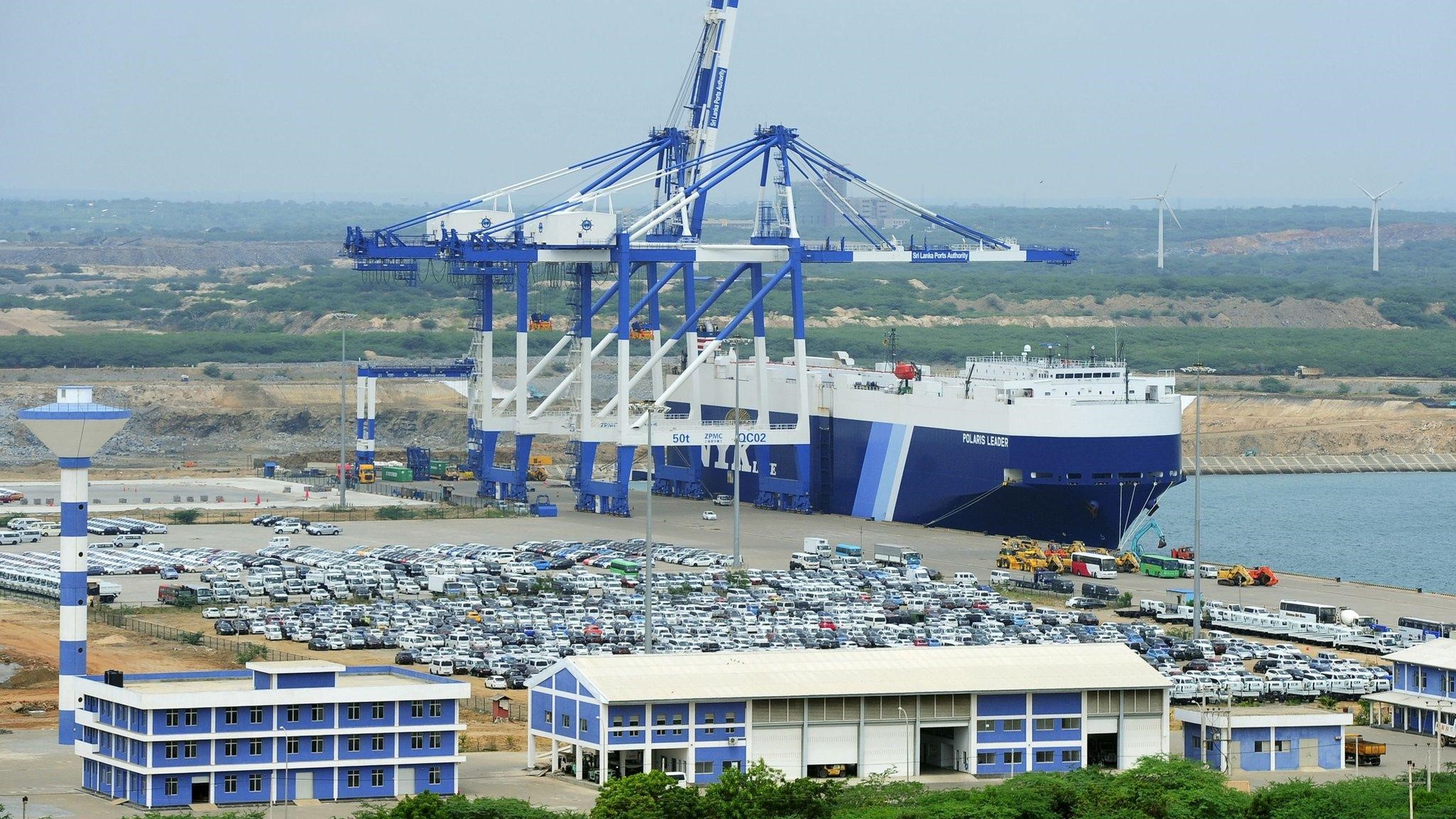
Figure 4. Hambantota PortSource: BBC
The Port of Hambantota has fluctuating development due to global politics, Chinese dominance and debt burdens. The 99 year lease agreement between China and Hambantota reflects China’s dominance, reduces trade to Hambantota for many years, and ongoing tensions in the region (World Bank, 2020). It also generates doubts in India’s foreign relations and questions her maritime trade (Medcalf, 2023). Though the port faces these problems, it has achieved significant growth in 2025. Estimates indicate an increase of 5.43 MMT in 2025 compared to 0.66 MMT in 2024 with total cargo up to 8.24 MMT in 2025 (ASL, 2025).
On the contrary, India’s eastern ports are governed by state and local governments, reducing the risk of external ownership. India could acquire valuable lessons from Hambantota’s development, such as the deep-draft terminals, which could increase investment and marketing for India in the Indo-Pacific. However, growth can be sustained only when there is honest and transparent financial management, robust governance mechanisms, and the ability to handle different cargo types (World Bank, 2020; ASL, 2025).
6. Challenges and Policy Implications
6.1 Infrastructure and Governance Challenges
These ports had to seek external assistance when there is not enough space for dockage affecting their operation at peak seasons and high traffic periods. Though the VCIC and ECEC connect inland connections to ports and ports with global markets, they remain uneven and gaps exist in trade connectivity, warehousing and logistics (ET Edge, 2025). The paper identifies that these ports have complex procedures and overlapping jurisdictions which shows project delays and land ownership constraints (Indian Port Association, 2024).
6.2 Geoeconomic Competition and Strategic Dependencies
Eastern coast ports of India are affected by great-power rivalries, in which the Indo-Pacific region has become a site of project competition. China controls Hambantota and Kyaukpyu ports. Likewise, Japan and the United States seek to expand their regional influence in the Indo-Pacific through initiatives such as the QUAD. In this context, India’s efforts to enhance its influence in the Indo-Pacific are hampered by imbalances in foreign direct investment, technology, and governance, underscoring the need for greater strategic autonomy over ports along India's eastern coast.
Another key concern is the reliance on foreign countries in trade and shipping. India conducts containerised transit trade through routes to Singapore, Colombo and Hambantota, which enhances its influence on shipping routes, tariffs, and information technology practices, thereby gaining influence in the Indo-Pacific (J. Schöttli, 2026). During peak seasons and crisis periods, foreign countries use choke points or employ other measures, such as rules for customs clearance, maritime security inspection practices, and timing restrictions on terminal arrival and departure for vessels, thereby indirectly affecting India’s trade. This issue demonstrates that India should have alternatives to Singapore, Colombo and Hambantota for transit, to retain control in its own hands.
6.3 Post‑Pandemic Supply‑Chain Resilience and China+1
Post COVID 19 period has exposed the realities of single source supply chains which made India opt for strategies like China+1 to improve its port efficiency and supply chain resilience (Indian Port Association, 2024). India attempted this through the China+1 strategy, which encourages multinational companies to expand their operations or relocate to the country, thereby building a strong presence linked to maritime infrastructure, such as industries and sector-specific hubs. With this note, the ports in Tamil Nadu and Andhra Pradesh, particularly Chennai and Visakhapatnam, offer significant advantages for these firms in terms of relocating or expanding their businesses (NICDC, 2010; ADB, 2026).
Multinational companies adopting this China+1 strategy might face sensitivities regarding port management and efficiency, connectivity to local road and rail links, and policy continuity. Traffic in ports due to vessel accumulation, security issues, regulatory practices, and forecasting might affect investment flows in India. India’s eastern coast ports should be viewed as strategic assets to defend geopolitical competition in areas of manufacturing, logistics, supply chains, and businesses intended for relocations and expansions (Medcalf, 2026). India should mend ways for industrial development around Chennai and Visakhapatnam that can be achieved by sector specific incentives and proper regulatory frameworks, to balance India’s position in the Indo-Pacific.
6.4 Strategic Autonomy and the Indo-Pacific Maritime Order
India’s eastern coast ports highly contribute to its strategic autonomy by reducing heavy dependence on external maritime hubs and strengthening independent operational capacity for India in the Indo-Pacific region. Strategic autonomy not only refers to military independence but also the ability to pursue the maintenance of secure trade routes, supply chains resilience, autonomous logistics systems and reliable industrial connectivity without overreliance on foreign controlled infrastructure. Chennai and Visakhapatnam are equipped with strategic positions in the Bay of Bengal maritime corridor and connect India with ASEAN, East Asia, and the Indo-Pacific. Their proximity to Southeast Asia enabled India to diversify from overreliance on western maritime routes passing through Arabian Sea and major transshipment hubs like Singapore, Colombo and Hambantota.
This increases India’s flexibility in maritime trade while reducing exposure to critical choke points and geopolitical disruptions. Additionally, the Port of Visakhpatnam is embedded with strategic military significance due to the presence of the Eastern Naval Command of the Indian Navy. To strengthen India’s maritime domain awareness and logistics preparedness in the Bay of Bengal, the integration of naval infrastructure, shipbuilding facilities and commercial port operations are necessary around India’s eastern coast ports. Therefore, they function as a commercial gateway and a strategic maritime asset.
The Indo-Pacific strategy by India includes the Act East Policy and India’s participation in the QUAD framework, while increasing the significance of eastern coast ports. With the connectivity projects, maritime cooperation, and supply chain resilience initiatives, these ports support engagement of India with Japan, Australia, ASEAN states and the United States. The QUAD emphasises supply chain resilience, trusted logistics networks, and critical infrastructure that directly aligns with the development of industrial maritime corridors such as the VCIC & ECEC. Development of eastern coast ports is not only an economic initiative but also a part of India’s long term geostrategic effort to stregnthen its maritime influence, regional integration, and strategic autonomy in the Indo-Pacific. Consequently, the development of India’s eastern coast ports should be understood as part of India’s long term geostrategic efforts to reinforce maritime influence, strategic autonomy and regional integration in the Indo-Pacific.
7. Policy Recommendations for Strengthening Geoeconomic Hubs
The below set of policy recommendations are identified by analysing the activities of the ports in Tamil Nadu and Andhra Pradesh to help India’s transformation into key geoeconomic hubs.
7.1 Infrastructure and Connectivity Upgrades
Expansion of deep draft terminals for the dockage of large vessels to reduce transit trade traffic in these ports. The states should also adopt and enhance automation mechanisms to handle containers at each terminal. The paper also suggests using technology-based management tools to address issues efficiently through digital methods in Chennai and Visakhapatnam (ADB, 2018; Indian Port Association, 2024). Therefore, adopting modernised port infrastructure to improve management and efficiency increases India’s influence in the Indo-Pacific. The economic and industrial corridors, like the Visakhapatnam Chennai Industrial Corridor and the East Coast Economic Corridor, should link inland connections, such as the road and rail links, to these ports, generating proximity to Southeast Asian and East Asian markets. It gives transit links and spaces for containers in inland areas, which strengthens multichannel trade connectivity in the Indo-Pacific (ET Edge, 2025). This also allows the ports to set up logistics parks and supply chains with attached warehouses, transport sectors and cold chains to reduce time and costs (NICDC, 2010).
7.2 Port‑Led Industrial Development and Governance Reform
Robust and clear customs clearance and digital platforms should be present in eastern coast ports (ADB, 2018; Invest India, 2025). Chennai and Visakhapatnam port should have robust customs clearance protocols and digitalised platforms for trade in the Indo-Pacific which expands industrial zones around ports in the eastern coastline of India. (ADB, 2026; Invest India, 2025).
The port authorities and state governments must have a coordinated framework for the VCIC & ECEC regions, with clear rules and regulations to assess environmental and social issues, their impacts in the region, and robust procedures for land ownership. The port authorities should oversee governance mechanisms and land-ownership procedures by integrating this framework across the Indo-Pacific and India’s eastern coast. This can be achieved through robust, smooth mechanisms, as these ports can increase their influence in the region and enhance India’s strategic autonomy. Supply chain and trade connectivity can be strengthened with the investment from private companies and public private partnerships which supports the creation of digital platforms and customs clearance protocols in ports allowing India to have control over its critical nodes (Indian Port Association, 2024; Medcalf, 2023).
7.3 Enhancing Supply‑Chain Resilience and Strategic Autonomy
India’s eastern coast ports should increase its dockage area and improve its governance procedures to enhance its image in maritime trade. This allows India’s eastern coast ports to form shipping alliances and reduce their dependence on the ports of Singapore, Colombo, Hambantota and Kandla for transit trade during peak seasons or high traffic. Ports should adopt these alternatives to reduce their dependence on key global players such as Singapore, Colombo, Hambantota and Kandla, thereby lowering costs and improving financial management (Sudan, 2022). The eastern coast ports should be involved in multilateral initiatives and connect India with supply chain resilience-based networks. These ports should also participate in multilateral initiatives which increases their security in the supply chain and logistics, facilitates trade, and improves standards at eastern coast ports, for example, through QUAD and ASEAN dialogues (Verma, 2021). Security and awareness systems must be reinforced with updated software and technology across surveillance, intelligence sharing, and port security procedures at the ports of Chennai and Visakhapatnam. This protects port infrastructure from physical threats and cyber threats, such as coercion, sabotage, and cyberattacks (Verma, 2021).
7.4 Policy‑Cohesion Between Industrial and Maritime Agendas
Central government authorities, such as the Ministry of Ports, Shipping and Waterways, Census Operations and Ministry of Commerce and Industry, should coordinate on the national roadways map to achieve India’s policy-related goals in foreign affairs and industry (Verma, 2021). Roadmaps for each sector should be created to connect production outlines with port abilities and logistics standards. An integrative network is built around maritime trade and industries, shaping India's maritime development. This also ensures that trade-related investments made in Chennai and Visakhapatnam yield profits in terms of trade volume, employment, and India’s strategic autonomy (Medcalf, 2023).
8. Conclusion
Ports of Tamil Nadu and Andhra Pradesh are transforming into geoeconomic hubs within the Indo-Pacific rather than being local gateways to connect with global markets. These ports gain importance and their value extends beyond cargo handling, and function as strategic nodes connecting manufacturing hubs, industrial corridors, multimodal logistics systems and local supply chains. The study demonstrates that India’s eastern coast ports differ structurally from India’s western coast ports. India’s western coast ports are highly associated with energy imports and transit trade serving Europe and the Middle East, while India’s eastern coast ports are associated with manufacturing exports, industrial integration and Bay of Bengal connectivity with markets in Southeast Asia and East Asia. The Visakhapatnam Chennai Industrial Corridor and the East Coast Economic Corridor reinforce factory to port efficiency by integrating industrial production with maritime infrastructure. The paper argues that India’s eastern coast ports contribute to its strategic autonomy by reducing overereliance on foreign transshipment hubs such as Singapore, Colombo and Hambantota while aligning with Act East policy and Indo-Pacific strategies. Their importance is extended to supply chain diversification trends, nearshoring strategies and increasing importance of resilient maritime logistics post Covid 19 pandemic. However, infrastructure gaps, governance inefficiency, technological challenges and geopolitical competition, constrains their transformation to globally important and competitive maritime hubs. An integrated policy framework, modernisation of logistics infrastructure, governance reforms and deeper regional connectivity with ASEAN and Indo-Pacific partners are necessary to address their challenges. Ultimately, India’s eastern coast ports are not only infrastructure projects but also a part of India’s broader geoeconomic and strategic transformation in the Indo-Pacific maritime order.
9. References
Asian Development Bank (2019, April 16). ADB Annual Report 2018. Retrieved April 20, 2026, from https://www.adb.org/documents/adb-annual-report-2018
Asian Development Bank (n.d.). India : Visakhapatnam-Chennai Industrial Corridor Development Program - Project 1. https://www.adb.org/projects/48434-003/main
Asia Society Policy Institute (n.d.). Strengthening Regional Supply Chain Resiliency Through the Indo-Pacific Economic Framework (IPEF). https://asiasociety.org/policy-institute/strengthening-regional-supply-chain-resiliency-through-indo-pacific-economic-framework-ipef
Accuracy Shipping Limited (n.d.). Hambantota Port Container Volumes Surge 705% in 2025, Capacity Expansion Underway. https://www.aslindia.net/newsletters/hambantota-port-container-volumes-surge-705-in-2025-capacity-expansion-underway
Chennai Port Authority, Government of India (n.d.). Annual Accounts & Administration Report of Chennai Port Trust. https://chennaiport.gov.in/api/static/default/inner_content/ar25%20english.pdf
Daily Mirror (n.d.). Colombo Port sets new transshipment mark with 6.31mn TEUs in 2024. Daily Mirror Online. https://www.dailymirror.lk/business-main/Colombo-Port-sets-new-transshipment-mark-with-6-31mn-TEUs-in-2024/245-300532
Deendayal Port Authority, Government of India (n.d.). Administration Report 2024-25. Deendayal Port Authority. https://www.deendayalport.gov.in/wp-content/uploads/2025/12/Annual-Administrative-Report2025-edp.pdf
ET Edge (n.d.). India’s economic corridors: A logistics perspective. ET Edge Insights. https://etedge-insights.com/industry/logistics/indias-economic-corridors-a-logistics-perspective/?amp=1
Indian Ports Association, Government of India (n.d.). Indian maritime trade and port performance report 2024. Indian Ports Association. http://www.ipa.nic.in/index1.cshtml?lsid=69
Kurlantzick, J. (2016). State capitalism: How the return of statism is transforming the world by Joshua Kurlantzick, Senior Fellow for Southeast Asia, Council on Foreign Relations. Council on Foreign Relations.
Maritime Gateway (n.d.). Cargo throughput at major ports increases a notch higher by 6% in May 2024. https://www.maritimegateway.com/cargo-throughput-at-major-ports-increases-a-notch-higher-by-6-in-may-2024/
Medcalf, R. (2017). Reimagining Asia: From Asia-Pacific to Indo-Pacific. In International relations and Asia’s southern tier: ASEAN, Australia, and India (pp. 9-28). Singapore: Springer Singapore.
Medcalf, R. (2022). Contest for the Indo-Pacific: Why China won't map the future. La Trobe University Press.
Medcalf, R. (2025). The Indo-Pacific as strategic imagination.
Ministry of Ports, Shipping and Waterways, Government of India (n.d.). Annual Report 2023-24. Ministry of Ports, Shipping and Waterways. https://www.shipmin.gov.in/sites/default/files/Annual%20Report%202023-24_English.pdf
NICDC, Government of India (n.d.). Vizag-Chennai Industrial Corridor (VCIC). NICDC. https://nicdc.in/projects/national-industrial-corridor-development-programme/vizag-chennai-industrial-corridor-vcic
Notteboom*, T. E., & Rodrigue, J. P. (2005). Port regionalization: towards a new phase in port development. Maritime Policy & Management, 32(3), 297-313.
Port Technology International (n.d.). Port of Singapore enjoys record container throughput in 2023. https://www.porttechnology.org/port-of-singapore-enjoys-record-container-throughput-in-2023/
PwC India (n.d.). The India-Middle East-Europe Economic Corridor – paving a new path for global trade. https://www.pwc.in/assets/pdfs/india-middle-east-europe-economic-corridor.pdf
Ministry of Ports, Shipping and Waterways, Government of India (n.d.). Sagarmala. Ministry of Ports, Shipping and Waterways. https://shipmin.gov.in/en/division/sagarmala
Singapore Business Review (n.d.). Singapore port container throughput soars to 16.90 million TEUs in 5M 2024. https://sbr.com.sg/shipping-marine/news/singapore-port-container-throughput-soars-1690-million-teus-in-5m-2024
Schottli, J. (2026). India’s limited hard balancing and strategic autonomy in the Indian Ocean and Indo-Pacific, post-Galwan. Asian Security, 1-19.
UN Trade and Development (n.d.). Review of Maritime Transport 2023. UNCTAD. https://unctad.org/system/files/official-document/rmt2023_en.pdf
Verma, A. (2021). India’s dependence on Colombo Port and regional maritime logistics. Observer Research Foundation.
Visakhapatnam Port Authority, Government of India (n.d.). 2024-25 Administration Report, Annual Accounts and Audit Report. Visakhapatnam Port Authority. https://vpt.shipping.gov.in/admin_assets/uploads/1772086657_Admin_Report_202425_english.pdf
World Bank (n.d.). Sri Lanka Development Update, Opening upto the Future. https://documents1.worldbank.org/curated/en/099654510092428580/pdf/IDU-d5aa8c92-ec43-44c8-b75b-7ddf3456747e.pdf
Disclaimer: Joshna Sri K V is a Research Intern at the Deccan Centre for International Relations and is currently a postgraduate student at Women's Christian College, Chennai. The views expressed in the article are those of the author and do not reflect the views of the Deccan Centre for International Relations.