Advancing South India’s Global Agenda
Thoothukudi: Reshaping and Imagining Palk Straits: Sripathi Narayanan, Ph.D.
BackThoothukudi: Reshaping and Imagining Palk Straits: Sripathi Narayanan, Ph.D.
Thoothukudi: Reshaping and Imagining Palk Straits
Author: Sripathi Narayanan, Ph.D.
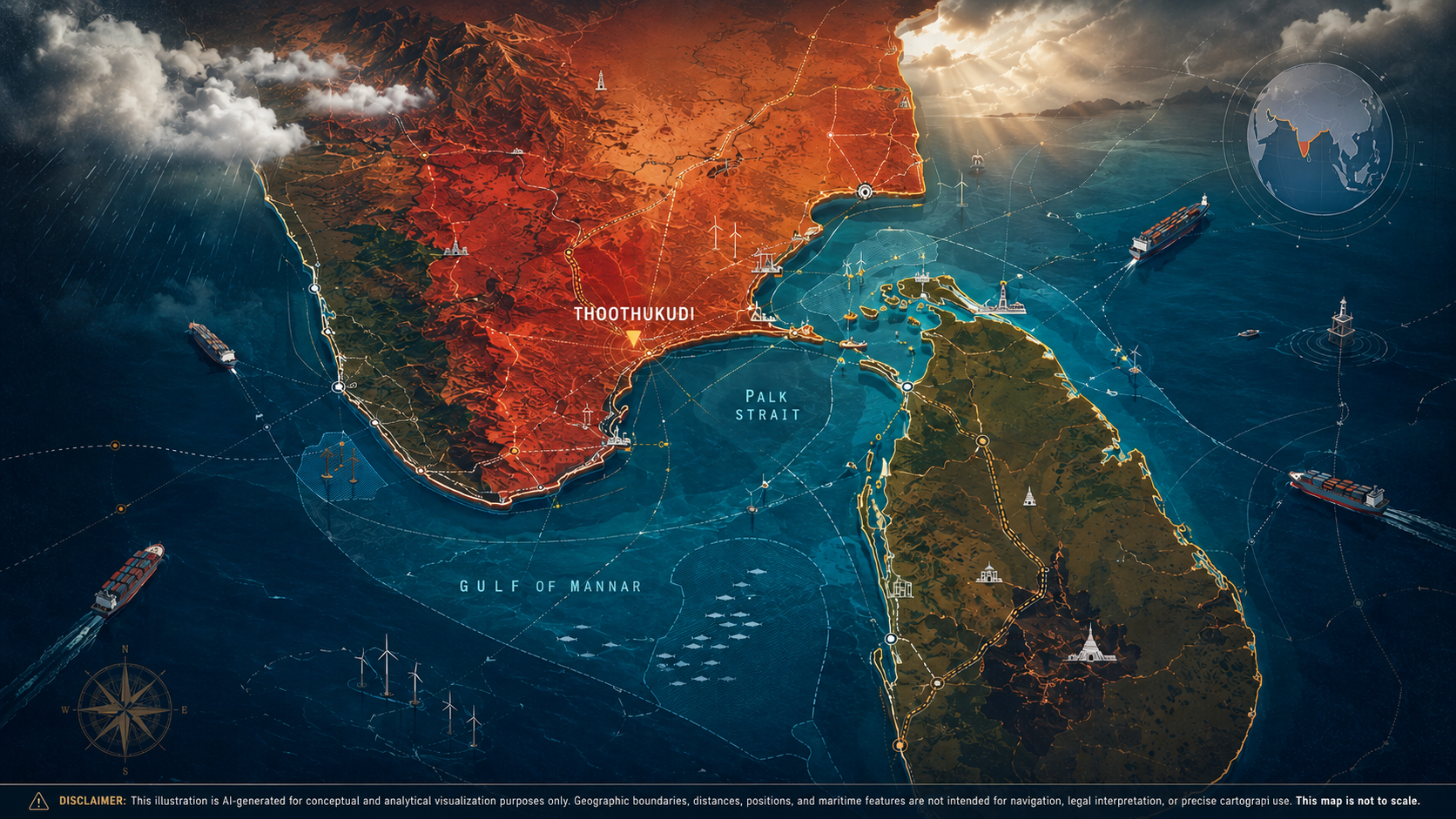
Any discourse on the Indian Ocean over the past few years tend to be steered towards a larger geostrategic power posturing. As a consequence the vastness of the world’s third largest water body and by far the most critical maritime economic corridors is reduced to a few specific points on the map. This myopic narrative also leaves by the wayside the dynamics and history of the many sub-regions of the Indian Ocean Region, beginning with the Palk Straits that separates continental/ peninsular India with the island nation of Sri Lanka.
This narrow sliver of water, since time immemorial has been a crucial waterway, which its historical ports of Korkai and Tondi in the northern shores and Mahatittha and Jambukola in the south have shaped and reshaped the fortunes of both modern-day Indian and Sri Lankan coastlines. However, for the better part of contemporary times, the rich legacy of pearl fishing and seafaring in these waters has been forgotten. Any reference to the Palk Straits, if at all, is only in terms of the role that this water-body played in shaping the multi-decade internal ethnic strife in Sri Lanka and the occasional fishers’ dispute between the two littorals from time to time. However, this expanse of water is on course to reset the legacy and in all probability reshape the economic dynamics of the sub-region.
Turning the Peninsular tip into a regional fulcrum
On the southernmost fringe of the Palk Straits on the Indian side, the Thoothukudi- Kanyakumari coastal belt along with Tirunelveli in the hinterland, has for long been serviced by a single major port, the V.O. Chidambaranar (VOC) Port apart from a number of fishing harbours. However, as part of New Delhi’s SAGAR and now MAHASAGAR initiative, that places a premium on modernisation of Indian ports, shipping and shipbuilding sectors, has the potential to transform the southern tip of the Indian peninsula into a major maritime gateway. Consequently, the operationalisation of the Vizhinjam Port, on west of Kanyakumari and outside the Palk Straits has come to be seen as a feather in the cap of MAHASAGAR. Nonetheless, the Palk Straits is not far behind.
India’s maritime policy under the banner Maritime Amrit Kaal Vision 2047 (MAKV 2047) aims to make the country one among the top five shipbuilding hubs with an average build output of 4.5 million gross tons annually, and in September 2025 had rolled out a ₹70,000 crore package for the same.
A step towards realising the ambitious MAKV 2047 was taken during the April 2026 Indian visit of President Lee Jae Myung of the Republic of Korea (ROK), with the two sides identifying cooperation in the maritime sector- covering shipping, shipbuilding and maritime logistics as an important pillar in the bilateral ties. India’s first Mega Greenfield Shipyard is proposed to be developed in Thoothukudi with HD Korea Shipbuilding & Offshore Engineering Co., Ltd. (HD KSOE) along with V.O.Chidambaranar Port Authority (VoCPA) and another Indian public sector entity as partners. This agreement, when fully operationalised in the future will have an annual throughout capacity of 2.5 million gross tons in terms of shipbuilding and could create as many as 15,000 direct jobs
What makes this agreement salient is that it will set the stage for and anchor the country’s much more ambitious plan to make this coastal district a major shipbuilding cluster, which would go on to complement the existing shipbuilding facility on the western front in Cochin, that in recent times has been receiving larger international commercial shipbuilding orders apart from servicing tractional domestic defence requirements.
The Third Leg
Korean companies are not new to India and definitely not to Tamil Nadu. But the entry of other players in this region, especially in this coastal town of Thoothukudi is. One such entrant with an initial investment of US $500 million is VinFast, a Vietnamese automaker in the EV domain. VinFast, a part of the VinGroup is expected to invest as much as US$2 billion in the coming years in the electrical vehicular sector apart from other sectors, because VinGroup, as a conglomerate has commercial interests in other areas like retail, health, and education and is already making parallel investments in the region.
The Singapore-based Sembcorp Industries has interests in making Thoothukudi a hub for green hydrogen and ammonia, predominately for exports, with an expected investment that may be in excess of ₹25,000 crores. What makes this investment in green energy and ammonia significant is that the region around Thoothukudi is already a hub for renewable energy. For decades now, the Kanyakumari – Tirunelveli belt has been an important source of wind energy and more recently, nuclear power. Thus, making this region a prospective hub of alternative energy and its applications, further attracting a cross-sectoral investment in those areas which are sensitive to their ecological footprint.
These investments in Thoothukudi are also important in terms of the political and security dynamics and in reshaping the cross-Straits relations. A notable irritant, that sticks out as a sour thumb in the bilateral ties between India and Sri Lanka has been and is the dispute of fishers crossing the international maritime boundary line (IMBL). A driving fact that has seen no end to this is the question of livelihood for the coastal communities who traditionally have been depended upon fishing for generations now. With this kind of investment in the pipeline, a considerable section of the coastal community can be gainfully employed alternatively and thereby constructively addressing the issues arising from these fishers’ transgressions, in the near future.
The second aspect is the cross-Straits economic integration. Despite a history of interaction and interdependence that dates back to millennia, the current nature of economic ties between India and Sri Lanka is far below their potential. With Palk Straits transforming into an important economic pillar with Thoothukudi as its fulcrum, it is possible that the northern shores of Sri Lanka that lies across this water body also can attract significant investment in the future. This would not only result in linking the economies of the two counties with greater connectivity. In this, the 2022 Memorandum of Understanding (MoU) for linking the two countries across, via rail and road, which as of date is a nonstarter can gain traction. However, what is of note here is that such a proposal has been mooted from time to time over the past many decades, to no avail. Now when big ticket investments are at play it is quite possible that in the future the 2022 MoU would be dusted, pulled out from cold storage and may see the light of day.
The third aspect is that of future-proofing. To begin with, Korea, a global leader in shipbuilding, electronics and other sectors has had a number of commercial concerns at home and abroad. These cover issues of labour unrest at home, supply chain concerns, disruption to global trade and other such issues that has necessitated Korean firms to diversify their portfolio. Similar is the case for investments from other countries which would also be driven by incentives that India is extending - green energy, a large home market and readily available train-able labour, but the most important clincher for Thoothukudi, is its location.
This district lies in close proximity to the SLOC in the Indian Ocean, with the Colombo Port as a vital node. Additionally, Vizhinjam Port as another hub makes the tip of peninsular India an ideal location for global commerce. It is also for this very reason that the prospects of Thoothukudi would come to play a nodal role in reshaping the geo-economic profile of the Palk Straits, a hitherto forgotten if not overlooked sub-region of the Indian Ocean.
(Sripathi Narayanan, Ph.D. is a New Delhi based security and foreign policy analyst).
Disclaimer: The views and opinions expressed in this article are those of the author(s) and do not necessarily reflect the official position of the Deccan Centre for International Relations.