
Advancing South India’s Global Agenda

The BNP's Return to Power and What it Means for India: Venkatakrishnan Asuri
BackThe BNP's Return to Power and What it Means for India: Venkatakrishnan Asuri
The BNP’s Return to Power and What it Means for India
Author: Venkatakrishnan Asuri
Introduction
When the Bangladesh Nationalist Party (BNP) came back to power in February 2026, the response in New Delhi was quietly apprehensive. For fifteen years, India had managed its eastern flank on the assumption of political continuity in Dhaka, an assumption almost built entirely on Sheikh Hasina’s grip on power. Her ouster in the August 2024 uprising complicated that calculus. The BNP’s electoral mandate and the mainstreaming of the Jamaat-e-Islami (JeI) has now formally closed that chapter.
What it has been replaced by, is harder to read. Tarique Rahman’s Bangladesh First policy does not sound much like the BNP of 2001, but more like the equidistance of a government determined to avoid overdependence on any one neighbour. Bilateral trade with India remains substantial, hovering around USD 14 billion annually, and Bangladesh continues to source nearly seventeen percent of its electricity from the Indian grid. So far, early signals have been pleasantly pragmatic rather than adverserial. Tarique Rahman has publicly committed to "balanced relations" with India, the BBIN motor vehicles protocol was finalised under the interim government, and the Bangladesh High Commissioner has signalled willingness to revive the stalled Akhaura-Agartala rail link. While the economic logic for cooperation is intact, economics rarely determines the nature of border and national security, where the more difficult questions lie.
The Corridor
India’s exposure on its eastern frontier is best understood through a map – the Northeast, with eight states, connects to the rest of the country through the Siliguri Corridor, a strip of land twenty kilometres wide at its narrowest. With Nepal to its north, Bhutan to its northeast and Bangladesh running along its southern edge, nearly ninety-eight percent of the region’s outer boundary touches foreign territory. Apart from being merely a logistical chokepoint, it forms the spine of India’s internal security architecture in the east.
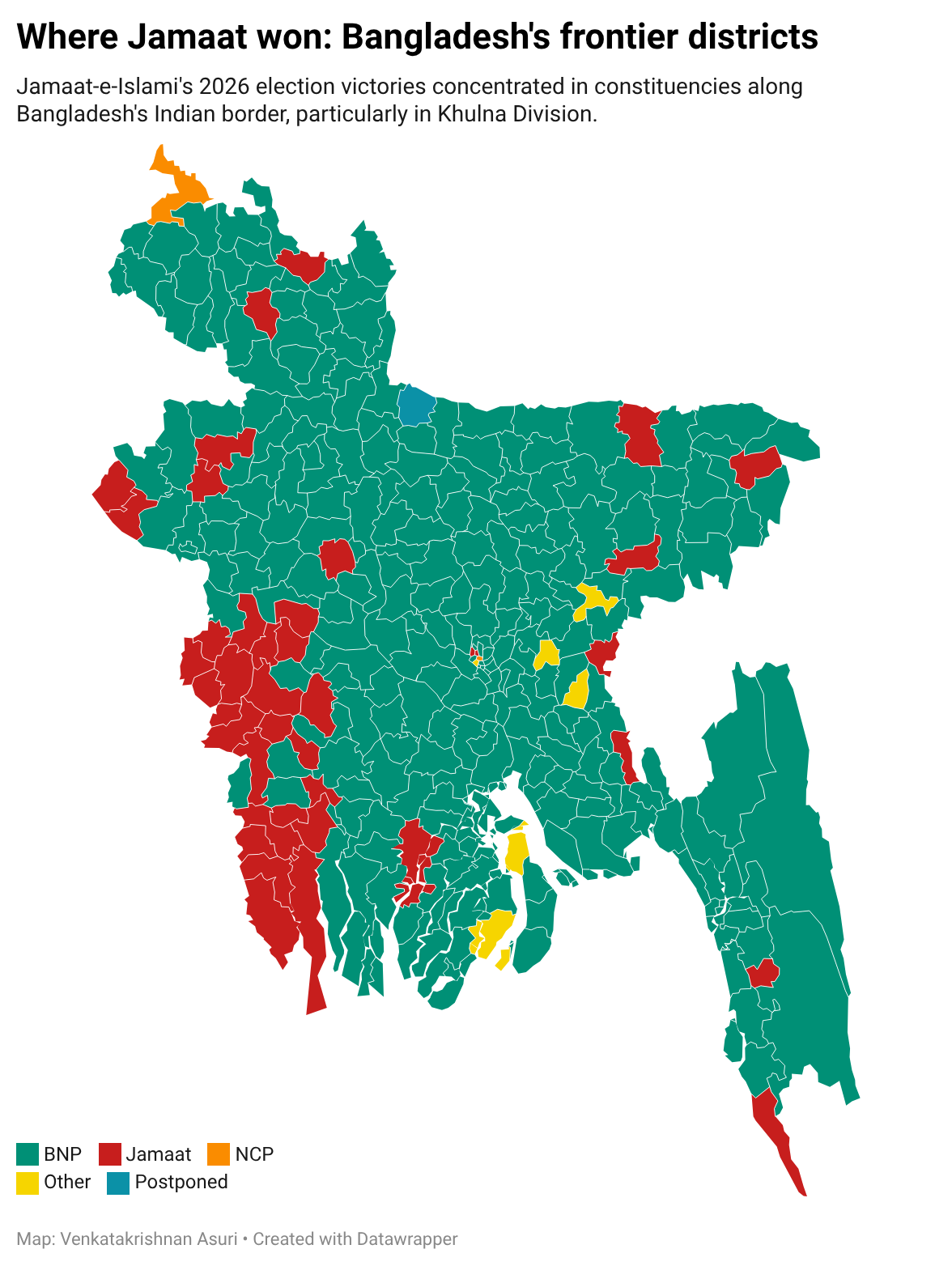
This is why political shifts in Bangladesh’s border districts deserve scrutiny beyond mere diplomatic concern. Although the BNP won decisively at the national level, the Jamaat (JeI) swept multiple constituencies along the Indian border, particularly in areas opposite South 24 Parganas, North 24 Parganas, Nadia, Murshidabad, Malda and Alipurduar. The party fielded 179 candidates nationally through an Islamist alliance, having spent much of the previous year recruiting young organisers and commissioning voter sentiment surveys, as per Reuters. And that the Jamaat’s electoral footprint is densest precisely along the Indian border is not coincidental.
On Counter-Terrorism
India’s concerns about the BNP owe to institutional memory. Through the early 2000s, the United Liberation Front of Assam (ULFA), the National Democratic Front of Bodoland (NDFB), and the National Liberation Front of Tripura (NLFT) operated openly from Bangladesh. ULFA’s top leaders ran businesses in Dhaka, Sylhet, and Chittagong. These included hotels, nursing homes, and bank accounts linked to official Bangladeshi institutions. The 2004 arms haul in Chittagong saw tens of truckloads of weapons intended for ULFA being intercepted by Bangladeshi authorities. It remains the most cited evidence of state-tolerated insurgent logistics in south Asia, with subsequent investigations implicating the former heads of National Security Intelligence and the Direction General of Forces Intelligence in the case.
This arrangement ended after Sheikh Hasina returned to power in 2009. Her government handed over Anup Chetia and other key ULFA figures, dismantled training camps, and brought Bangladesh’s intelligence apparatus into close working with Indian counterparts. While the structural grievances behind these insurgencies persisted, their operational capacity in Assam and Tripura had considerably diminished by the mid-2010s, owing to the gradual erosion of the cross-border infrastructure that enabled them.
The interim government led by Yunus undid much of this; a recent assessment describes the year 2025 as a “critical backslide” in Bangladeshi counter-terrorism. Arms looted during the August 2024 uprising have not yet been fully recovered, and specialised counter-terror units have been diverted to ordinary policing roles. The Jamaat, formally banned since 2013, was rehabilitated, and new jihadist formations such as the Jamatul Ansar Fil Hindal Sharqiya have surfaced, with documented links to al-Qaeda in the Indian Subcontinent (AQIS). A foiled plot against the US Embassy in Dhaka in July 2025 and the visible expansion of Hizb-ut-Tahrir (HuT) activity indicates that the security environment has significantly shifted.
However, it remains an open question, whether Dhaka under the BNP government has either the capacity or the will to reverse this drift in its security condition. The situation, from an Indian viewpoint, is undoubtedly worrying. Bangladeshi militants are reported to be moving between Pakistan and Bangladesh with increasing frequency. And direct travel and diplomatic channels with Islamabad, which were frozen for over a decade under Hasina, have been quietly reopened.
Nuances of the Mandate
Domestically, the result is contested. BNP and Jamaat constituencies see it as the restoration of competitive politics after the drift towards authoritarianism under Hasina, while moderates and civil society note that the Awami League's electoral exclusion has narrowed the very pluralism the vote reasserts. The Jamaat in itself has worked to soften its image through welfare politics and the first-time nomination of a Hindu candidate. Yet, a parallelly large wave of mob violence against Hindu, Christian, and Sufi communities through 2025 has left minority anxieties unresolved.
As much as the discomfort due to the Jamaat’s victories along the border exists, India cannot afford to view it as a monolith. There is a distinct line between the Jamaat’s electoral politics and ideological extremism arising from Islamist ecosystems. The Jamaat’s actual voter base consists heavily of conservative merchants, local traders and religious moderates, who are deeply invested in maintaining regional trade and stable borders. Radical outfits linked to AQIS, such as the Jama’atul Ansar and Hizb-ut-Tahrir (HuT) compete with the Jamaat for the same religious and political constituency, but without electoral returns. The Jamaat’s leadership has strong self-serving reasons to stay distance from these elements, and keep this divide well policed.
The Pakistani Variable
This Pakistani connection is not hypothetical. Former ISI chief Asad Durrani has publicly acknowledged, in proceedings linked to the Asghar Khan case, that the ISI funded political parties in the early 1990s, including the BNP under Khaleda Zia. Between 2001 and 2006, the Pakistani High Commission in Dhaka reportedly acted as a coordination point for ISI-ULFA links. This includes a January 2002 meeting where ULFA leaders finalised arms training arrangements for Bangladeshi Islamist groups. For India, what matters is that, despite economic logic, the BNP no longer has reason to police the Islamic fundamentalist ecosystem as vigorously as Hasina did.
The Myanmar Factor
One more less discussed factor in the India-Bangladesh equation, often less discussed, is Myanmar. The Arakan Army’s seizure of the Rakhine State, including the 270-kilometer Bangladesh-Myanmar Border has fundamentally changed India’s eastern theatre. The Arakan Army (AA) now operates the “Black Triangle” narcotics corridor, the tri-junction where Bangladesh, Myanmar and India meet. The growing concern over narcotics revenues and the systematic erosion of state capacities has prompted Indian security establishments to frame such threats in terms of emerging and emergent “narco-states”. In the R.N.Kao Memorial Lecture delivered by Union Home Minister Amit Shah in May 2026, the government warned against allowing narco-states from becoming alternate power centres.
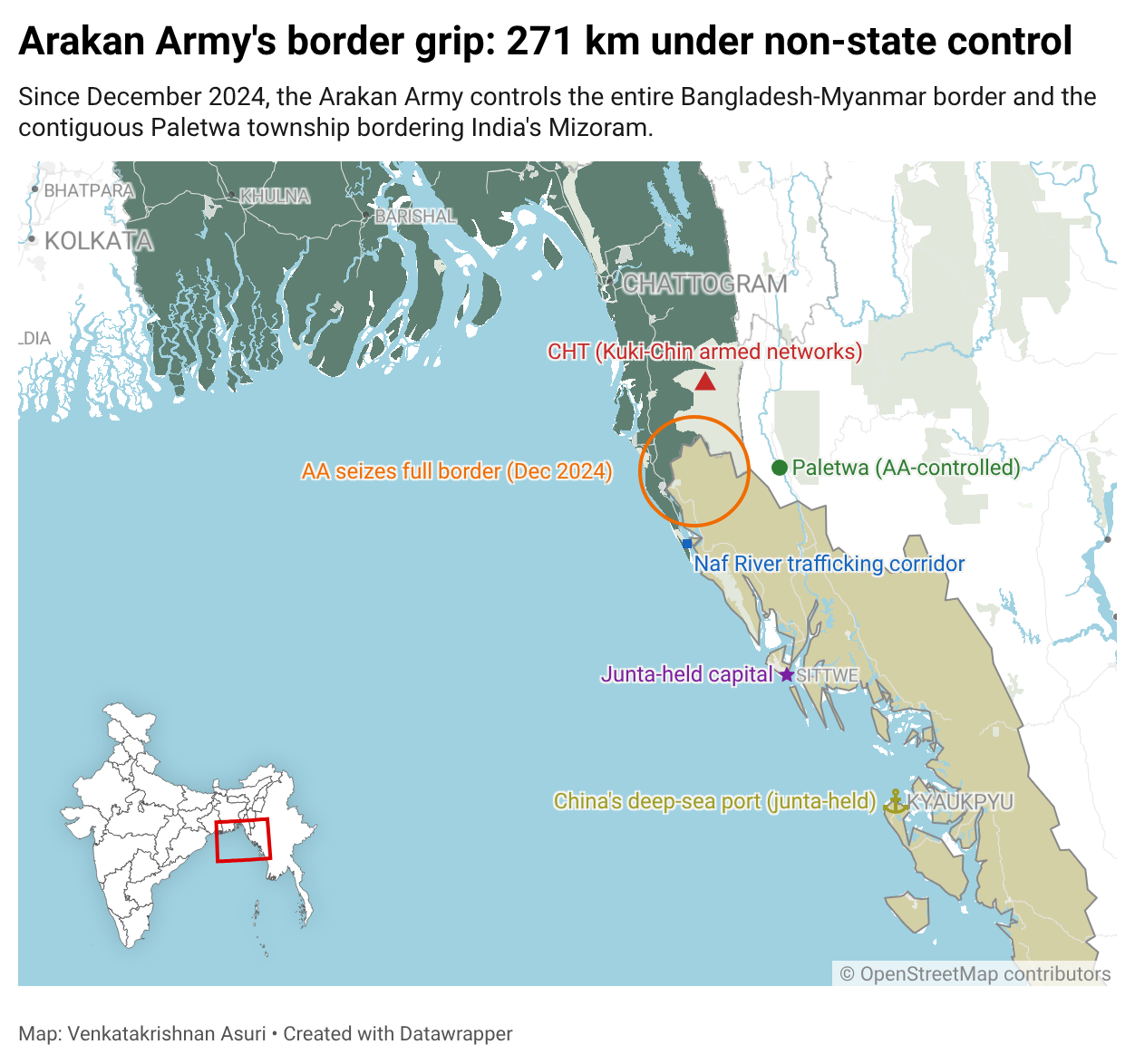
The problem lies in the dispersing instability of Myanmar, which has been in a fully blown-out civil war since 2021. The Chittagong Hill Tracts (CHT) saw sustained Bangladesh Army operations throughout 2025 against the Kuki-Chin National Front (KNCF), whose armed wing has reportedly developed links with Salafi-jihadist networks in the region. The Kuki-Chin question is something that concerns India, as it connects directly to the unresolved ethnic conflict in Manipur, where cross-border networks, weapon flows and refugee movements have previously overwhelmed state capacity. A more permissive Bangladesh remains an uncomfortable variable between the Arakan Army and ethnic tensions in Manipur.
Conclusion
The deeper problem in Bangladesh is one that India has been slow to acknowledge. For fifteen years, Bangladesh policy was essentially Hasina policy. New Delhi cultivated a personal relationship at the top, treating institutional engagement as a secondary concern. Although, it must be noted that Hasina did not do much either, when it comes to institutional capacity building. Reversing the changing security situation is not merely a matter of public diplomacy; Indian agencies will need to build solid working channels with the BNP, and swallow the bitter pill of carefully studying and engaging with the Jamaat, however uncomfortable the optics.
It is important for New Delhi to not refuse engagement with Dhaka, as it simply hands them over to other suitors. The real test will not be visible in summits or diplomatic visits, but in the measurement of important indicators: the operational status of insurgency corridors, the capacities of Pakistani intelligence in Bangladesh, and the stabilisation or deterioration of the Bangladesh-Myanmar border. On these, India’s security in the Northeast will be crucially decided, and unlike the past fifteen years, the outcome will no longer be merely New Delhi’s to orchestrate.
Venkatakrishnan Asuri is an undergraduate student at the Indian Institute of Technology, Madras. His interests include South Asian security, Chinese studies, and India’s neighbourhood. His works have appeared in reputable platforms, such as CNN News18, the Deccan Herald and the Deccan Centre for International Relations.