
Advancing South India’s Global Agenda

China’s Defence Modernisation and Security Implications for India: Lt Gen S L Narasimhan
BackChina’s Defence Modernisation and Security Implications for India: Lt Gen S L Narasimhan
China’s Defence Modernisation and Security Implications for India
Author: Lt Gen S L Narasimhan
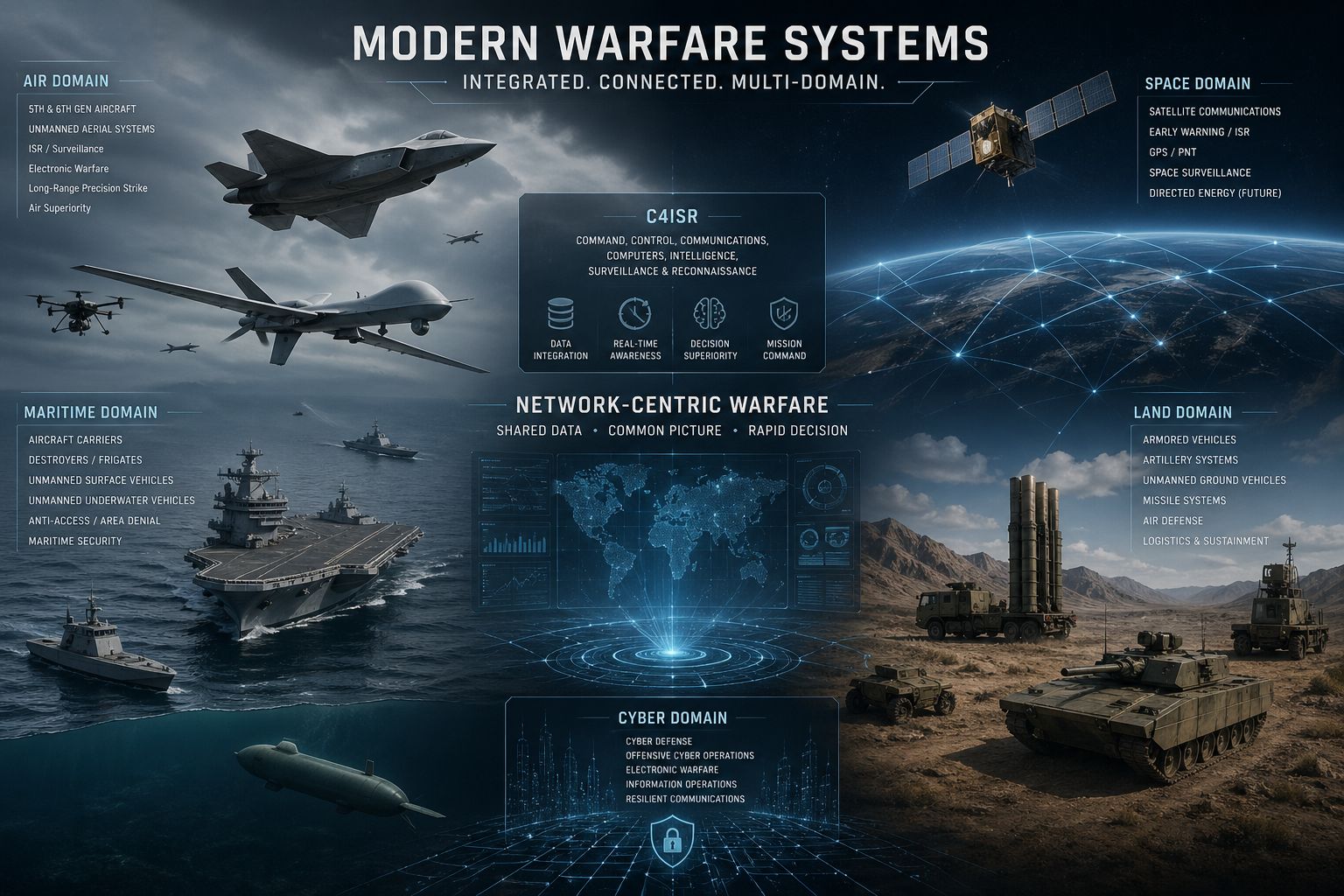
China’s Peoples Liberation Army (PLA) started its modernisation programme in 1997. It was given the timelines of 2010, 2020 and 2050 to modernise itself by Mr Jiang Zemin, the then President of China and later elaborated by Mr Hu Jintao in the 2006 Defence White Paper. This white paper formalised the importance of informationisation (信息化) even though it was being informally worked upon since the late 1990s. These timelines corresponded to:
- Step One (1997–2010): Reduction in manpower, procure modern equipment and weapons, and streamline the organisation to fight mechanised wars.
- Step Two (2010–2020): Utilise increasing defence budget to develop weapons and equipment.
- Step Three (2020–mid-century): Complete the modernisation of national defence and the armed forces by mid-21st (Selected Works of Jiang Zemin, Volume II, 2006).
In 2016, under the watch of Mr Xi Jinping, China’s Peoples Liberation Army went into a major modernisation drive. This tranche of modernisation involved the following:
- Reform of higher defence organisation also called Above the Neck reforms (颈以上改革). Above the neck reforms refer to the dissolution of the four departments namely General Staff Department, General Political Department, General Armament Department and General Logistics Department. After the reforms their responsibilities were shifted to 15 offices, bureaus, departments and commissions directly under the Central Military Commission.
- Creation of PLA Ground Forces Headquarters because it was not existing prior to these reforms and the ground forces were controlled by the four departments mentioned above. PLA Navy, Airforce and Second Artillery Corps had their respective headquarters.
- Reorg of Military Regions into theatre commands- Geographical area of China was divided into seven military regions earlier. This was converted into five theatre commands. Western Theatre Command of China is responsible for the Line of Actual Control with India. Earlier Chengdu and Lanzhou Military Regions were responsible for the same.
- Upgradation of PLA Rocket Force to full service – Though this reform did not have any major implication, there is an important development that one needs to take note of. Post the reforms, six missile brigades hold both conventional and strategic missiles. This creates an ambiguity in the minds of the adversary in case of a conflict as to which missile is being launched by that brigade.
- Creation of PLA Strategic Support Force (PLASSF) and PLA Joint Logistics Support Force – Creation of the PLASSF is the most important reform of all. PLASSF was later disbanded in April 2024 and three forces were created. They are the Aero Space Force, Information Support Force and Cyber Space Force and they give all the support that the PLA needs to fight a war. Joint Logistics Support Force ensures the logistics support needed for all fighting elements that go into combat.
- Reduction of 300,000 pers – PLA has been reducing manpower ever since China became a Peoples Republic in 1949. The last reduction was completed in 2017. Pl see the Chart below:
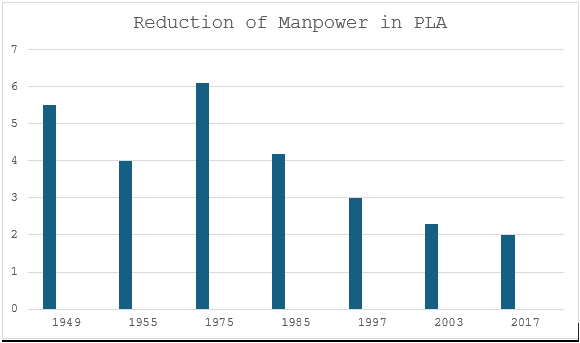
Source: Compiled by the author
Two amongst the many reasons for these reforms were to remove the corruption in the four departments mentioned above and improve PLA’s capability to carry out joint operations. This background given so far is necessary for understanding the developments in Galwan Valley in 2020 and the developments till now.
A lot has been written about the Galwan Valley incident. One of the reasons amongst many that were mentioned by Chinese as to why the Galwan incident happened was that the PLA felt that it was capable of carrying out that operation. This confidence is very likely to have emanated from the PLA reforms and its constantly developing military capability. Post the Galwan incident, PLA has improved its infrastructure along the LAC, integrating its air defence capabilities between the ground forces and its air force, induct terrain specific weaponry and completing 628 Xiao Kang (小康) Villages which may have civil and military usage. They can act like watch towers keeping an eye on the border. Some of these villages have been constructed in disputed areas thereby complicating the boundary question. China’s building villages in its disputed territory with Bhutan close to the LAC creates suspicions on China’s intentions. Additional combined armed brigades are now stationed in high-altitude areas throughout the year, ending the traditional practice of withdrawing troops during harsh winter months.
What do all these mean for India’s national security? To answer this question, we need to look at both traditional and non-traditional security spheres.
In the traditional security, technological advances that China has achieved brings in an additional paradigm of increased battlefield transparency. Intelligence, Surveillance and Reconnaisance (ISR)capabilities with strong support from satellites are shrinking the timelines for movement, deployment and preparation of defences for India’ s armed forces. Movement of reserves from one sector to another will rarely go unnoticed.
During Operation Sindoor, China had given targeting information and intelligence on Indian armed forces movements to Pakistan. This is likely to happen in future situations also. With over 360 satellites devoted to ISR, and High-Altitude Drones being integrated with them, China is developing a formidable ISR capability. 80% of Pakistan’s military equipment is of Chinese origin. China has signed a contract to supply 40 J 35 fifth generation stealth aircraft to Pakistan which will enhance Pakistan Air Force’s capability considerably. This is likely to increase the two-front threat to India. High Altitude terrain specific equipment like the VT 4 tanks and PCL 181 artillery guns have been inducted which increases the combat capability of the PLA.
Indian Ocean, which is reasonably benign is likely to see more contest. PLA Navy’s fourth aircraft carrier named Hejian (核舰) which means nuclear ship, is expected to have nuclear propulsion and is supposed to be as big as US Navy’s Gerald L Ford Aircraft Carrier. The growing fleet of aircraft carriers combined with a large number of submarines (both attack and nuclear), Type 055 Destroyers which have 10000 to 12000 DWT, PLA Navy’s capability towards becoming a Blue water Navy will increase considerably. PLA Navy is concentrating on Western Pacific Ocean now but the days of its coming into Indian Ocean in strength are getting nearer by the day. Even now, at any point in time there are 8-11 PLA Navy combatants operating in the Indian Ocean. In addition, intelligence gathering ships in the garb of fishing trawlers operate in the Bay of Bengal and the Arabian Sea. Satellite tracking vessels which have a lot of sensitive monitoring equipment on board, operate in Indian Ocean Region and have been docking either in Sri Lanka or the Maldives.
On surface communication, an alternate highway named G 695 which will run parallel to the present G 219 (known as the Western Highway) but closer to the LAC is being planned, which will facilitate lateral movement of PLA troops in case of a conflict with India. Further, improving the highway G6011 and other strategic highways ensures that the PLA can sustain large volume of troops and equipment in extreme terrain and weather. Approximately 500 Kms long roads have been constructed opposite Ladakh after the Galwan Incident. A second bridge on the Pangong Tso has been built that reduces the induction time of the troops from 12 hours to four hours.
Eight new airports and heliports have been constructed or further developed in Tibet Autonomous Region. The developments in these include hardened shelters and runways capable of handling advanced fighter jets and heavy transport aircraft. This will enable better combat support for the PLA ground forces. The increased length of runways in the airfields in Tibet will help the PLA Airforce surmount the load penalty that high altitude and temperatures impose on its combat aircraft.
PLA Rocket Force that was upgraded to a full military service, has a missile for every range. Therefore, it can target any place in India. Post the modernisation, six missile brigades have both conventional and strategic missiles thereby creating an ambiguity. It means when these brigades launch a missile, it will be difficult to predict whether the missile being launched is a conventional or a nuclear one. This creates a dilemma in the minds of the adversary. Also, it brings China’s No First Use Policy into question.
Civil-Military Fusion has not been mentioned prominently in China’s 15th Five Year plan document, that was released in March 2026, to keep it away from the limelight. However, it is being actively pursued as a government policy in China. As a national strategy it has been given an impetus wherein the PLA leverages the technological advancements that the civilian sector achieves particularly in sectors like Artificial Intelligence (AI), quantum technologies and logistics. While quantum communication enables PLA to communicate without being intercepted, quantum sensing allows PLA to detect stealth aircraft at a distance of 100Kms. There is a quantum communication network that is already operating in China with 145 fiber backbone nodes, 144 fiber links, and over 10,103 km of total fiber, with metropolitan access networks in 20 cities supporting more than 800 user nodes. Total fiber mileage exceeds 12,000 km across 17 provinces and 80 cities. In 2019 Defence White Paper of China, it was mentioned that PLA should be preparing for an intelligentised Warfare. The PLA is integrating AI both into its border posture and logistics. Former will counter India’s reconnaissance capabilities and the latter will ensure timely support to PLA during a war.
Coming on to the non-traditional security issues, three warfare strategy that China practices comprises of public opinion, psychological and legal warfare. United Front Work Department of the Chinese government operates across many platforms. As an example, in six tranches China has given Chinese names to locations in Arunachal Pradesh. While it does not make any difference on ground realities or in Indian government’s stand of the boundary question, it applies psychological pressure on the minds of India’s armed forces and people. China carries out such operations not only on the India China border but also in South China Sea and Indian Ocean. China is among the world leaders in cyber capability. 18% of world’s cyber attacks emanate from China. Indian armed forces have been building up cyber resilience. It needs to be a constant effort.
The modernisation of the PLA represents a fundamental shift from a "quantity-based" to a high-tech, intelligentised military which has direct implications for India along the LAC.
India on its part has been developing infrastructure along the LAC. It has carried out the trials of Zorawar Light Tank, created Ashni Platoons, Bhairav Battalions and Rudra Brigades. The ISR capability has increased manifold and integration of air defence is being further strengthened. India has to be on the vigil constantly and keep upgrading its warfighting capability.
Disclaimer : Lt Gen S L Narasimhan is a Non-Resident Distinguished Fellow at the Deccan Centre for International Relations. The views expressed are those of the author and do not reflect the views of the Deccan Centre for International Relations.