
Advancing South India’s Global Agenda

Learning from India: Addressing the Situation of Sri Lankan Refugees:
Ms. Areti Sianni, Chief of Mission, UNHCR India
Back
Learning from India: Addressing the Situation of Sri Lankan Refugees:
Ms. Areti Sianni, Chief of Mission, UNHCR India
Learning from India: Addressing the Situation of Sri Lankan
Refugees
Author: Ms. Areti Sianni, Chief of Mission, UNHCR India
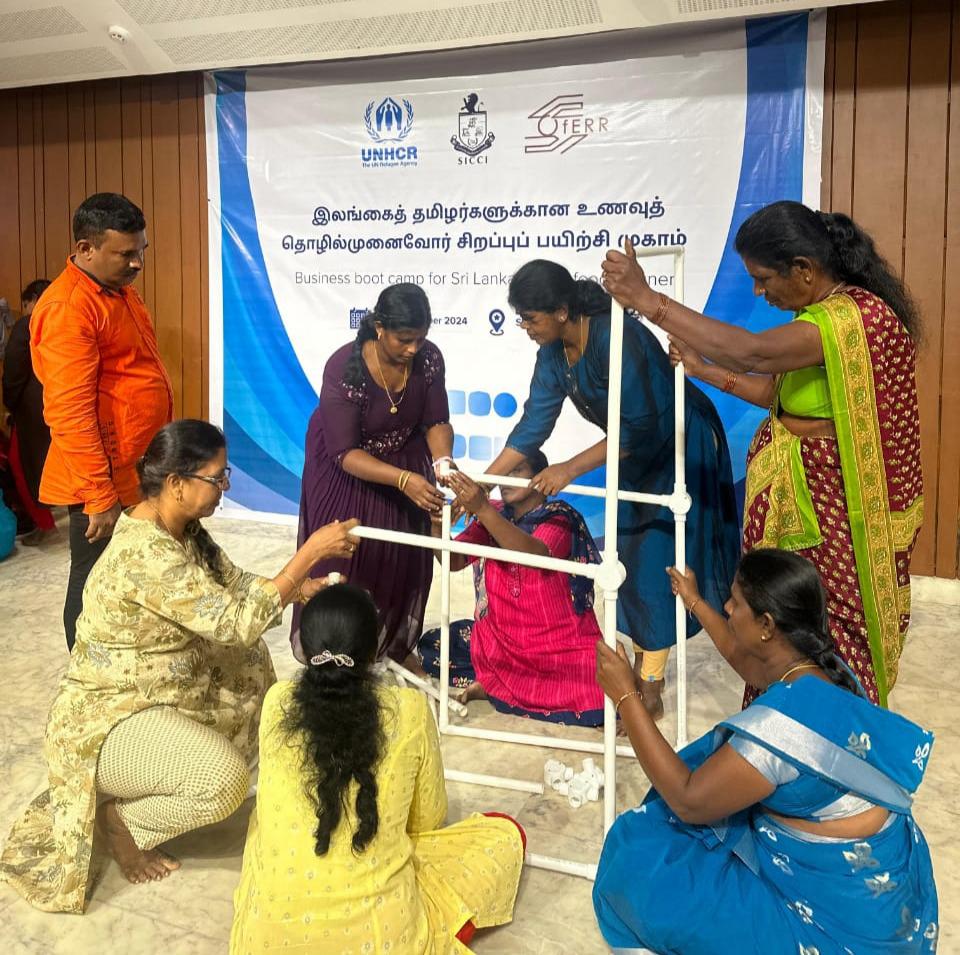
The situation of Sri Lankan Tamil refugees in India is one of the longest-standing displacement situations in South Asia. More than four decades after the first major influx in 1983, over 89,000 Sri Lankan refugees remain in Tamil Nadu. India’s long established humanitarian ethos has underpinned many government measures for care and protection over a prolonged period. Regardless, there is increasing recognition that the time has come for change.
India’s Humanitarian Ethos and Administrative Practice
In India, the total refugee population, comprising Tibetans, Sri Lankans, people form Myanmar, Afghanistan, the Middle East, Africa, and other countries, stands at approximately 240,000 (including those registered with UNHCR).
India’s response to refugees, asylum seekers, and other displaced groups has historically been shaped by its cultural ethos, constitutional values, and historical experiences of large- scale displacement. Since Independence, the country has approached displacement with a fundamentally people centred orientation. Cultural notions such as Atithi Devo Bhava (“the guest is akin to God”) and the broader spirit of “the world as one family” continue to influence administrative and social attitudes toward those seeking safety in India. Although not a single approach has underpinned responses, humanitarian values have often translated into flexible, practical welfare measures at State and local level, and a general inclination toward a humane response—despite limited resources and multiple domestic development priorities.
India’s Administrative Tradition: Flexibility Without Formal Refugee Legislation
India is not a signatory to the 1951 Refugee Convention or its 1967 Protocol. Its approach to refugees seems to be anchored in administrative convenience. A notable example is the Tibetan Rehabilitation Policy (2014), under which the Government of India formalised a wide range of support for nearly 63,000 Tibetan refugees1, including access to land on lease, livelihood opportunities, travel permits, and, in some cases, pathways to citizenship. This stands as a testament to India’s willingness to include refugees and capacity to support refugee self-reliance while enabling communities to preserve their cultural identity.
The Sri Lankan Tamil Refugee Context: A Multi-Generational Population
The arrival of Sri Lankan Tamils in India occurred in multiple waves, particularly during and after the civil conflict beginning in 1983. Over the years, more than 300,000 people sought refuge in India. Today, approximately 89,000 remain- about 57,000 in over 103 camps and the remaining live in urban areas with police registration.
The camps, originally established with Government of India’s support and currently maintained by the Government of Tamil Nadu, provide housing, basic amenities, monthly allowances, social protection schemes, educational access, skills development, livelihood support (including vehicle registration and driving licences), and pathways to higher education through scholarships. Multi-generational communities live there with long held cultural, economic, and social connections to the host population. According to a demographic assessment carried out by the Commissionerate of Rehabilitation and Welfare of Non- Resident Tamil, Government of Tamil Nadu, around 79% of these communities have lived in India for more than 30 years, while 45% have been born in India.
Limited Interest in Voluntary Repatriation
Voluntary repatriation is often described as “the preferred solution”. Despite the end of Sri Lanka’s civil war in 2009, the interest in return has however declined over the years as many Sri Lankan Tamil refugee have been born in India and know no other home while individuals who arrived as children, might not see their future and that of their families in places of origin. Since 1992, UNHCR has facilitated voluntary repatriation and durable solutions at the invitation of the Government of India. UNHCR supports voluntary repatriation under conditions of safety, dignity, and voluntariness. In the past five years, the rate of returns have suggest a declining trend.
The Case for Durable Solutions Within India’s Existing Legal Framework
Over the years, Sri Lankan refugees in India have demonstrated remarkable resilience, they have built livelihoods, contributed to local economies, and forged deep ties with host communities. In the absence of a dedicated refugee law, refugees are governed by legal and policy frameworks that apply to foreign nationals in an irregular situation without valid passports or visas. These designate Sri Lankan Tamil refugees—many of whom were born in India or have lived here for most of their lives—as “illegal migrants”, restricting access to formal employment and full economic participation.
Crucially, resolving this situation does not require new legislation. India’s existing legal and administrative framework already contains the tools needed to resolve this protracted displacement. What is required is a flexible and differentiated application of current provisions, particularly in cases where documentation barriers are historical rather than substantive.
The demographic assessment conducted by the Government of Tamil Nadu in 2023 identified several legally distinct groups with varying eligibility for regularization of status or citizenship. These include individuals born in India before 1987, children of mixed parentage born before 2004, refugees married to Indian citizens, and more than 5,130 persons of Indian origin with well-documented ancestral links to India. Many among the latter retain records linked to bilateral agreements such as the Sirimavo–Shastri Pact of 1964 and the Indo–Ceylon Agreement of 1974, providing a clear historical and legal basis for resolution.
Long-Term Visas offer another viable administrative pathway. Issuing such visas would remove the “illegal migrant” description and allow eligible individuals to apply for naturalization under existing provisions of the Citizenship Act. An important step in this direction has been the recent exception from penalization of Sri Lankan refugees for irregular entry or stay introduced in September 2025. Similarly, extending visa facilities to spouses of Indian citizens or adopting identity and registration mechanisms comparable to those used for Tibetan refugees would provide legal certainty without altering India’s broader migration framework.
A differentiated, case-based approach would respect individual circumstances, uphold the integrity of India’s legal processes, and offer families predictable pathways to a legal status and future. More importantly, it would allow India to close one of South Asia’s longest-running refugee situations using the flexibility and pragmatism that have long characterized its humanitarian practice.
A humane conclusion to a protracted situation
India’s existing legal and administrative framework already contains the tools required to deliver solutions to Sri Lankan Tamil refugees and end their displacement.
India has consistently positioned itself as a responsible humanitarian actor in global fora, including the Global Refugee Forum and the UNHCR Executive Committee. There is a strong case to be made and opportunities at hand to translate decades of generosity and protection into sustainable solutions for the Sri Lankan Tamil refugee population in Tamil Nadu. By strategically employing existing legal avenues and administrative flexibility, India can resolve one of the region’s longest-standing displacement situations. Doing so would honour the country’s cultural ethos and humanitarian leadership, and stand as an important global example of how protracted displacement can be resolved with dignity, generosity, and respect for shared regional histories.
1 https://www.mha.gov.in/sites/default/files/AnnualReport_27122024.pdf; page number 237
Disclaimer: The views and opinions expressed in this article are those of the author(s) & UNHCR and do not necessarily reflect the official position of the Deccan Centre for International Relations.