
Advancing South India’s Global Agenda

Taiwan’s Expanding Industrial Presence in South India: Mehak Gautam
BackTaiwan’s Expanding Industrial Presence in South India: Mehak Gautam
Taiwan’s Expanding Industrial Presence in South India
Author: Mehak Gautam
Introduction
For more than three decades, the relationship between India and Taiwan has “quietly” deepened. Despite the absence of formal diplomatic relations between the two, their partnership has echoed across sectors such as manufacturing, trade, education, science & technology and investment. Taiwan considers India an “oasis of peace and stability,” with bilateral trade now exceeding US $12.5 billion, making India one of its primary export destinations. For India, Taiwan serves as a strategic partner essential to fulfilling its own manufacturing ambitions.
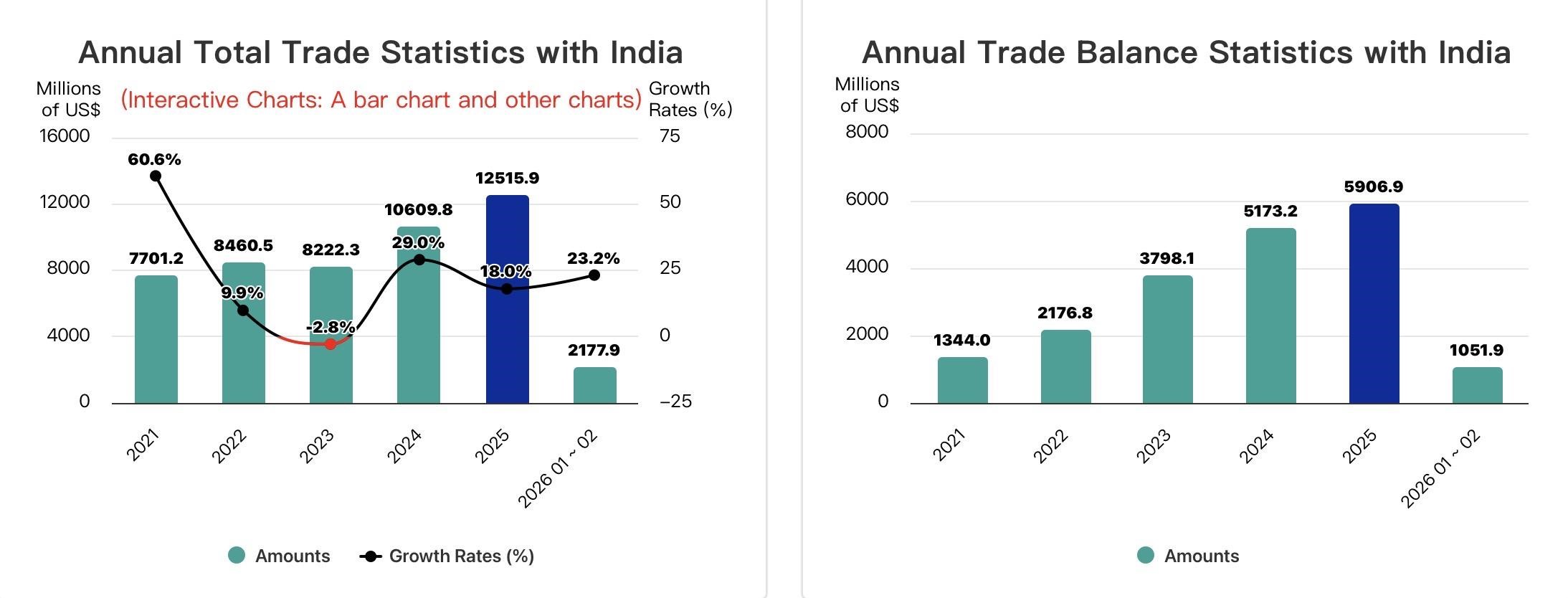
Figure 1.India’s and Taiwan’s Trade with Taiwan (in $ billion)
Source: Trade Administration, Ministry of Economic Affairs (Taiwan), Bilateral Trade Statistics: India.
India has traditionally maintained ‘strategic ambiguity’ in managing its relations with Taiwan, however a new course of action under this was when India decided to send representatives from four South Indian states—Tamil Nadu, Andhra Pradesh, Telangana, and Karnataka—to explore investment opportunities in electronics, electric vehicles (EVs), and artificial intelligence (AI) to Taiwan. Under Taiwan’s New Southbound Policy (新南向政策), India is viewed as a key partner for diversifying supply chains; while India’s Act East Policy regards Taiwan as an important partner for its regional engagement strategy. The East Asian Tiger, sees India’s strategic location as an opportunity to further expand its influence to Africa, Middle East, and Europe. Consequently, the relationship between the two is not merely economical but also “geoeconomic”; as both regard themselves important for advancing their respective strategic interests.
This dynamic partnership is especially visible in the southern states of India, which accounts for more than 71-74% of trade with Taiwan. This article explores the growing Taiwanese industrial and economic presence in South India and examines the factors that have made the region an attractive destination for Taiwanese companies.
Drivers of Taiwan’s Presence in South India
Taiwan today has more than 350 companies in India; of which more than 160 are in the Southern Region. The cumulative direct investments are close to $6 billion, covering sectors like —Electronics manufacturing of smartphones by companies like foxconn, pegatron (Tata JV), Bharat FIH; Footwear manufacturing by Feng Tay (Lotus), Pou Chen, Shoe Town; Power Electronics and EV components by Delta Electronics, Foxconn (Project Cheetah); Semiconductor & Storage by MediaTek, Phison Electronics; Computer & computer Electronics by Asus & Acer; Electronic Components by Foxlink or Cheng Uei Precision.
|
Sector |
Key Companies |
Primary States |
|
Electronics Manufacturing (Smartphones) |
Foxconn, Pegatron (Tata JV), Bharat FIH |
Tamil Nadu, Andhra Pradesh, Karnataka |
|
Footwear Manufacturing |
Feng Tay (Lotus), Pou Chen, Shoe Town |
Tamil Nadu (primary) |
|
Power Electronics & EV Components |
Delta Electronics, Foxconn (Project Cheetah) |
Tamil Nadu (Krishnagiri), Karnataka |
|
Semiconductors & Storage |
MediaTek, Phison Electronics, Adata |
Tamil Nadu (Chennai), Karnataka (Bengaluru) |
|
Computers & Consumer Electronics |
ASUS (laptops), Acer (sales) |
Tamil Nadu (Chennai), pan-South India |
|
Electronic Components |
Cheng Uei Precision, |
Andhra Pradesh |
Figure 2. Major Taiwan Companies in South India-Sector Breakdown
Source: Author’s own, using data from multiple sources
State-Level Distribution of Taiwanese Investments in South India
- Tamil Nadu
Tamil Nadu has a much stronger partnership with Taiwan when compared to other South Indian states. Since 2021, it has focused on a nation-specific cluster strategy that fosters trust while also drawing in anchor firms along with their Tier-2, Tier-3, and Tier-4 suppliers, thereby enabling the development of a complete value chain. The state has a total of 40 Special Economic Zones (SEZs) and has attracted investments from over 20 major Taiwanese companies. Today, Tamil Nadu hosts seven of Apple India’s suppliers, including Hon Hai Precision (Foxconn), Tata Electronics, and Flex.
Apart from this, the Taiwan Footwear Manufacturers Association (TFMA) has also signed an MoU with Guidance Tamil Nadu, while both recent and established Taiwanese investors in the region include firms such as Feng Tay, Pou Chen (High Glory Footwear India), Evervan Group, Hong Fu, TKG Taekwang, Foxconn, Pegatron, Wistron, and Delta Electronics. Foxconn, also known as the ‘crown jewel of Taiwanese investment’, recently committed an additional $1 billion specifically for a smartphone display module assembly unit in Oragadam (near Chennai). which is a massive shift from simple assembly to high-value component manufacturing.
Adata, a global player in memory and storage technology, has also become the first Taiwanese company to establish memory module manufacturing in India through its wholly owned subsidiary company—Adata Semiconductor Private Limited, in Chennai.
A major milestone in their partnership was achieved when an MoU was signed between Guidance Tamil Nadu and the Taiwan Chamber of Commerce to establish Taiwanese Industrial Parks, which are expected to attract ₹10,000 crore in investments and generate around 20,000 jobs in the state.
- Andhra Pradesh
In Andhra Pradesh, Taiwanese firms have shown growing interest in setting up manufacturing units across the state. The Pou Chen Group has proposed establishing a footwear manufacturing unit in Kuppam, while Creative Sensor Inc. has planned to set up an image sensor manufacturing unit in Orvakal, along with an advanced battery manufacturing facility at an estimated cost of $2.2 billion. The Andhra Pradesh government has assured support in providing connectivity to the proposed industrial parks and has also requested the delegation to establish a skill development centre in the state to train local youth and generate greater employment opportunities.
The state is also home to a supplier, Cheng Uei Precision, which manufactures connectors, cables, and electronic components used in smartphones, computers, and networking equipment.
- Telangana
Telangana’s state government promotes the idea of ‘Make in Telangana’ mission, which aims to strengthen domestic production capabilities and enhance global exports. Telangana’s Industries and Information Technology Minister, K. T. Rama Rao, was among the first to propose the idea of a Taiwan-specific industrial cluster in India in order to attract greater Taiwanese investment. It is also the only Indian State to set up a start-up alliance with Taiwan.
To further strengthen trade and economic ties between Telangana and Taiwan, the Taiwan Chamber of Commerce (TCC) and Telangana’s IT, Electronics and Communications (ITE&C) Department signed a Memorandum of Understanding (MoU) to promote investment, infrastructure development, and job creation. The MoU identifies five key sectors for attracting Taiwanese FDI—biotechnology, electronics, artificial intelligence, green energy, and the creative and cultural industries—and also outlines plans for collaboration on developing the India–Taiwan Industrial Park (ITIP) in Hyderabad.
In addition, to enhance cooperation between Taiwanese investors and the Telangana government, TCC India will establish an office in Hyderabad, which will serve as a crucial link for promoting investment opportunities, facilitating information exchange, and assisting Taiwanese companies in navigating the Indian market.
At the corporate level, SixUnited, a Taiwanese consumer electronics firm, has signed an agreement with Resolute Group, a diversified Indian manufacturing company, to jointly manufacture tablets, personal computers, and laptops in Telangana. The Telangana government is also considering the establishment of a dedicated Telangana–Taiwan manufacturing zone and exclusive textile clusters in the state to further attract Taiwanese firms.
Taiwan-based Sera Networks has partnered with Resolute Appliances to set up a new electronics manufacturing facility in Hyderabad and initially involves an investment of about ₹300 crore. The facility has been introduced to produce advanced equipment such as data centre switches, 5G technology hardware, and other high-end electronic components; for this the Telangana government has allotted around 10 acres of land for the project within the E-City industrial area. Once operational, the project is expected to create nearly 2,000 jobs and further strengthen Telangana’s growing reputation as an emerging hub for networking and telecom technology manufacturing.
In addition, education-led projects like ‘Pathway to Taiwan’ have been introduced at T-Works campus in Hyderabad to promote talent exchange, skill development and higher-education collaboration.
Taiwan's D-Link,which is a global leader in connectivity for small, medium and large enterprises and business networking, has agreed to collaborate with the Telangana government to support the local IT industry by improving network infrastructure, investing in the region, and developing new talent.
D-Link plans expand public internet connectivity by installing Wi-Fi hotspots that will provide wireless access to citizens as well as public institutions. The company will also help upgrade the government’s networking systems to align with modern security standards, which is expected to reduce risks related to vulnerabilities and cyber-attacks. D-Link intends to deepen its presence in Hyderabad by expanding its local offices, setting up a global research and development centre, and establishing a specialised network training academy which will focus on developing local technical talent through education, recruitment, and professional training programmes.
The planned expansion represents an investment of around ₹350 crore and is expected to create approximately 1,000 new jobs in the region.
- Karnataka
Karnataka has emerged as another key destination for Taiwanese engagement in India, largely due to its established ecosystem in electronics, semiconductors, and advanced manufacturing. As the technology hub of India, with Bengaluru at its center, the state offers a strong base of skilled human capital, research institutions, and global technology firms. Over the past decade, growing economic cooperation between Taiwan and Karnataka has been driven by mutual interests. Karnataka has signed an MoU with Taiwan-based Allegiance Group to establish an India–Taiwan Industrial Technology Innovation Park (ITIP) for its electronics and semiconductor goals. The project involves an investment of Rs 1,000 crore, and is expected to generate nearly 800 jobs over the next five years. The ITIP will be developed as a dedicated hub for Taiwanese firms that are involved in electronics manufacturing, semiconductors, research and development and advanced technology innovation. It is believed the park will strengthen Karnataka’s position as India’s leading Electronics System Design and Manufacturing hub while boosting the semiconductor ecosystem of the state.
- Kerala
Prior collaborations have happened between TECC officials and Confederation of Indian Industry Kerala over business opportunities on EV, medical devices, Ayurved, education, seafood, food processing, Tourism etc. Tourism in this regard has stood out the most—Taiwan Kerala or TAiKe (臺客) an Association in Taiwan has been created expressly to promote tourism. Economically, Kerala’s strengths in rubber production, seafood exports, and human capital complement with Taiwan’s technological and industrial capabilities.
Why South India?
The growing presence of Taiwanese companies in South India raises an important question: why has this region emerged as the primary destination for Taiwanese investment in India? One of the primary reasons is the strong electronics and manufacturing ecosystem that already exists there. For instance, Hyderabad has Special Economic Zones and HITEC City (Hyderabad Information Technology and Engineering Consultancy City) dedicated to information technology. In terms of economic indicators, Telangana has been top-ranked in Ease of Doing Business and holds the second place in the export of ITC products in India. Kerala’s core advantages include a skilled, English-speaking workforce, strong educational institutions, clean and green cities, and an abundance of water and power. Meanwhile, Tamil Nadu accounts for nearly one-third of the country’s textile business and 21% of textile exports. The state is also strong in sustainable production and ESG compliance.
In addition, the state governments actively build industrial corridors and host projects across sectors, supported by skilled manpower and world-class infrastructure. Together, this well-rounded ecosystem and abundant human capital make South India an ideal destination for foreign investors to establish their operations.
Key Insights and Difficulties
The India–Taiwan partnership reflects a clear example of mutually beneficial cooperation. At the same time, the rise of South India as a major destination for Taiwanese investment illustrates how economic liberalism can operate effectively without directly engaging with sensitive core security or political issues between the two sides.
However, in this partnership a key challenge remains the lack of a proper vertical integration and tier-1 and smaller suppliers. Other issues faced by Taiwanese investors include land issues, administrative efficiency, immigration clearance and visa issuance. Meanwhile, differences between the state and central governments make it much harder for investments to progress smoothly.
The two can further collaborate in solar energy, wind energy and hydrogen energy which can help India to become a green economy as Taiwan's expertise in the field of green technology—solar panels and energy storage, is parallel with India's own energy security goals.
References
- Abraham, Rajesh. “‘Taiwan of India’: Why High-Skill Jobs, Not Low-Wage Factories Are Defining Kerala’s Future,” June 15, 2025. https://www.newindianexpress.com/web-only/2025/Jun/15/taiwan-of-india-why-high-skill-jobs-not-low-wage-factories-are-defining-keralas-future.
- Admin 5. “11 Taiwanese Companies Collaborate with Telangana to Launch Operations,” March 20, 2025. https://www.bizzbuzz.news/news-capsules/11-taiwanese-companies-collaborate-with-telangana-to-launch-operations-1355859.
- archit_tandon. “SixUnited, Taiwan & Resolute, India to Manufacture Tablets in Telangana,” May 23, 2025. https://www.communicationstoday.co.in/sixunited-taiwan-resolute-india-to-manufacture-tablets-in-telangana/.
- Basu, Pratnashree, and Soumya Bhowmick. “India-Taiwan Economic Ties: Synergies, Challenges, and Strategies.” Taiwan Politics, January 2, 2025. https://doi.org/10.58570/001c.127681.
- Bureau, The Hindu. “Allegiance Group to Invest ₹1,000 Cr. to Set up India-Taiwan Industrial Park.” The Hindu, December 5, 2025, sec. Karnataka. https://www.thehindu.com/news/national/karnataka/allegiance-group-to-invest-1000-cr-to-set-up-india-taiwan-industrial-park/article70362279.ece.
- ———. “Telangana Moots Manufacturing Zone, Textile Clusters for Taiwanese Firms.” The Hindu, July 25, 2025, sec. Hyderabad. https://www.thehindu.com/news/cities/Hyderabad/telangana-moots-manufacturing-zone-textile-clusters-for-taiwanese-firms/article69855556.ece.
- Correspondent, A. C. N. “Taiwan’s Adata Lays Foundation for ₹931-Crore Memory Plant in Tamil Nadu,” March 1, 2026. https://www.asiancommunitynews.com/taiwans-adata-lays-foundation-for-₹931-crore-memory-plant-in-tamil-nadu/.
- Correspondent, D. C. “Taiwan’s Sera Networks to Invest Rs 300 Cr in E-City,” March 22, 2025. https://www.deccanchronicle.com/southern-states/telangana/taiwans-sera-networks-to-invest-rs-300-cr-in-e-city-1868450.
- EUROVIEW. “The Untapped Potential of Taiwan-India Ties.” Accessed March 13, 2026. https://euroview.ecct.com.tw/category-inside.php?id=2593.
- FDIinsider. “Telangana and Taiwan Sign MoU to Boost Trade,” October 9, 2024. https://fdiinsider.com/news/telangana-and-taiwan-sign-mou-to-boost-trade/.
- FOUNDATION, OBSERVER RESEARCH. “China Watches India-Taiwan Ties with Unease.” Accessed March 13, 2026. https://www.orfonline.org/expert-speak/china-watches-india-taiwan-ties-with-unease.
- ———. “China Watches India-Taiwan Ties with Unease.” Accessed March 13, 2026. https://www.orfonline.org/expert-speak/china-watches-india-taiwan-ties-with-unease.
- “Global Banking & Finance Review.” Accessed March 17, 2026. https://www.globalbankingandfinance.com/.
- “Home | TAiKe ( Taiwan Kerala Association).” Accessed March 14, 2026. https://rkaronnie.wixsite.com/taike.
- “India–Nigeria Relations | Manohar Parrikar Institute for Defence Studies and Analyses.” Accessed July 12, 2024. https://www.idsa.in/backgrounder/india%E2%80%93nigeria-relations-akumar-081021.
- “India’s Partnership with Taiwan - Taipei Times,” January 25, 2025. https://www.taipeitimes.com/News/editorials/archives/2025/01/25/2003830792.
- Institute, Global Taiwan. “China’s Influence on India-Taiwan Economic Dynamics,” May 1, 2024. https://globaltaiwan.org/2024/05/chinas-influence-on-india-taiwan-economic-dynamics/.
- Kandavel, Sangeetha. “Tamil Nadu Showcases Its Strength to Taiwan Footwear Manufacturers in a Bid to Attract Investment.” The Hindu, March 17, 2023, sec. Tamil Nadu. https://www.thehindu.com/news/national/tamil-nadu/tamil-nadu-showcases-its-strength-to-taiwan-footwear-manufacturers-in-a-bid-to-attract-investment/article66632464.ece.
- Naveen. “Taiwan Sees India as Oasis of Peace, Key Partner in Tech & Geopolitics,” March 7, 2026. https://www.newkerala.com/news/a/india-oasis-peace-stability-turbulent-region-taiwans-nsc-358.htm.
- PA, Aneesa. “Taiwan Firms Investing Big in Tamil Nadu, Creating Tens of Thousands of Factory Jobs. What’s Driving It,” November 7, 2024. https://theprint.in/india/taiwan-firms-investing-big-in-tamil-nadu-creating-tens-of-thousands-of-factory-jobs-whats-driving-it/2344630/.
- Saran, Samir, and H H Michael Hsiao. “Taiwan-India @30: Charting a New Arc of Cooperation,” n.d.
- Service, Express News. “Karnataka Industrial Park to See Rs 1,000 Crore Taiwanese Investment, Promises New Jobs,” December 7, 2025. https://www.edexlive.com/news/karnataka-industrial-park-to-see-rs-1000-crore-taiwanese-investment-promises-new-jobs.
- ———. “Taiwan’s D-Link to Invest Rs 350 Crore in Telangana,” June 6, 2015. https://www.newindianexpress.com/states/telangana/2015/Jun/06/taiwans-d-link-to-invest-rs-350-crore-in-telangana-751505.html.
- Sharma, Pallavi. “Taiwan–India Collaborations to Shape the Future of Growth,” September 18, 2025. https://bottindia.com/taiwan-expo-2025-in-india-taiwan-india-collaborations-to-shape-the-future-of-growth/.
- Singh, Naina. “India-Taiwan Relations: Making a Case for Active Sub-National Diplomacy with Tamil Nadu,” 2022.
- SixUnited, Taiwan & Resolute, India to Manufacture Tablets in Telangana. 23 May 2025, https://www.communicationstoday.co.in/sixunited-taiwan-resolute-india-to-manufacture-tablets-in-telangana/.
- “Taiwan Product Center.” Accessed March 13, 2026. https://tpc.taiwantrade.com/home#_Taiwan_Product_Center_1.
- “Taiwan- Telangana State Roadshow.” Accessed March 15, 2026. https://www.investindia.gov.in/team-india-blogs/taiwan-telangana-state-roadshow.
- Team, Internet. “The Taipei Economic and Cultural Center in Chennai Hosts a Symposium ‘Looking at India’s Development from the Perspective of Global Market and Supply Chain Trends’ with Taiwanese Businessmen on October 31, 2023.” Accessed March 14, 2026. https://www.roc-taiwan.org/inmaa_en/post/7737.html.
- ‘Telangana Govt, TCC Ink MoU to Boost Taiwanese Investments in State’. The Times of India, 8 Oct. 2024. The Economic Times - The Times of India, https://timesofindia.indiatimes.com/business/india-business/telangana-govt-tcc-ink-mou-to-boost-taiwanese-investments-in-state/articleshow/114055251.cms.
- ———. “印度泰倫迦納(Telangana)州積極向台灣企業招商.” Accessed March 16, 2026. https://www.roc-taiwan.org/inmaa/post/10924.html.
- “The Growing Economic Synergy between India and Taiwan.” Accessed March 17, 2026. https://www.investindia.gov.in/team-india-blogs/growing-economic-synergy-between-india-and-taiwan.
- “The India-Taiwan Economic Corridor Can Flourish.” Accessed March 13, 2026. https://www.anz.com/institutional/insights/articles/2024-05/the-india-taiwan-economic-corridor-can-flourish/.
- The Times of India. “Taiwan’s Allegiance Group to Invest Rs 400 Crore in AP Industrial Park.” November 13, 2025. https://timesofindia.indiatimes.com/city/vijayawada/taiwans-allegiance-group-to-invest-rs-400-crore-in-ap-industrial-park/articleshow/125305671.cms.
- The Times of India. “Telangana Govt, TCC Ink MoU to Boost Taiwanese Investments in State.” October 8, 2024. https://timesofindia.indiatimes.com/business/india-business/telangana-govt-tcc-ink-mou-to-boost-taiwanese-investments-in-state/articleshow/114055251.cms.
- The Times of India. “TN Govt to Set up Taiwanese Industrial Park near Chennai.” April 25, 2025. https://timesofindia.indiatimes.com/city/chennai/tn-govt-to-set-up-taiwanese-industrial-park-near-chennai/articleshow/120627407.cms.
- V _11831, Kamalakara Rao. “Taiwan, Italy Eye Setting up Industrial Park, Cluster in A.P.” The Hindu, November 13, 2025, sec. Visakhapatnam. https://www.thehindu.com/news/cities/Visakhapatnam/taiwan-italy-eye-setting-up-industrial-park-cluster-in-ap/article70275056.ece.
- 中央通訊社. “台灣與印度互設代表處30年 雙方關係穩步前行 | 國際,” December 19, 2025. https://www.cna.com.tw/news/aopl/202512190195.aspx.
- 自由時報電子報. “一路向南》回顧台灣與印度關係的歷史發展,我們可以得到什麼借鏡? - 自由評論網,” September 3, 2018. https://talk.ltn.com.tw/article/breakingnews/2539758.
Disclaimer: The views and opinions expressed in this article are those of the author(s) and do not necessarily reflect the official position of the Deccan Centre for International Relations.